Sharjah Mainland License Guide: Cost, Steps, Documents and Rules (2026)
A Sharjah mainland license is a trade license issued by the Sharjah Economic Development Department (SEDD) that lets a business operate in Sharjah and trade across the UAE. Most activities now allow 100% foreign ownership. Expect first-year costs of roughly AED 15,000–40,000, depending on activity, legal form, and your office lease.
Sharjah mainland license
Dubai gets the headlines, but a growing number of founders now start their UAE journey one emirate north. Sharjah sits right next to Dubai, offers lower rents, and runs a licensing system that has become noticeably faster in the past two years.
A Sharjah mainland license is the document that makes this possible. It gives your company the legal right to operate in the emirate and to trade with customers anywhere in the UAE, without the market restrictions that free zone companies face. Since 2021, it also allows foreign investors to hold 100% of most mainland companies.
This guide explains how the license works, what it really costs, which documents you need, and where applicants tend to lose time and money. It also covers a few points that many online guides get wrong, such as the lease registration system and the new Instant License.
What Is a Sharjah Mainland License?
A Sharjah mainland license is an economic license issued by SEDD, the government body that registers and regulates commercial, professional, and industrial activity in the emirate. Every mainland company in Sharjah, from a corner trading shop to a manufacturing firm, operates under one.
The license does three jobs at once. It names your legal entity and trade name, it lists the exact activities you may carry out, and it ties your business to a registered physical address. Banks, immigration authorities, and the Federal Tax Authority all rely on it.
“Mainland” simply means the company is licensed by the emirate’s economic department rather than by a free zone authority. This distinction matters because it decides where you can sell, who you can contract with, and how you are regulated.
Sharjah Mainland vs Free Zone: Which One Fits Your Business?
Sharjah has several free zones, including Hamriyah Free Zone, the Sharjah Airport International Free Zone (SAIF Zone), Sharjah Media City (SHAMS), and Sharjah Publishing City (SPC). Each one issues its own licenses. Choosing between a free zone and the mainland usually comes down to your customers.
| Factor | Sharjah Mainland (SEDD) | Sharjah Free Zone |
|---|---|---|
| Licensing authority | SEDD | The individual free zone authority |
| Foreign ownership | 100% for most activities | 100% |
| Selling inside the UAE | Direct, across all emirates | Usually needs a distributor or extra arrangements |
| Government contracts | Generally accessible | Limited |
| Premises | Physical, municipality-attested lease required for a standard license | Flexi-desk or shared options often available |
| Typical upfront cost | Higher, mainly because of rent | Often lower |
In short, if most of your revenue will come from UAE customers, the mainland is usually the cleaner choice. If you mainly export, re-export, or run an online business with no local storefront, a free zone can cost less.
Can Foreigners Own 100% of a Sharjah Mainland Company?
Yes, for most activities. SEDD began applying its full foreign ownership policy in June 2021, following Federal Decree-Law No. 26 of 2020, which amended the UAE Commercial Companies Law. SEDD stated at the time that the decision carried no minimum capital requirement and no extra fees for foreign investors.
SEDD later published a list of roughly 1,200 activities open to full foreign ownership. The main exceptions are activities classed as having “strategic impact” under UAE Cabinet Decision No. 55 of 2021. These include security, defence and military activities, among a handful of other sectors. Such businesses still need local participation.
Two practical points help here. First, always confirm your exact activity code with SEDD before you pay anyone, because ownership rules apply to the activity, not to the business idea. Second, commercial agency arrangements follow their own law and are not covered by the 100% ownership rule.
Types of Mainland Licenses in Sharjah
SEDD issues several license categories. The right one depends on what you do and where you will work.
| License type | Suited to | What to know |
|---|---|---|
| Commercial | Trading, import and export, retail, wholesale | The most common type; needs a physical office, shop, or warehouse |
| Professional | Consultants, engineers, IT and marketing firms, other service providers | Based on skills and services rather than goods |
| Industrial | Manufacturing and processing | Needs a site in an approved industrial area and extra approvals |
| Tourism | Travel and hospitality-related activities | Often needs approval from the relevant tourism authority |
| E-commerce / e-trader | Online sellers | A lower-cost route for home-based online activity; check eligibility with SEDD |
| Home business | Small activities run from a residence | Aimed mainly at UAE nationals |
SEDD’s own FAQ makes one point clear: a standard business license requires a physical location. For home-based work, the options are the home business license (for citizens) or the e-commerce license.
Legal Structures You Can Choose
Your legal form changes your liability, your paperwork, and part of your fee.
A sole establishment is owned by one person and is the simplest and cheapest structure. The owner carries unlimited personal liability, which is its main drawback.
A Limited Liability Company (LLC) needs at least two shareholders in most cases and a Memorandum of Association (MoA). It limits each owner’s liability to their share of capital, which is why many investors prefer it for larger operations.
A civil company suits professionals such as lawyers, engineers, and consultants who practice together. A branch of a foreign company lets an overseas business operate in Sharjah under its own name, and SEDD has said such branches no longer need a local agent.
SEDD’s fee schedule also lists a service agent contract for certain sole-ownership cases, so ask which route applies to your nationality and activity before you start.
The Instant License: Sharjah’s Fastest Route
In mid-2025, SEDD launched an Instant License service after approval from the Sharjah Executive Council. It allows eligible investors to obtain a commercial license within one working day.
The service covers office-based activities that need no external approvals, and it permits up to three employees per license. In the first year, applicants can skip the MoA and the lease contract. From the second year, the full licensing requirements apply.
SEDD reported that 1,165 licenses were issued under the service in 2025.
This route works well for consultants, small trading offices, and early-stage startups that want to test the market. It is not a shortcut around regulated activities, though. If your business needs health, education, or environmental approvals, you will still follow the standard process.
A quick note to avoid confusion: Sharjah’s widely reported “AI-powered trade license,” launched in September 2024 with Microsoft, was introduced through the Sharjah Investor Services Center (Saeed) and the SPC Free Zone. It is a separate initiative from SEDD’s mainland Instant License.
Step-by-Step: How to Get a Sharjah Mainland License
The process is logical once you see the order. Most delays come from doing steps out of sequence.
1. Choose your activity. Match your business to an approved activity description. This choice drives your license type, your fees, and whether any outside approvals apply.
2. Select your legal form. Decide between a sole establishment, LLC, civil company, or branch. If you have partners, agree on ownership shares now.
3. Reserve your trade name. Submit your preferred names through SEDD’s e-services. Your name must follow UAE naming rules and avoid religious, political, or misleading terms.
4. Get initial approval and technical evaluation. SEDD reviews the activity and ownership. For activities that need it, the Commercial Control and Protection Department carries out a technical evaluation.
5. Secure your premises. Sign a lease for suitable commercial space. SEDD’s process points to the Sharjah Electricity, Water and Gas Authority (SEWA) for the electricity deposit and lease attestation fees, and the lease must be attested through the Sharjah Municipality system.
6. Complete your legal contracts. LLCs sign and certify a Memorandum of Association. Other structures sign the contracts that match their legal form, such as a service agent or partnership agreement.
7. Collect external approvals. Regulated activities need sign-off from bodies such as Civil Defence, the municipality, or health authorities.
8. Pay fees and receive your license. After final approval, you pay the license fees and SEDD issues the license and commercial register certificate.
Experienced applicants usually finish in about one to two weeks when documents are complete. Industrial and regulated activities take longer.
Documents Required for a Sharjah Mainland License
Requirements shift slightly with your structure and activity, but most applications need the following:
- A completed license application form, available through SEDD e-services, SEDD branches, or Tasheel centres
- Passport copies of all shareholders and managers
- Emirates ID copies for UAE residents
- Passport-size photographs
- A trade name certificate
- A municipality-attested lease contract (not required for the Instant License in year one)
- Initial approval and any external approvals for regulated activities
- A certified MoA for LLCs, or the matching contract for other legal forms
- For foreign company branches: attested parent company documents
Documents issued outside the UAE normally need attestation before SEDD accepts them. Check this early, because attestation can take longer than the license itself.
Sharjah Mainland License Cost: What You Will Actually Pay
Cost is the main reason people search for this topic, and it is also where online guides disagree the most. The honest answer is that Sharjah licensing is not a single fixed price.
How SEDD calculates the license fee
According to SEDD, the license issuance and renewal fee is based on your lease or site area, depending on the activity. The department’s published rate is 8% of the lease value when all partners are UAE nationals and 13% for partners of other nationalities. Service fees tied to the license type, activity, and legal form are added on top.
This is why your office choice affects your license cost directly. A larger or more expensive lease raises the percentage-based fee.
As a simple illustration of the formula only, a lease worth AED 30,000 a year with foreign partners produces a percentage fee of AED 3,900 before the fixed service fees and other costs below.
Fixed SEDD service fees
SEDD lists a number of smaller charges that apply at issuance. These include a signboard permit (AED 200), the commercial register certificate (AED 500 for sole proprietorship licenses and AED 1,200 for industrial licenses), license printing (AED 300), e-services (AED 100), and a representative card (AED 300). A technical evaluation costs AED 150, and certifying a service agent contract costs AED 550.
Third-party costs come on top. These include Sharjah Chamber of Commerce and Industry fees, SEWA’s electricity deposit, lease attestation, and charges from any authority that approves your activity.
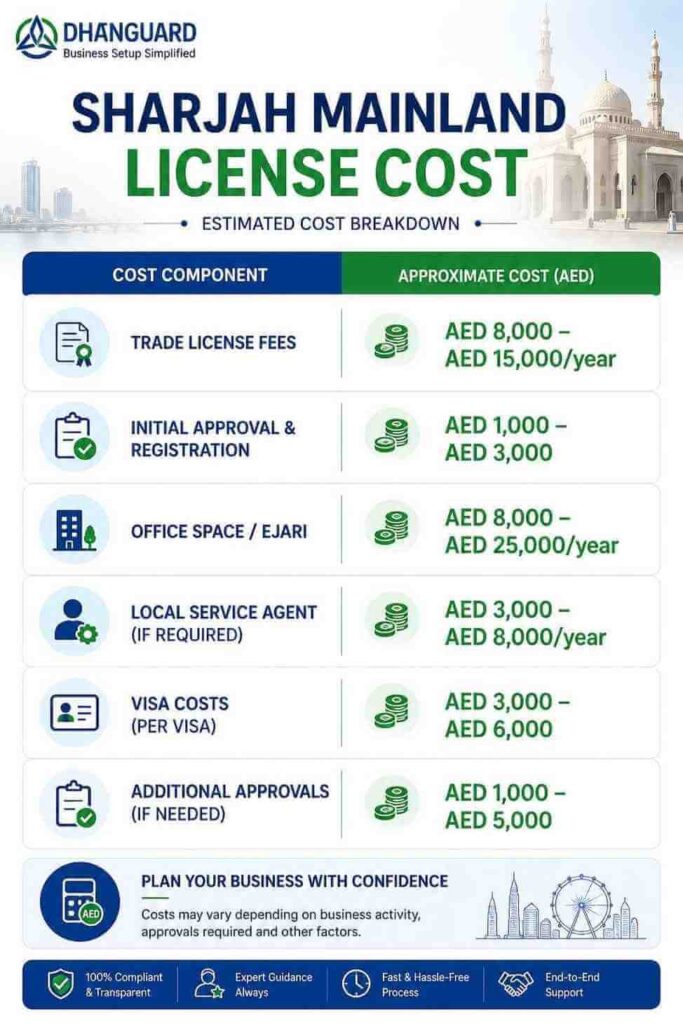
Typical first-year budget
Market advisers quote first-year totals that differ because they bundle different items. Putting the more consistent figures together gives this picture:
| Cost item | Typical range (AED) | Notes |
|---|---|---|
| Trade name reservation | 500–1,500 | Varies by source and name type |
| Initial approval | 100–500 | |
| License fee (SEDD) | 5,000–15,000 and above | Depends on lease, activity, and legal form |
| MoA notarisation (LLC) | 1,500–3,000 | |
| Chamber of Commerce registration | 1,000–2,000 | |
| Office lease | 5,000–25,000+ | Largest variable; mandatory for standard licenses |
| Establishment card | 1,000–2,500 | Needed before you sponsor visas |
| Estimated year-one total | 15,000–40,000 | Excludes visas, staff, and bank charges |
Treat these ranges as planning figures, not quotes. Advisers disagree on several line items, and SEDD updates its schedules. Use SEDD’s official fee calculator or ask for an itemised written quote before you commit.
Ways to keep costs down
Pick the smallest compliant premises, since rent drives both your lease and your percentage fee. Check whether you qualify for the Instant License in year one. Ask whether an e-commerce license fits an online model. Finally, add only the activities you need now, because each extra activity costs AED 300 to add later, but unnecessary approvals can cost far more.
Renewal, Amendments, and Cancellation
Your license must be renewed every year. SEDD’s renewal fee follows the same percentage logic as issuance, and the department offers renewal through its digital portal.
Late renewal is expensive. SEDD charges commercial register clearance fees that rise with the time since expiry (AED 500, 1,000, or 1,500), plus delay penalties that depend on how long the license has lapsed. Renewing before expiry avoids all of this.
Changes to your license carry set fees. Adding an activity costs AED 300 per activity, adding or removing a partner or service agent costs AED 500 per person, and a registered amendment costs between AED 500 and AED 2,000 depending on legal form. A cancellation declaration costs AED 350.
Close the file properly if you shut down. An abandoned license keeps generating fees and penalties.
After You Get the License: Tax, Visas, and Banking
The license is a starting point, not the finish line.
Corporate tax. The UAE introduced federal corporate tax at 9% on taxable profits above AED 375,000, and mainland Sharjah companies fall under it. Most businesses must register with the Federal Tax Authority (FTA) even if their profit is low. Small Business Relief has been available to qualifying companies with limited revenue, so check the current FTA rules and deadlines.
VAT. The standard rate is 5%. Registration is mandatory once your taxable supplies pass AED 375,000 in 12 months, and voluntary registration is possible at a lower threshold.
Visas and labour. You will need an establishment card and a Ministry of Human Resources and Emiratisation (MoHRE) file before you sponsor employees. Your visa quota generally depends on your premises and activity.
Banking. UAE banks usually ask for your license, MoA, lease, and shareholder documents. Open the account early, because some banks run lengthy due diligence.
Common Mistakes to Avoid
Many applicants lose weeks because of avoidable errors. Some of the most common are listed below.
The biggest one is mixing up registration systems. Dubai uses Ejari for leases, but Sharjah leases are attested through the Sharjah Municipality and SEWA process, and guides that tell you to “get Ejari” for Sharjah are mixing emirates. Another frequent mistake is signing a lease before checking that the space is approved for your activity. Others include choosing a vague activity description, forgetting external approvals, assuming a virtual office or flexi-desk will satisfy SEDD for a standard license, and ignoring the renewal date.
A final tip: get every fee in writing and ask which items are government charges and which are the adviser’s own service fee.
Sharjah vs Dubai Mainland: A Quick Comparison
| Area | Sharjah mainland | Dubai mainland |
|---|---|---|
| Licensing authority | SEDD | Dubai Department of Economy and Tourism (DET) |
| Lease system | Municipality attestation with SEWA process | Ejari |
| Rent levels | Generally lower | Generally higher, especially in prime areas |
| Market proximity | Borders Dubai; short drive to ports and airports | Direct access to Dubai’s business districts |
| Fast-track options | Instant License for eligible activities | Various digital and fast-track services |
| Best for | Cost-conscious trading, light industry, SMEs | Businesses that need a prime Dubai address and visibility |
Sharjah makes the most sense when you want mainland access without prime-address rents. Dubai makes sense when client perception and location are part of your brand.
Advantages and Disadvantages
The strengths are clear. You get direct access to the whole UAE market, 100% foreign ownership for most activities, usually lower rent than Dubai, a strong industrial and trading base, and a licensing authority that keeps investing in digital services.
The trade-offs are just as real. A standard license needs a physical, attested lease, which raises your fixed costs compared with a free zone. Some activities need outside approvals that slow things down. And fee quotes vary enough between advisers that careless comparison shopping can lead to surprises.
Future Outlook
Sharjah’s direction is clear: faster, more digital, and more founder-friendly. The Instant License, the e-services portal, and the AI-led licensing pilot in Sharjah’s investor channels all point to faster approvals. SEDD has also stressed digital transformation and AI capability in its 2025 performance review.
Expect continued adjustments to fees and eligibility. Check SEDD directly before applying, and re-check at renewal.
Actionable Recommendations
Start by confirming your activity and ownership eligibility with SEDD. Then compare the Instant License against the standard route. Request an itemised quote that separates government fees from service fees. Choose premises sized for today’s team rather than next year’s hopes. Finally, register for corporate tax and, if needed, VAT soon after you receive your license.
FAQs
1. What is a Sharjah mainland license?
It is a trade license issued by SEDD that allows a company to operate in Sharjah and trade across the UAE. It lists your legal entity, trade name, activities, and registered premises.
2. How much does a Sharjah mainland license cost?
First-year totals commonly fall between AED 15,000 and AED 40,000. SEDD’s license fee is based on your lease value (8% for UAE national partners, 13% for others), plus fixed service fees and third-party charges.
3. Can a foreigner own 100% of a mainland company in Sharjah?
Yes, for most activities. SEDD has applied full foreign ownership since June 2021. Activities with strategic impact remain restricted.
4. Do I need an office for a Sharjah mainland license?
For a standard license, yes. SEDD requires a physical location. The Instant License lets eligible applicants skip the lease in year one.
5. How long does it take to get a license?
The Instant License can be issued within one working day. A standard license typically takes around one to two weeks if your documents are complete and no outside approvals are needed.
6. What is the SEDD Instant License?
It is a fast-track commercial license for office-based activities that need no external approvals. It allows up to three employees per license, and the MoA and lease are not required in the first year.
7. Is Ejari required in Sharjah?
No. Ejari is Dubai’s registration system. In Sharjah, your lease must be attested through the Sharjah Municipality and the SEWA-linked process required by SEDD.
8. How much does it cost to renew a Sharjah mainland license?
SEDD’s renewal fee follows the same percentage-of-lease approach as issuance. The exact amount depends on your lease, activity, and legal form, so use SEDD’s portal for a current figure.
9. What happens if I renew late?
SEDD charges commercial register clearance fees and delay penalties that grow with the time your license has been expired.
10. Can I add business activities later?
Yes. SEDD charges AED 300 per added activity, and some activities need external approvals.
11. What is the difference between a mainland and a free zone license in Sharjah?
Mainland licenses come from SEDD and allow direct trade across the UAE. Free zone licenses come from the zone authority and are usually cheaper but limit direct local trading.
12. Do mainland companies in Sharjah pay corporate tax?
Yes. UAE federal corporate tax of 9% applies to taxable profits above AED 375,000, and most companies must register with the FTA.
Conclusion
A Sharjah mainland license gives you what many founders want: full access to the UAE market, 100% ownership for most activities, and costs that stay below prime Dubai levels. The process is manageable when you follow the right order, choose your activity carefully, and plan around the lease, which drives most of your expense.
The best preparation is a clear activity description, an itemised fee quote, and an early check with SEDD. With the Instant License and digital services expanding, Sharjah is becoming an easier place to start. Do the groundwork well, and your license will become a stable base rather than a source of surprises.

Sara is a UAE-based banking and accounting expert with over 4 years of professional experience in the financial sector. Her expertise spans retail banking, financial reporting, compliance, and practical money management topics relevant to individuals and businesses in the UAE.
She contributes clear, accurate, and well-researched financial content, simplifying complex banking and accounting concepts for everyday readers. Sara’s writing reflects strong industry knowledge, regulatory awareness, and a commitment to financial accuracy and transparency.