
Download Salary Certificate in UAE for Free: Complete 2026 Guide
A salary certificate in the UAE is an official letter from your employer confirming your job title, joining date and monthly salary. HR usually issues it free of charge on company letterhead, signed and stamped. Banks, landlords and embassies use it as proof of income. You can request it in writing or through your HR portal.
You are halfway through a loan application, a family visa file or a tenancy renewal, and the checklist suddenly asks for one more paper: a salary certificate. The good news is that a salary certificate UAE free of charge is the norm, not the exception. The less obvious news is that no website can issue one for you. The letter only has value when your employer prepares, signs and stamps it.
This guide explains what the document is, what it must contain, how to get it without paying a fee, and where people usually go wrong. You will also find a copy-and-adapt template, the difference between a salary certificate and a salary transfer letter, and a clear view of when attestation applies.
What Is a Salary Certificate in the UAE?
Definition and purpose
A salary certificate is a formal letter that proves two things: that you work for a named company, and what that company pays you. It lists your designation, date of joining and salary, usually split into basic pay and allowances. It does not describe your performance, and it does not promise future employment.
Think of it as a snapshot. It is accurate on the date of issue, which is why most recipients care about how recent it is.
Who issues it, and why it is free
Your employer issues the certificate, normally through the HR or PRO team. No government authority produces it. Because the document costs the company almost nothing to prepare, employers generally provide it free of charge when an employee asks. Large organisations often let staff request it through a self-service HR portal, while smaller companies handle it by email.
The word free needs one clarification. Many websites offer free salary certificate templates for download. A template is only a layout. It becomes a valid certificate once your employer fills in the verified details and adds an authorised signature and the company stamp.
Is your employer legally required to issue one?
This is a point most competing guides skip. The UAE labour framework, under Federal Decree-Law No. 33 of 2021, clearly requires employers to provide an experience certificate, free of charge, when a contract ends and the worker asks for it. MOHRE guidance describes that certificate as including details such as the final salary and the reason for leaving.
A salary certificate issued during active employment is a little different. There is no single government-mandated format for it, and in practice it is issued as a routine HR service rather than as a statutory entitlement spelled out in one article. If your employer refuses without a reason, raise it with HR first. If the problem continues, MOHRE’s Labour Consultation and Claims Centre (80084) is the official channel for private-sector workers.
Salary Certificate vs Similar Documents
Most rejected applications come from asking HR for the wrong paper. These documents look alike, but each does a different job.
| Document | What it confirms | Addressed to | Typical use |
|---|---|---|---|
| Salary certificate | Employment, designation, salary | To Whom It May Concern | Visas, tenancy, school admission, general proof of income |
| Salary letter | Same facts, with a stated purpose | A named bank or entity | One specific application only |
| Salary transfer letter | Your employer will route your salary to a particular bank | A named bank | Loans, mortgages and some credit cards |
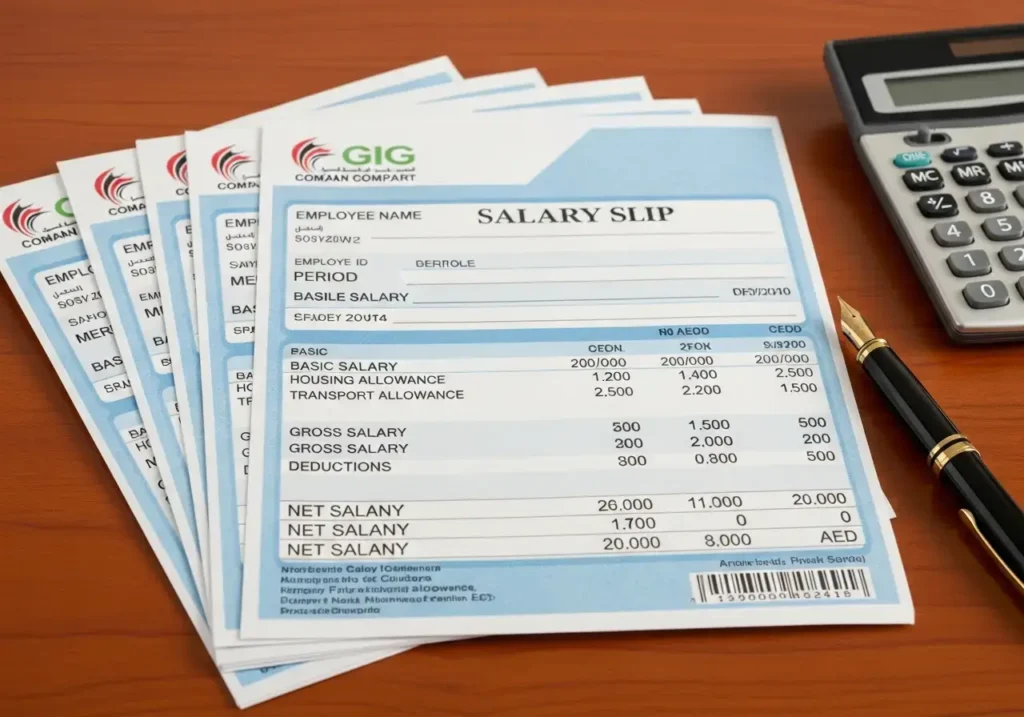
| Salary slip (payslip) | One month’s pay and deductions | Not addressed | Payroll record |
| Experience certificate | Past employment and final salary | To Whom It May Concern | Job changes, visas, end of service |
A simple rule helps. If a bank is lending you money and wants your salary credited to its account, ask the bank which letter it needs, because it will often have its own template. For most other requests, the standard salary certificate is the right choice.
The difference between a salary certificate and a payslip also matters. A payslip shows what you were paid in a given month and what was deducted. A certificate is a formal declaration by the employer, prepared for a third party to rely on.
Who Asks for a Salary Certificate, and Why?
The request usually arrives from one of four places.
Banks and lenders. Before approving a personal loan or credit card, a bank wants to know that your income is stable. The certificate sits next to your bank statements and passport copy. Lenders also look at how much of your income is already committed, which is why this guide pairs well with our explainer on the debt burden ratio.
Immigration and embassies. Family sponsorship files and travel visa applications often need proof that you have a job and enough income to support the plan. Embassies may ask for the certificate to be recent and, in some cases, attested.
Landlords and property agents. Some landlords ask for it before releasing a tenancy contract, to confirm that you can afford the rent.
Schools and other institutions. Admission teams sometimes request it when fee payment plans or sponsorship details are involved.
What a UAE Salary Certificate Must Include
There is no official national template, but accepted certificates share the same building blocks. Missing even one of them is a common reason for a bounce-back.
Employer details
The letter should sit on the company letterhead. It should show the company name, address, contact details and trade licence or registration number, so the reader can verify the issuer.
Employee details
Use your full name exactly as it appears on your passport. Add your passport number or Emirates ID number, your designation, your department if relevant, your date of joining and your contract type. A mismatch between the spelling on the certificate and the spelling on your passport is one of the easiest ways to create a delay.
Salary breakdown
An itemised breakdown is more useful than a single figure. List basic salary, housing allowance, transport allowance and any other regular allowance, then total them as the gross monthly salary in AED. Some recipients also want the net figure after deductions. Check what the requesting party needs before you ask HR.
Date, signature and stamp
The date of issue, the name and designation of the authorised signatory, a signature and the company stamp complete the document. Many recipients also like to see a stated purpose, for example for a bank application or for a visa file. Stating the purpose protects the employer and helps the recipient accept the letter.
Free Salary Certificate Template (Copy and Adapt)
Use the following layout as a starting point. Send it to HR if your company does not have its own format, but expect HR to place it on the official letterhead and fill in the verified figures.
[COMPANY LETTERHEAD]
Date: [DD Month YYYY]
TO WHOM IT MAY CONCERN
Subject: Salary Certificate
This is to certify that Mr./Ms. [Full name as per passport], holder of passport number [Passport No.] and Emirates ID [Emirates ID No.], is employed with [Company name] (Trade Licence No. [Licence No.]) as [Designation] in the [Department] since [Date of joining]. The employment contract is [permanent / fixed-term].
Monthly salary details: Basic salary: AED [amount] Housing allowance: AED [amount] Transport allowance: AED [amount] Other allowances: AED [amount] Total gross monthly salary: AED [total]
This certificate is issued at the request of the employee for [purpose, such as bank application, visa or tenancy] and does not create any financial liability for the company.
Authorised signatory: [Name], [Designation] Signature and company stamp
Two cautions apply. First, the figures must match your labour contract and payroll records, because banks and embassies cross-check them against the salary that actually reaches your account. Second, never edit the figures yourself or print the template with an invented stamp. A forged or altered employment document can lead to a rejected application and to criminal liability, so it is never worth the shortcut.
How to Get a Salary Certificate in the UAE for Free: Step by Step
- Confirm the exact document. Ask the bank, embassy or landlord whether they need a salary certificate, a salary letter or a salary transfer letter, and whether they have a template.
- Note the details they need. This may include the addressee, purpose, salary breakdown, language, and how recent the date must be.
- Send a written request to HR or your PRO. An email works well. Mention the addressee, the purpose and your deadline.
- Check the draft before you leave the office. Compare the name, passport and Emirates ID numbers, joining date, designation and salary figures with your own documents.
- Collect the signed and stamped original. Ask for a scanned copy as well, since many portals accept PDFs.
- Submit it quickly. Because most recipients value a recent date, do not request the letter weeks before you need it.
Most employers complete this in a few working days, and many do it within one.
Digital Salary Certificates and UAE PASS
Paper is no longer the only route. Several 2026 guides report that certificates signed digitally through UAE PASS, or through an authorised corporate digital signature system, are legally recognised and widely accepted by UAE banks and government bodies. That is good news if you work in Dubai but are travelling when the request arrives.
Two practical points remain. Some overseas authorities still insist on a physical stamp, and some local recipients prefer a wet signature on paper. When in doubt, ask the receiving party whether a digitally signed PDF will be accepted before you rely on it.
Attestation: When You Need It and When You Do Not
Inside the UAE
For most local uses, such as a bank application or a tenancy file, a certificate on company letterhead with a signature and stamp is accepted as issued. Attestation is normally not required. One exception: if the document is submitted in a labour or judicial matter, it may need a certified Arabic translation and extra verification.
For use abroad
If you will use the certificate outside the UAE, for example in a visa application, the receiving country may ask for attestation. The usual chain is: the employer issues and signs the letter, an authorised body such as the Chamber of Commerce verifies it where required, the Ministry of Foreign Affairs (MOFA) attests it, and the destination country’s embassy completes the process if it asks for that step. Some guides link the requirement to the declared salary level, with a threshold around AED 10,000, but this varies by purpose and authority, so confirm it with the embassy.
Costs and timing
MOFA attestation is a government service with a fee. A 2026 guide from Property Finder puts the typical cost at AED 150 to AED 200 per document, available through the MOFA digital portal or app. Fees change, so check the current amount on the official MOFA channels. Note that attestation costs are separate from the certificate itself, which remains free from your employer.
A Realistic Example: A Jebel Ali Employee’s Request
Consider an illustrative case. A logistics technician at a company inside Jebel Ali Free Zone wants to bring his spouse to the UAE. He commutes on the Dubai Metro Red Line, which serves the Jebel Ali corridor, and he plans to ask HR for the certificate on his way home.
He checks the sponsorship requirements first and learns that the immigration file needs a recent certificate with a salary breakdown, not a bank-addressed letter. He emails HR with the purpose and addressee, reviews the draft the next morning, and notices that the housing allowance is missing. HR corrects it before signing. The whole process takes two working days and costs nothing.
The lesson is simple. Know the document before you ask, and read the draft before you leave. Free zone employees follow the same routine, with the free zone licence number shown on the letterhead.
Special Situations
Newly joined employees. A certificate is possible soon after you start, but some banks want to see a minimum period of service, so check their rules.
Salary changes. If your pay changed recently, request a fresh certificate. An old one with a previous figure invites questions.
Business owners and freelancers. There is no HR team to issue the letter. If you draw a salary from your own company, the company can issue the certificate on its letterhead through an authorised signatory, provided the payroll and accounting records support the figures. Banks may also accept a trade licence, audited statements or bank statements instead.
Arabic or bilingual versions. Government departments and courts sometimes prefer Arabic. Ask for a bilingual letter if you are unsure.
Common Mistakes That Get Certificates Rejected
The same few errors appear again and again. People ask for a salary certificate when the bank needs a transfer letter. They submit a document with an old date. They overlook a misspelt name or a missing Emirates ID number. They forget the stamp. They ask for a net salary figure when the recipient wants the gross breakdown, or the reverse. Finally, some applicants submit a figure that does not match the salary credited to their bank account, which raises doubt about the whole file.
Each mistake is easy to avoid with a two-minute check before submission.
Practical Tips From the Process
Request the certificate only when you are close to the submission date, because many authorities accept letters issued within about the last three months. Keep one digital copy and one original. Ask HR to state the purpose on the letter. Keep your passport and Emirates ID details handy when you send the request. If the recipient provides its own format, forward it to HR in the original request rather than asking later.
Future Outlook
The direction of travel is clear: more digital issuance, more signatures through UAE PASS, and more HR portals that generate certificates from payroll data. As verification tools improve, recipients are likely to rely less on stamps and more on traceable digital signatures. Even so, the basics will remain the same. A certificate is only as credible as the records behind it.
FAQs
1. Is a salary certificate free in the UAE?
In most cases, yes. Employers normally issue it free of charge through HR. Fees apply only to extra steps such as attestation, notarisation or translation.
2. Can I download a salary certificate from a government website?
No. A salary certificate comes from your employer, not from a government portal. You can download a template, but the employer must complete, sign and stamp it.
3. How do I request a salary certificate from my employer?
Send HR a written request stating the addressee, the purpose and the date you need it. Attach the recipient’s template if there is one.
4. What should a salary certificate include?
Company letterhead and licence details, issue date, your name as per passport, passport or Emirates ID number, designation, joining date, a salary breakdown in AED, and an authorised signature with the company stamp.
5. What is the difference between a salary certificate and a salary transfer letter?
A salary certificate confirms your job and pay. A salary transfer letter is addressed to a bank and states that your salary will be paid into your account there. Lenders usually require the second one.
6. How long is a salary certificate valid?
There is no fixed legal validity. Recipients decide, and many accept letters issued within roughly three months. Always confirm with the bank or embassy.
7. Does a salary certificate need attestation?
Usually not for local use. For use abroad, it may need Chamber of Commerce, MOFA and embassy attestation, depending on the destination and purpose.
8. Is a digitally signed salary certificate valid?
Certificates signed through UAE PASS or an authorised corporate signature system are reported to be widely accepted in the UAE. Some foreign authorities may still ask for a physical stamp.
9. What is the difference between a salary certificate and a payslip?
A payslip is a monthly pay record that shows earnings and deductions. A salary certificate is a formal employer declaration prepared for a third party.
10. Can a self-employed person get a salary certificate?
Only if they draw a salary from their own company, which can then issue the letter through an authorised signatory. Otherwise, banks usually accept a trade licence, financial statements or bank statements.
11. Can I get the certificate in Arabic?
Yes. Many employers issue bilingual letters, and you can request Arabic when the recipient needs it.
12. What can I do if my employer refuses to issue one?
Request it again in writing and explain the purpose. If a private-sector employer still refuses, you can seek guidance from MOHRE, including its labour helpline.
Conclusion
A salary certificate looks like a small piece of paper, yet it often decides how smoothly a loan, visa or tenancy application moves. Getting it right comes down to four habits: identify the exact document the recipient wants, give HR a clear written request, check every detail before you leave, and submit while the date is still fresh. The certificate itself is free in the normal course, so keep your spending for genuine extras such as attestation. Treat the letter as a record of verified facts, never as a document to improvise, and it will serve you well in banks, embassies and rental offices across the UAE.

Sara is a UAE-based banking and accounting expert with over 4 years of professional experience in the financial sector. Her expertise spans retail banking, financial reporting, compliance, and practical money management topics relevant to individuals and businesses in the UAE.
She contributes clear, accurate, and well-researched financial content, simplifying complex banking and accounting concepts for everyday readers. Sara’s writing reflects strong industry knowledge, regulatory awareness, and a commitment to financial accuracy and transparency.