Sheikh Zayed Road Area Guide 2026: Landmarks, Living, Transport & Investment
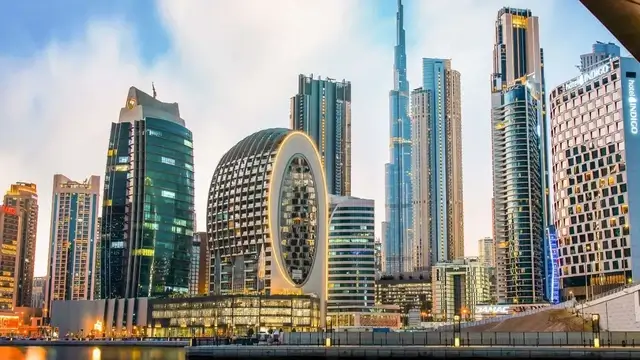
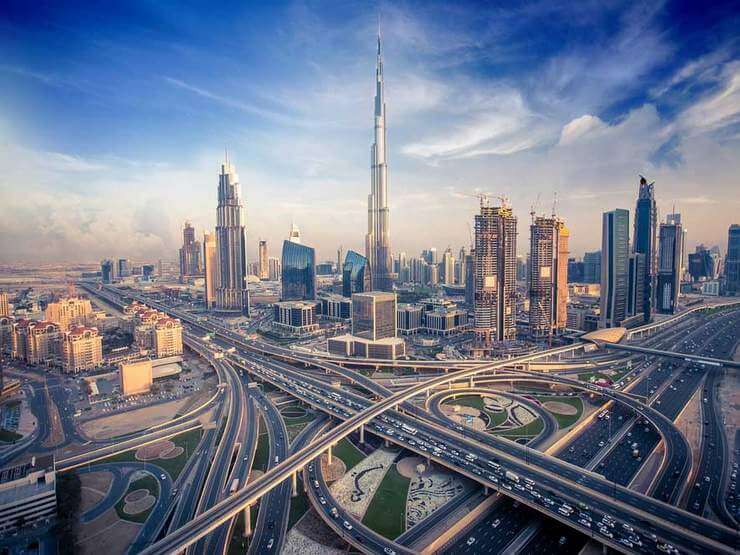
Sheikh Zayed Road (SZR) is Dubai’s principal highway and business corridor, running from the Trade Centre area through Downtown Dubai to Business Bay and beyond. Home to the Burj Khalifa, Emirates Towers, DIFC, and the Museum of the Future, it blends high-rise offices, luxury hotels, residential towers, and the Dubai Metro Red Line into the emirate’s busiest and most iconic address.
Few roads in the world carry as much symbolic weight as Sheikh Zayed Road. Stretching through the heart of Dubai, this highway is more than an artery for traffic – it is the skyline itself, the backbone of the city’s financial engine, and one of the most sought-after addresses for both residents and businesses in the UAE. Whether you are relocating for work, scouting investment property, or simply curious about the towers you see flashing past on the way from the airport, understanding Sheikh Zayed Road means understanding modern Dubai.
This guide breaks down everything you need to know about Sheikh Zayed Road in 2026 – its history, landmarks, neighborhoods, transport links, real estate market, dining and hotel scene, and what the future holds for this ever-evolving corridor.
What Is Sheikh Zayed Road? A Quick Overview
Sheikh Zayed Road, officially part of the E11 highway, is the road that links Dubai to Abu Dhabi and, further along, to the other emirates including Sharjah, Ajman, and Ras Al Khaimah. Within Dubai, the corridor most commonly referred to as “Sheikh Zayed Road” runs for roughly 55 kilometers through the city, though the wider E11 route across the UAE extends for several hundred kilometers, connecting the country’s major urban centers into a single continuous highway system.
In everyday Dubai usage, however, “Sheikh Zayed Road” usually means something more specific: the dense skyscraper corridor stretching from the Trade Centre (Za’abeel) Roundabout down through Downtown Dubai to Business Bay and Interchange 1 near the Dusit Thani hotel. This roughly two-kilometer stretch is where the postcard skyline lives – a wall of glass towers on either side of a highway that can carry up to 12–14 lanes of traffic at its widest points.
Who Was Sheikh Zayed?
The road is named in honor of Sheikh Zayed bin Sultan Al Nahyan, the founding father and first President of the United Arab Emirates. Known for uniting the seven emirates in 1971 and steering the nation’s rapid development, his legacy is reflected in the very road that bears his name – a route built to physically connect the emirates he brought together.
The History of Sheikh Zayed Road
Understanding the present-day skyline requires a quick look back. Before the 1970s, travel between Dubai and Abu Dhabi meant following rough desert tracks with no formal road markings. Construction of Sheikh Zayed Road began in 1971 and the highway was completed in 1980, making it one of the UAE’s first major infrastructure projects and a symbol of the country’s transition from a coastal trading economy into a modern nation.
The corridor’s transformation into a skyscraper district happened gradually:
- 1979 – The Dubai World Trade Centre opened, becoming the city’s first skyscraper and, for a time, the tallest building in the Middle East.
- 2000 – The twin Emirates Towers opened, instantly becoming a symbol of Dubai’s corporate ambitions. One tower houses offices; the other operates as the Jumeirah Emirates Towers Hotel.
- 2000s–2010s – A wave of supertall towers followed, including the Burj Khalifa, Al Yaqoub Tower, and HHHR Tower, cementing the road’s reputation as a living architectural timeline.
- Today – The corridor continues to densify, with newer additions like the Museum of the Future adding cultural landmarks to a skyline once dominated purely by commercial towers.
This progression – from desert track to global business address in under 50 years – is central to why Sheikh Zayed Road carries so much weight in any conversation about Dubai’s growth story.
Iconic Landmarks Along Sheikh Zayed Road
Driving or walking along Sheikh Zayed Road feels like moving through an open-air museum of 21st-century architecture. Here are the landmarks that define the corridor.
Burj Khalifa and Downtown Dubai
The world’s tallest building anchors the southern stretch of the corridor. Along with The Dubai Mall and the Dubai Fountain nearby, this cluster forms Downtown Dubai – arguably the most photographed square kilometer in the Middle East.
Emirates Towers
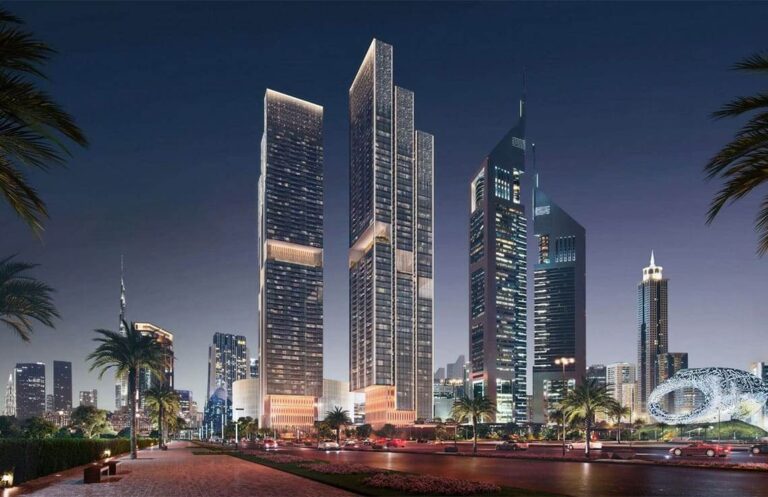
Opened in 2000, the Emirates Towers remain one of the most recognized silhouettes in Dubai. The taller of the two towers held records for height in the Middle East when it was completed, and the complex today combines Grade-A office space with a five-star hotel and a well-known co-working hub.
Dubai World Trade Centre
As the road’s original anchor building, the Dubai World Trade Centre now functions as a major exhibition and conference venue, hosting internationally recognized events such as GITEX, Gulfood, and Arab Health throughout the year.
Museum of the Future
A torus-shaped structure wrapped in Arabic calligraphy, the Museum of the Future has become one of Dubai’s most Instagrammed buildings and a symbol of the city’s push toward innovation-led tourism.
DIFC (Dubai International Financial Centre)
Sitting just off the main highway, DIFC is the region’s leading financial free zone, home to international banks, asset managers, and a growing cluster of fintech firms – reinforcing Sheikh Zayed Road’s identity as Dubai’s financial spine.
Al Yaqoub Tower and HHHR Tower
Two towers that showcase the corridor’s architectural personality: the Al Yaqoub Tower, styled after London’s Big Ben but standing several times taller, and the HHHR Tower, known for its striking blue glass façade.
Business Bay
At the road’s southern edge, Business Bay extends the skyline further with a dense cluster of commercial and residential towers built around an extension of Dubai Creek.
Living on Sheikh Zayed Road
Who Lives Here?
Sheikh Zayed Road appeals primarily to working professionals and expatriates who want to minimize commute times to Dubai’s main business districts. Because many towers combine office and residential floors in the same building, residents often live just an elevator ride away from their workplace – a rare convenience in a city built around long commutes.
Property Types and Pricing
The corridor offers everything from compact studios to multi-bedroom penthouses. Based on current real estate listings, studio apartments along Sheikh Zayed Road tend to start in the mid AED 700,000s, one-bedroom units generally begin above AED 1.3 million, and larger two- and three-bedroom apartments can range from roughly AED 2 million up to AED 8.7 million depending on the building, floor, and view. These figures move with market conditions, so treat them as a general guide rather than a fixed price list, and always verify current listings with a licensed agent or the Dubai Land Department before making a decision.
Freehold Conversion
A notable recent development for investors: the Dubai Land Department has identified a set of plots along Sheikh Zayed Road – commonly cited as 128 plots – for conversion from leasehold to freehold ownership. Property owners and investors can check eligibility for specific plots through the Dubai REST platform, making this an area worth monitoring for anyone tracking Dubai’s evolving freehold zones.
Major Developers
Several of Dubai’s best-known developers have shaped the Sheikh Zayed Road skyline, including Emaar Properties (known for The Address Hotels + Resorts brand), DAMAC Properties, MAG Property Development, and Sobha Group, each contributing residential and mixed-use towers with distinct architectural identities.
Hotels and Hospitality Along Sheikh Zayed Road
Because it doubles as Dubai’s premier business corridor, Sheikh Zayed Road is lined with hotels catering to both corporate travelers and tourists. Notable properties include:
| Hotel | Positioning |
|---|---|
| Jumeirah Emirates Towers Hotel | Business-focused, part of the Emirates Towers complex |
| Fairmont Dubai | Five-star, central location near Trade Centre |
| Conrad Dubai | Business and leisure hybrid |
| Sheraton Grand Hotel Dubai | Long-standing five-star option |
| Crowne Plaza Dubai | Business travel, meeting facilities |
| Towers Rotana | Serviced suites and apartments |
| Millennium Plaza Hotel Dubai | Mid-range luxury |
| Dusit Thani Dubai | Marks the southern end of the core SZR hotel strip |
Many of these hotels sit within walking distance of a Dubai Metro station, reducing reliance on taxis for guests moving between meetings, malls, and Downtown attractions.
Getting Around: Transport and Connectivity
Sheikh Zayed Road’s transport network is one of its biggest advantages for both residents and visitors.
Dubai Metro Red Line
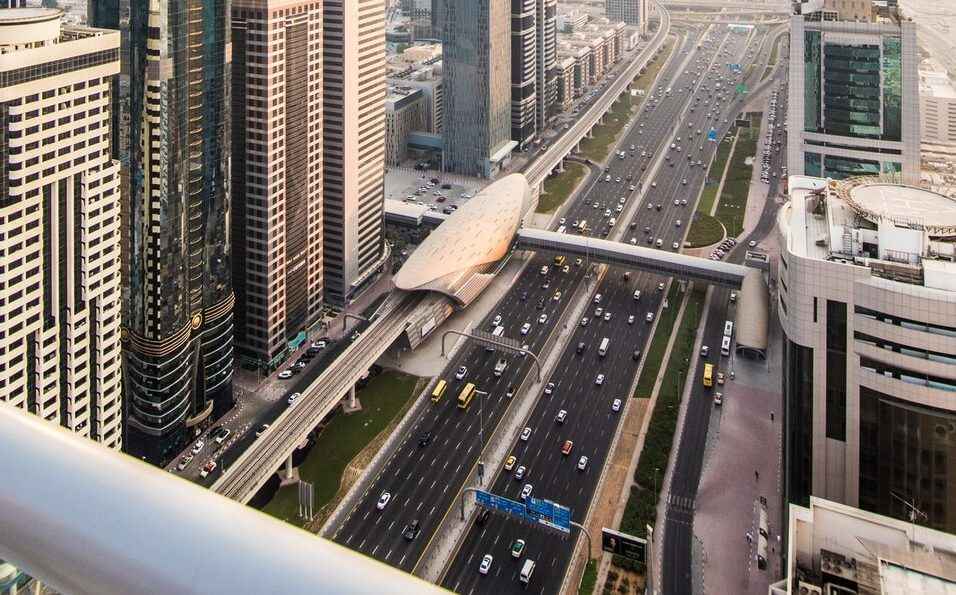
The Dubai Metro Red Line runs largely parallel to Sheikh Zayed Road, with stations such as Emirates Towers, Financial Centre (DIFC), World Trade Centre, and Business Bay providing direct access to the corridor’s biggest landmarks and office towers.
Buses, Taxis, and Ride-Hailing
RTA bus routes and feeder services complement the metro, while taxis and ride-hailing apps such as Careem and Uber remain widely used, particularly for late-night travel or areas slightly off the metro line.
Driving on SZR
For drivers, Sheikh Zayed Road is a multi-lane highway – considerably wider than a typical city street. While convenient for long-distance travel, the highway’s design makes it difficult for pedestrians to cross outside of designated bridges and underpasses, so anyone exploring on foot should plan routes around metro stations and pedestrian bridges rather than attempting to cross at street level.
Business, Events, and Economic Significance
Sheikh Zayed Road is arguably Dubai’s single most important commercial corridor. The Dubai World Trade Centre alone hosts some of the region’s largest trade shows and exhibitions annually, drawing international businesses and delegations. Combined with DIFC’s financial services cluster and the dense concentration of corporate headquarters in towers along the route, the road functions as a physical map of Dubai’s economic priorities: finance, trade, hospitality, and real estate, all within a few kilometers of highway.
This concentration also explains why so many towers along SZR combine office and residential use – demand from professionals wanting to live near work has shaped the building typology of the entire corridor.
Common Mistakes to Avoid When Exploring Sheikh Zayed Road
- Assuming it’s walkable end-to-end. The highway’s scale makes casual walking between distant landmarks impractical; use the metro to hop between clusters instead.
- Confusing “Sheikh Zayed Road” the neighborhood with the full E11 highway. Locally, the name usually refers to the Trade Centre–to–Business Bay stretch, not the entire route to Abu Dhabi.
- Overlooking freehold eligibility when buying property. Not every plot qualifies for freehold conversion – always verify status through Dubai REST before committing to a purchase.
- Ignoring peak traffic hours. As Dubai’s busiest highway, SZR sees heavy congestion during standard rush hours; the metro is often faster for short hops between towers.
Future Outlook: What’s Next for Sheikh Zayed Road
Dubai’s ambitions for the corridor show no sign of slowing. Reports point to further supertall developments planned near the Museum of the Future area, continuing the decades-long trend of the skyline growing taller and more architecturally ambitious. Combined with ongoing freehold conversions and ongoing metro and infrastructure upgrades, Sheikh Zayed Road is positioned to remain Dubai’s most dynamic corridor for business, tourism, and residential investment well into the next decade.
FAQs
1. What is Sheikh Zayed Road known for?
Sheikh Zayed Road is Dubai’s main highway and business corridor, known for its dense cluster of skyscrapers including the Burj Khalifa, Emirates Towers, and DIFC, alongside luxury hotels and residential towers.
2. How long is Sheikh Zayed Road?
Within Dubai, the highway stretches roughly 55 kilometers. It forms part of the wider E11 highway, which connects Dubai to Abu Dhabi and onward to other emirates over a much longer total distance.
3. Who is Sheikh Zayed Road named after?
It is named after Sheikh Zayed bin Sultan Al Nahyan, the founding father and first President of the UAE.
4. When was Sheikh Zayed Road built?
Construction began in 1971 and the highway was completed in 1980.
5. What are the main landmarks on Sheikh Zayed Road?
Key landmarks include the Burj Khalifa, Emirates Towers, Dubai World Trade Centre, Museum of the Future, DIFC, and The Dubai Mall.
6. Is Sheikh Zayed Road a good place to live?
Yes, especially for professionals who want proximity to Dubai’s business districts. It offers a mix of studios to multi-bedroom apartments, though pricing tends to be higher than in more suburban communities.
7. How do you get around Sheikh Zayed Road without a car?
The Dubai Metro Red Line runs parallel to the highway with several stations, supplemented by RTA buses, taxis, and ride-hailing apps like Careem and Uber.
8. Can tourists stay on Sheikh Zayed Road?
Yes. The corridor has numerous five-star hotels and serviced apartments, making it a popular base for visitors who want to be close to Downtown Dubai and DIFC.
9. Is Sheikh Zayed Road freehold?
Portions of it are being converted to freehold ownership by the Dubai Land Department. Eligibility varies by plot, so buyers should check status through Dubai REST before purchasing.
10. What is the difference between Sheikh Zayed Road and the E11 highway?
The E11 is the full highway connecting multiple emirates. “Sheikh Zayed Road” is often used specifically to describe the skyscraper-lined stretch within Dubai, though technically the name applies to the whole route through the emirate.
11. Is it safe to walk along Sheikh Zayed Road?
The highway itself is not pedestrian-friendly due to its scale and traffic volume. Pedestrian bridges and metro stations provide safer ways to move between buildings.
12. What events are held at Dubai World Trade Centre?
The venue hosts major international exhibitions and conferences, including trade shows such as GITEX and Gulfood, drawing visitors and businesses from around the world.
Conclusion
Sheikh Zayed Road is not simply a road – it is the story of Dubai told in glass and steel. From a 1970s desert highway project to a corridor lined with some of the world’s most recognizable skyscrapers, it captures the pace and ambition that define the emirate. Whether you’re evaluating it as a place to live, a base for business, or simply the backdrop to your Dubai visit, understanding its landmarks, transport links, and real estate landscape gives you a genuine head start on navigating one of the most important streets in the Middle East.

Ali is a full-time content writer and financial specialist with over 6 years of experience living and working in the UAE. He focuses on business finance, insurance, investments, and corporate financial strategies, delivering authoritative content tailored to entrepreneurs and professionals.
Ali combines in-depth industry research with practical insights, helping readers understand complex financial and insurance topics in a simple, actionable way. His content is designed to build trust, authority, and long-term value for business-focused audiences.