Deem Credit Card Guide: Types, Fees, Rewards, Eligibility and How to Apply (2026)
Most credit card guides in the UAE tell you what a card offers. Fewer tell you what it costs when things go wrong. This guide does both. A Deem Credit Card sits in an interesting corner of the UAE market: it is issued by a Central Bank-regulated finance company rather than a traditional retail bank, it lets you choose between earning points and entering a prize draw, and it comes in three tiers that start at a monthly salary of AED 5,000.
We reviewed Deem’s published Key Facts Statement, its March 2026 Schedule of Fees and Charges, and its own cardholder guides to build this article. Where Deem’s documents differ from one another, we say so, because that is exactly the kind of detail that decides whether a card suits you.
What Is a Deem Credit Card?
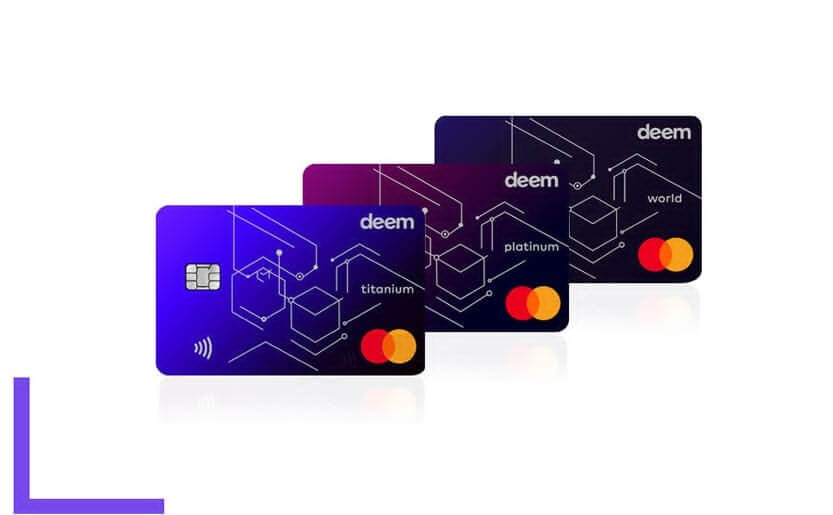
A Deem Credit Card is a Mastercard-network credit card issued by Deem Finance LLC, a UAE Central Bank-regulated lender. Deem offers three tiers: Titanium (AED 5,000 minimum salary), Platinum (AED 10,000) and World (AED 25,000). Cardholders choose between JOY points and WIN draw entries, and apply digitally through the Deem website.
What Is a Deem Credit Card?
A Deem Credit Card is a revolving credit facility. Deem approves a credit limit, you spend within it, and you repay either in full or in part each month. According to Deem’s Key Facts Statement, the card can be a plastic card or a digital virtual card. You can use it at point-of-sale machines, on online payment gateways, and at Mastercard-enabled ATMs around the world.
Every account includes a primary card and the option to add supplementary cards for family members. Deem’s March 2026 fee schedule lists supplementary cards as free for up to five cardholders.
Who Issues It?
The issuer is Deem Finance LLC, which operates offices in Abu Dhabi (Awad Al Otaiba Building, Al Reem Plaza) and Dubai (Dubai Outsource City). Deem states that it is regulated by the Central Bank of the UAE. That matters for two reasons. First, the card is subject to Central Bank rules on fees, disclosures and interest. Second, Deem is legally prohibited from charging interest on accrued interest on credit cards, a protection written into the federal law governing the Central Bank and financial institutions.
How It Differs From a Typical Bank Card

Traditional bank cards often lean on relationships. A salary account, a savings balance or a mortgage can unlock better limits and fees. A Deem Credit Card is built differently. It is a standalone product that you manage almost entirely through the Deem Mobile App and Deem Online. That makes it simpler to hold, but it also means you should read the fee schedule yourself, because there is no branch relationship manager to smooth over surprises.
Deem Credit Card Types: Titanium, Platinum and World
Deem sorts its cards by income and lifestyle. The tier you qualify for depends mainly on your monthly salary.
| Feature | Titanium | Platinum | World |
|---|---|---|---|
| Minimum monthly salary | AED 5,000 | AED 10,000 | AED 25,000 |
| Annual fee (primary card) | AED 210 | AED 315 | AED 525 |
| Retail interest (per month) | 3.99% | 3.99% | 3.75% |
| Airport lounge access | Not listed in Deem’s 2026 benefits guide | 25+ lounges in the Middle East and the Levant | 1,000+ lounges worldwide |
| Complimentary valet parking | No | Yes, at selected locations | Yes, at selected locations |
| Trip.com discount on flights and hotels | Not listed | Up to 10% | Up to 15% |
| Supplementary cards | Free up to 5 | Free up to 5 | Free up to 5 |
Fees and interest come from Deem’s March 2026 Schedule of Fees and Charges. Benefits come from Deem’s July 2026 lifestyle guide. Always confirm current terms before applying.
Deem Titanium Credit Card
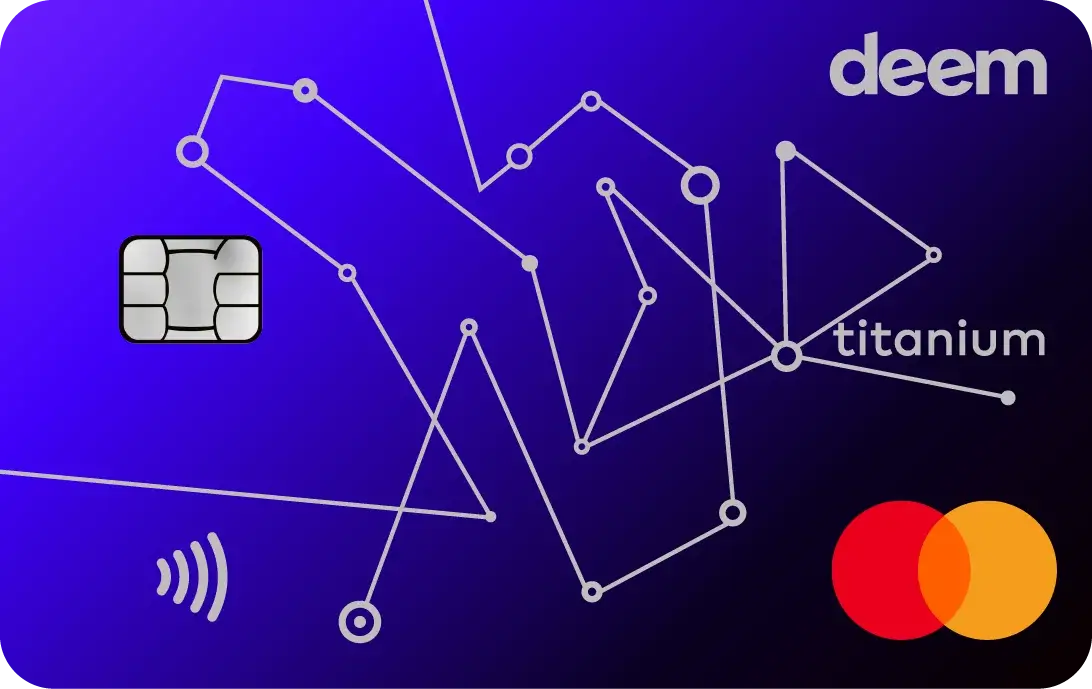
Titanium is the entry tier. It suits salaried residents who want a straightforward card for groceries, fuel, utilities and online shopping. With a minimum salary of AED 5,000, it is one of the more accessible entry points among UAE credit cards. Deem describes the tier as focused on simplicity and everyday value.
Some third-party listings mention a first-year fee waiver on Titanium. Deem’s own fee schedule simply lists AED 210, so treat any waiver as a promotion that you should confirm at the time of application.
Deem Platinum Credit Card
Platinum is the balanced tier. At AED 10,000 minimum salary, it adds airport lounge access, complimentary valet parking and a larger travel discount through Trip.com. For many people, this is the sweet spot: the lifestyle benefits start to pay for the AED 315 fee if you travel even a couple of times a year or regularly visit malls with valet service.
Deem World Credit Card
World is the premium tier, aimed at higher earners and frequent travellers. The headline benefit is access to more than 1,000 participating airport lounges worldwide, plus the highest Trip.com discount and international lifestyle privileges covering hotels, car rentals and shopping. It also carries the lowest retail interest rate in the range at 3.75% per month, although a card you pay off in full each month never triggers that rate at all.
A Note on Older “Cash Up” and “Miles Up” Names
If you search for Deem cards, you will find older material and some third-party pages that use names such as Cash Up and Miles Up. Deem’s current published material organises the range by tier and by the JOY and WIN reward choice. If a comparison site lists a product you cannot find on Deem’s own website, ask Deem Customer Care whether it is still open for new applications.
JOY or WIN: How Deem’s Reward Program Works
This is the feature that sets the card apart. In 2025, Deem launched what it called its Joy-Win program, which lets you choose how your spending is rewarded. You make the choice in the Deem Mobile App, and you can switch monthly.
JOY: Points You Can Redeem
With JOY, you earn Joy Points on your spending. You can also choose between a Lifestyle category and a Travel category for accelerated earning, provided you meet the monthly spend criteria. Joy Points can be redeemed for cashback against your card outstanding, flights and hotel bookings, airline miles, gift vouchers and purchases with participating partners.
WIN: Draw Entries Instead of Points
With WIN, you earn one entry into Deem’s AED 250,000 bi-annual draw for every AED 100 spent on eligible retail purchases. There is no point balance to track. You are simply entering a prize draw with your everyday spending.
Which One Should You Choose?
Think of it as certainty versus a lottery ticket. JOY gives you a predictable return that you can redeem for something concrete, such as cashback against your balance. WIN offers a small chance at a very large prize.
For most households, JOY is the more sensible default, because points are guaranteed and the value compounds with regular spending. WIN can make sense in a month when you expect heavy spending that you would not otherwise redeem points on. Since you can switch every month, you do not have to commit.
One caution applies to both options: spending that does not qualify, such as cash advances, does not earn rewards. Deem’s program terms list the non-eligible transaction types, so read them before assuming that every dirham counts.
Lifestyle and Travel Benefits Worth Knowing About
Beyond rewards, Deem’s published benefits include the following, which vary by tier and carry their own terms:
- Cinema offers: Buy 1 Get 1 Free tickets at participating VOX Cinemas and Reel Cinemas.
- Family attractions: Discounts at participating Emaar Entertainment destinations, including KidZania, Dubai Aquarium & Underwater Zoo, Dubai Ice Rink and EKart Zabeel.
- Airport lounges: 25+ lounges for Platinum and 1,000+ for World.
- Valet parking: Complimentary at selected locations for Platinum and World.
- Travel discounts: Up to 10% (Platinum) or 15% (World) on eligible Trip.com bookings.
- Flight Delay Pass: Lounge access when a registered flight meets the delay criteria, subject to registration.
- Everyday convenience: Easy Payment Plans, Apple Pay and Google Pay compatibility, and app-based card management.
A practical tip: benefits with usage limits, registration steps or participating-location lists tend to go unused. Before you pay a higher annual fee for a higher tier, check how many complimentary lounge visits or valet services you actually receive, because Deem notes that the number of services varies by card type.
Deem Credit Card Fees and Charges
Fees are where credit cards earn their money, so this section deserves your full attention. The figures below come from Deem’s March 2026 fee schedule and Key Facts Statement.
| Charge | Amount |
|---|---|
| Annual fee (primary) | AED 210 Titanium, AED 315 Platinum, AED 525 World |
| Supplementary cards | Free up to 5 |
| Late payment fee | AED 241.50 per missed minimum payment |
| Over-limit charge | AED 341.25 |
| Cash advance fee | About 3% of the amount or AED 105, whichever is higher |
| Foreign transaction fee | About 2.99% of the transaction amount |
| Card replacement | AED 78.75 |
| Sales voucher copy | AED 26.25 |
| Liability or no-liability letter | AED 52.50 |
| Credit balance refund | AED 26.25 |
| Additional paper or emailed statement | AED 26.25 (statements in the app are free) |
| Balance transfer processing fee | Up to 4.20% of the amount transferred |
| Deem Double Secure (optional credit shield) | 1.04% of monthly outstanding balance |
Two small discrepancies are worth knowing. The Key Facts Statement shows the cash advance fee as 3.15% and the foreign transaction fee as 3.139%, while the fee schedule shows 3% and 2.99%. The difference is exactly 5%, which suggests VAT is included in one document and not the other. Either way, expect to pay roughly 3% on both.
Interest Rates
Deem’s Key Facts Statement states that interest on retail and cash transactions is up to 3.99% per month. Its worked example uses an annual percentage rate of 47.88%, which is simply 3.99% multiplied by twelve. Interest is calculated daily on the balance.
That is a high rate by any standard, which is why the single most valuable habit with this card is paying the full statement balance by the due date.
The Interest-Free Period
Deem advertises an interest-free period of up to 51 days on retail purchases. You qualify when you paid the previous statement in full by its due date and made no cash transaction in the statement period. The period does not apply to cash advances, exchange-house and money-service transactions, or to Easy Payment Plans.
The 51 days come from a simple structure: a statement cycle of roughly 30 days plus 21 days to pay after the statement date. A purchase made right after a statement closes gets close to the full 51 days. A purchase made just before it closes gets far less.
Deem’s statement calendar shows how this works in practice. A statement generated on the 4th is due on the 25th of the same month. A statement generated on the 15th is due on the 5th or 6th of the next month.
The Minimum Payment Trap
Deem calculates the minimum payment as 5% of the outstanding balance plus VAT, any Easy Payment Plan instalment, any insurance premium and any over-limit amount, or AED 100, whichever is higher.
Here is what that means in practice. Suppose your statement shows AED 4,000. The minimum payment is about AED 200. If you pay only that, you carry AED 3,800 forward, and at up to 3.99% monthly you can expect interest in the region of AED 150 for the following month. Deem calculates interest daily, so the exact figure will differ, but the pattern is clear: paying the minimum keeps you in debt for a very long time.
Deem’s own documents carry a warning to this effect. Paying only the minimum means more interest and a longer repayment period.
Who Can Apply? Eligibility and Documents
Salary is the entry ticket, but it is not the only test. Deem says approval is also influenced by several other factors:
- Your credit history and AECB score from the Al Etihad Credit Bureau
- Your debt burden ratio, since total monthly debt payments should generally not exceed 50% of your salary
- Employment stability and job tenure
- Your payment history on loans, cards and even telecom bills
Meeting the minimum salary only qualifies you for consideration. It does not guarantee approval.
Documents You Will Typically Need
Deem’s guidance lists the following:
- Emirates ID
- Passport copy
- Salary certificate or payslips for the last three months
- Bank statements for the last three months
- A UAE mobile number registered in your name
Deem may ask for additional documents at its discretion. If your application does not meet the product terms, Deem can decline it or request more supporting documents.
A Security Cheque May Be Requested
Under Central Bank rules, Deem may ask you to provide a cheque equal to 120% of your credit limit as additional security. It can present this cheque if you fall into continuous default. If you are asked for one, ask exactly when and under what circumstances it can be presented.
Improve Your Chances Before You Apply
Check your AECB credit score first, pay down existing balances to reduce your debt burden ratio, and make sure your salary certificate and bank statements match each other. Inconsistencies between documents slow down applications more often than low income does. Our guide to checking your credit score in the UAE walks through the AECB process step by step.
How to Apply for a Deem Credit Card
The application is digital.
- Choose your tier. Compare the three cards against your salary and spending habits, using the table above.
- Start the application on the Deem website. The journey begins on Deem’s credit card page and takes you through identity verification.
- Verify your identity. Have your Emirates ID and passport ready.
- Upload income documents. Provide your salary certificate or payslips, plus bank statements.
- Wait for assessment. Deem reviews your profile, credit history and documents. Approval is subject to verification and its discretion.
- Activate and set up the app. Once approved, set up your card in the Deem Mobile App, choose JOY or WIN, and add the card to Apple Pay or Google Pay if you want contactless payments.
The Five-Day Cooling-Off Period
Deem gives you five business days from accepting the offer to cancel the card without penalty. Fees billed in that period are refunded, net of any direct costs Deem has already incurred. If you are unsure about the annual fee or the terms, use this window rather than ignoring the card and waiting for a charge to arrive.
Managing Your Card Day to Day
Statements, Due Dates and Payments
You receive one statement a month, free, in the Deem Mobile App and on Deem Online. The payment due date falls 21 days after the statement date. Set a reminder for a few days before the due date, or better still, set up a payment that clears the full balance.
Easy Payment Plans
Easy Payment Plans let you convert a purchase or balance into instalments. They come with their own interest, quoted by Deem as up to 2.75% monthly on a flat rate, plus a processing fee of up to 4.20% of the amount. They do not benefit from the interest-free period. Use them only after comparing the total cost with simply paying the balance.
Supplementary Cards
You can request supplementary cards through the Deem Mobile App or Deem Online, or by calling Customer Care. They are free for up to five cardholders, but all spending lands on your limit and your statement, so agree on a spending rule with family members before issuing them.
Disputing a Transaction
If you spot a transaction you did not make, you can raise a dispute within 30 days of receiving your statement. Check each statement as soon as it arrives. Deem also reminds customers that if fraud involves a PIN, password or one-time password, the customer can be held liable, because no other party should know these details.
Keeping Your Deem Credit Card Secure
Deem’s security guidance is practical and worth following:
- Never share your Deem Mobile App password, PIN, CVC or one-time password. Deem says it will never ask for these by phone or email.
- Avoid simple passwords tied to birthdays, and change them regularly.
- Use trusted networks rather than public Wi-Fi when you check statements.
- Cover the keypad at ATMs and point-of-sale terminals, and look for devices attached to card readers.
- Never sign a blank cheque, and do not sign more than one Direct Debit Authority form.
- Mark copies of your identity documents with two parallel lines and the purpose of the copy.
To report suspicious activity on your card, Deem asks you to write to its information security team at deeminfosec@deem.io.
Deem Customer Care and Complaints
Deem’s Customer Care Centre runs around the clock on 600 525550. You can also email customercare@deem.io. Use the same channels to ask about balances, request statements, report a lost card or begin the card closure process.
If you cannot resolve an issue with Deem directly, UAE residents can escalate unresolved complaints about licensed financial institutions through the Central Bank’s consumer protection channels. Keep a record of dates, reference numbers and the names of the staff you spoke with.
How to Close a Deem Credit Card
Closing the card is straightforward but has a few consequences you should know about first. Call Customer Care or email customercare@deem.io, and an agent will tell you what outstanding balance you need to clear. Once you pay it, the card is blocked for closure and the credit limit drops to zero. The card is fully closed 45 days after Deem receives your payment.
Two warnings apply. Any accumulated reward points are forfeited as soon as Deem receives your closure request, so redeem your Joy Points first. And if Deem is holding a security cheque, ask for its return in writing once the account is closed.
Advantages and Disadvantages
Advantages
- A low entry salary of AED 5,000 for the Titanium tier
- Choice between guaranteed points (JOY) and a prize-draw entry (WIN), switchable monthly
- Free supplementary cards for up to five people
- Digital application and app-based management
- A well-documented fee schedule published by the issuer
- Up to 51 interest-free days on retail purchases when paid in full
Disadvantages
- Interest of up to 3.99% per month, which is expensive if you carry a balance
- Premium benefits such as lounge access are reserved for the higher-fee tiers
- Cash advances attract a fee of about 3% or AED 105, plus interest from day one
- Some benefits carry registration, usage limits or participating-location rules
- Rewards are forfeited immediately when you request closure
Common Mistakes to Avoid
Paying only the minimum. It feels manageable, but it is the costliest way to use the card.
Taking cash advances. They are charged a fee, attract interest immediately, and also cancel the interest-free period for that statement cycle.
Choosing a tier for the brochure rather than the budget. Paying AED 525 a year for lounge access you will use once is poor value.
Ignoring the foreign transaction fee. A fee of around 3% adds up quickly on holiday or on overseas online shopping. Where possible, pay in AED if the merchant offers a fair rate.
Forgetting to redeem points before closing. Points disappear when the closure request is received.
Applying to several lenders at once. Multiple applications in a short period leave several enquiries on your AECB file, which can hurt your chances.
Which Deem Card Fits Which Person?
A few practical profiles help here.
If you earn between AED 5,000 and AED 9,999 and mostly spend on groceries, fuel and utilities, Titanium is the only tier you qualify for, and its value comes from the reward choice and the supplementary cards.
If you earn AED 10,000 or more and travel a few times a year, Platinum offers the most balanced package, because lounge access and valet parking begin to justify the extra AED 105 over Titanium.
If you earn AED 25,000 or more and fly often, World makes sense mainly for the global lounge network and the larger Trip.com discount. If you take fewer than a handful of trips a year, run the numbers before accepting the AED 525 fee.
In every case, the best card is the one you can pay off in full each month.
The Outlook for Deem Cards
The direction of travel is clear. Deem’s Joy-Win program reflects a broader UAE trend towards cards that let the customer choose between value types rather than follow a single fixed rewards scheme. Digital application journeys, mobile wallet support and app-based controls are also becoming standard rather than premium features.
For cardholders, that means more choice but also more responsibility. Programs change, partner offers rotate, and fee schedules are updated with 60 days’ notice, according to Deem’s Key Facts Statement. Review the latest documents every year before your card renews.
FAQs
1. What is the minimum salary for a Deem Credit Card?
It depends on the tier. Titanium requires AED 5,000 a month, Platinum AED 10,000 and World AED 25,000. Meeting the salary requirement does not guarantee approval, because Deem also reviews your credit history, debt burden and employment stability.
2. How much is the annual fee on a Deem Credit Card?
Deem’s March 2026 fee schedule lists AED 210 for Titanium, AED 315 for Platinum and AED 525 for World. Supplementary cards are free for up to five cardholders. Check Deem’s website for any current promotional waiver.
3. What is the interest rate on a Deem Credit Card?
Deem states that interest on retail and cash transactions is up to 3.99% per month, which is about 47.88% a year. The World card lists a lower retail rate of 3.75% per month. Paying your full balance by the due date avoids retail interest entirely.
4. What is the difference between JOY and WIN?
JOY earns Joy Points that you can redeem for cashback, flights, hotels, airline miles, vouchers and partner purchases. WIN gives you one entry into an AED 250,000 bi-annual draw for every AED 100 of eligible retail spending. You can switch between them monthly in the Deem Mobile App.
5. Which Deem Credit Card offers airport lounge access?
Platinum offers access to more than 25 participating lounges across the Middle East and the Levant. World offers access to more than 1,000 participating lounges worldwide. Access rules and guest privileges depend on the lounge program terms.
6. How long is the interest-free period?
Up to 51 days on retail purchases, provided you paid the previous statement in full by the due date and made no cash transaction in the statement period. It does not apply to cash advances or Easy Payment Plans.
7. What is the minimum payment on a Deem Credit Card?
It is 5% of the outstanding balance plus VAT, any Easy Payment Plan instalment, any insurance premium and any over-limit amount, or AED 100, whichever is higher. Paying only the minimum increases the interest you pay.
8. What is the late payment fee?
Deem charges AED 241.50 each time you miss the minimum payment by the due date. Late payment also risks a negative record with the credit bureau, which can limit future borrowing.
9. What documents do I need to apply?
You will typically need your Emirates ID, passport copy, salary certificate or three months of payslips, three months of bank statements and a UAE mobile number registered in your name. Deem may ask for additional documents.
10. Can I cancel a Deem Credit Card after approval?
Yes. You have a five-business-day cooling-off period from accepting the offer to cancel without penalty. After that, call Customer Care on 600 525550, clear any outstanding balance, and the card will be fully closed 45 days after your payment is received.
11. What should I do if my card is lost or stolen?
Contact Deem Customer Care on 600 525550 immediately, which is available 24 hours a day. Report suspected fraud to deeminfosec@deem.io, and raise a dispute for any unrecognised transaction within 30 days of receiving the statement.
12. Does Deem require a security cheque?
It can. Subject to Central Bank rules, Deem may request a cheque equal to 120% of your credit limit as additional security, which it may present only if you continuously default on your card payments.
Conclusion
A Deem Credit Card is a practical option for UAE residents who want a straightforward, digitally managed card with a low entry salary, flexible rewards and free supplementary cards. The JOY and WIN choice is a genuinely different idea in a market where most cards offer a single fixed rewards scheme, and the three-tier structure makes it easy to match the card to your income.
The trade-off is cost. With monthly interest of up to 3.99%, a late fee of AED 241.50 and a foreign transaction charge of around 3%, the card rewards disciplined users and punishes those who carry a balance. Choose the tier your spending actually justifies, pay in full every month, redeem your points before they expire or before you close the account, and read Deem’s latest Key Facts Statement before you apply. Used that way, a Deem Credit Card can be a useful and inexpensive tool rather than an expensive habit.

Sara is a UAE-based banking and accounting expert with over 4 years of professional experience in the financial sector. Her expertise spans retail banking, financial reporting, compliance, and practical money management topics relevant to individuals and businesses in the UAE.
She contributes clear, accurate, and well-researched financial content, simplifying complex banking and accounting concepts for everyday readers. Sara’s writing reflects strong industry knowledge, regulatory awareness, and a commitment to financial accuracy and transparency.