Dubai Tram Transport Guide 2026: Routes, Stations, Fares & Tips
The Dubai Tram is an RTA-operated light rail line that has connected Al Sufouh, Dubai Marina, JBR, and Jumeirah Lakes Towers since November 2014. It runs along an 11-station, 10.6 km coastal loop, links directly to Dubai Metro at DMCC and Sobha Realty stations, and connects to the Palm Monorail at Palm Jumeirah station. A single ride costs AED 3 with a Nol card.
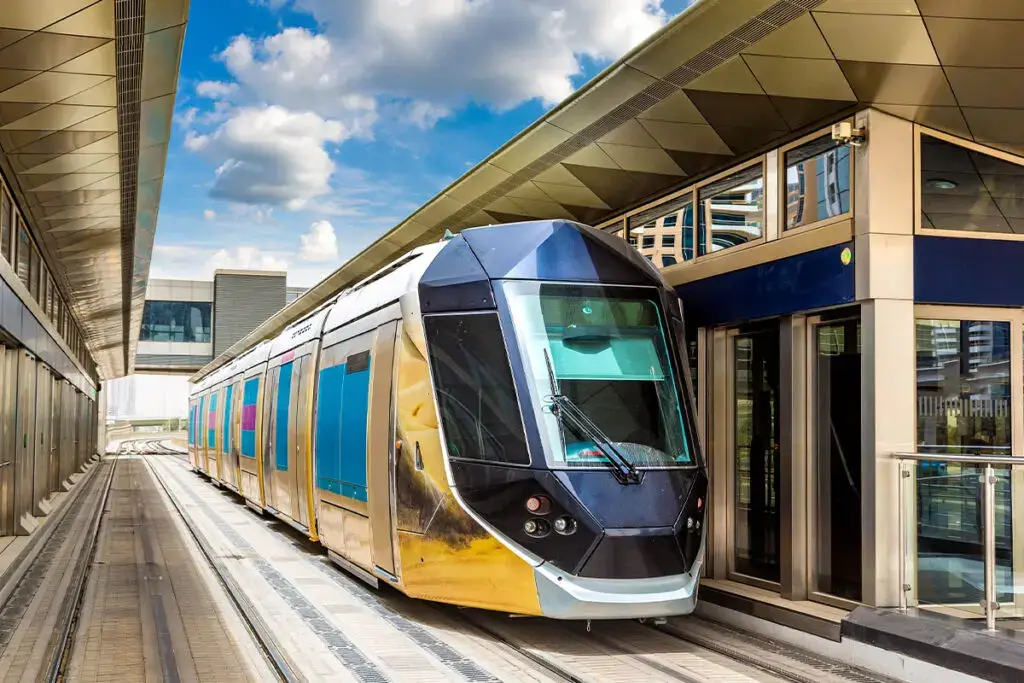
Stand on Sheikh Zayed Road during rush hour and you’ll understand instantly why the Dubai Tram exists. Marina traffic crawls, taxis get boxed in, and a five-minute trip can eat up twenty. The tram sidesteps all of it, gliding along a dedicated, ground-level track that threads through Dubai’s most visited waterfront district.
For residents of Dubai Marina, JBR, and Jumeirah Lakes Towers, the tram isn’t a novelty – it’s the fastest way to reach the beach, the mall, or the nearest Metro station without touching a steering wheel. For visitors, it’s an easy, affordable way to explore the coast, hop between hotels, and reach Palm Jumeirah without booking a taxi.
This guide covers everything the Dubai Tram area needs in 2026: the full route and station list, timings, fares, Metro and Palm Monorail connections, accessibility features, rules and fines, and what’s coming next as RTA expands the network. Whether you’re planning a daily commute or a single sightseeing trip, you’ll have a complete picture of how the tram fits into Dubai’s wider transport system by the end of this article.
What Is the Dubai Tram?
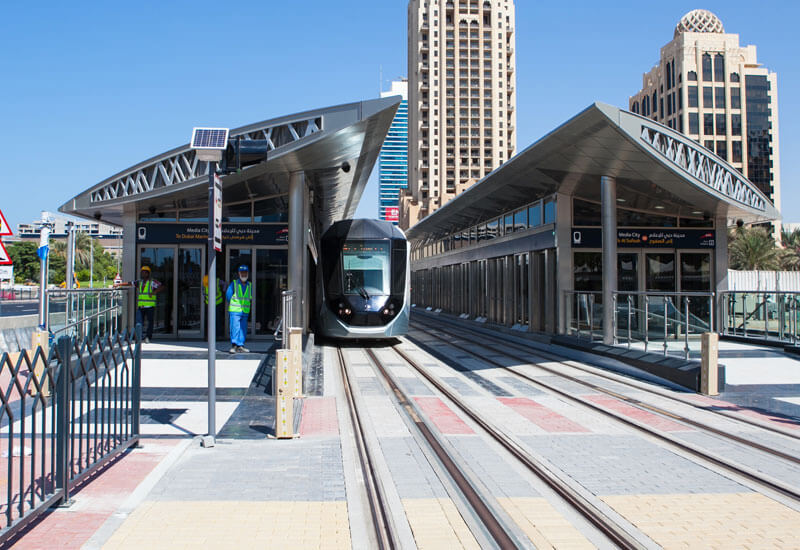
The Dubai Tram is a modern, street-level light rail system operated by Dubai’s Roads and Transport Authority (RTA). It opened to the public on 12 November 2014 under its original name, the Al Sufouh Tram, and was inaugurated by His Highness Sheikh Mohammed Bin Rashid Al Maktoum, Vice President and Prime Minister of the UAE and Ruler of Dubai.
It holds a notable engineering distinction: it was among the first tram systems outside Europe to run on a ground-based electric power supply rather than overhead wires, keeping the skyline along Al Sufouh Road and Dubai Marina free of cables. The system was designed from the outset to integrate with the Dubai Metro, Palm Monorail, and RTA bus network, forming one connected public transport web rather than a standalone line.
The tram primarily serves short, coastal journeys. It isn’t built to compete with the Metro on speed over long distances – instead, it fills the gap the Metro can’t reach: the dense residential and leisure corridor between Al Sufouh and Jumeirah Lakes Towers.
Why the Tram Matters for Dubai’s Transport Network
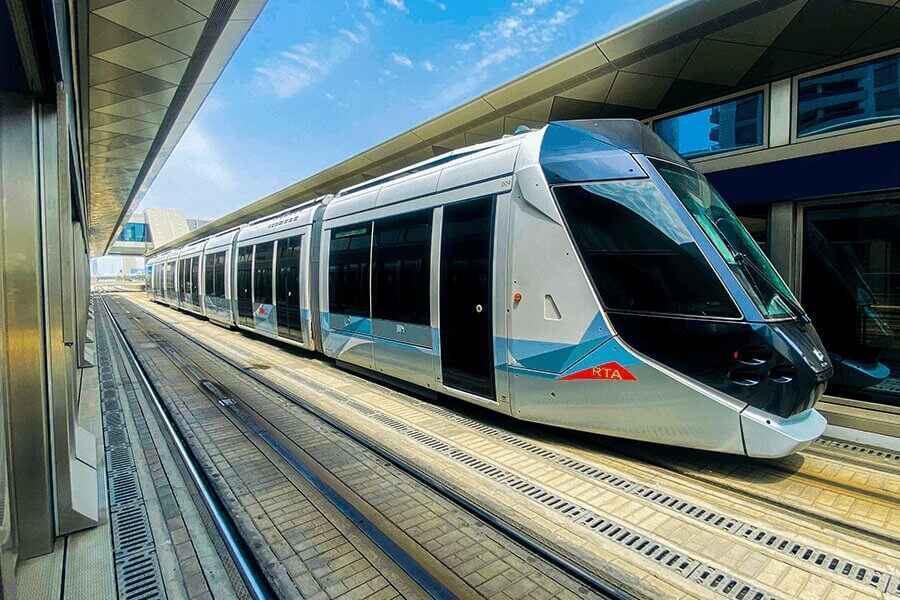
Dubai Marina and JBR are among the most densely populated and heavily visited areas in the emirate, yet the Metro’s Red Line runs along Sheikh Zayed Road, a walkable-but-inconvenient distance from the waterfront towers. The tram closes that last-mile gap. It reduces private car dependency, eases congestion on internal Marina roads, and gives tourists a stress-free way to move between hotels, beaches, and malls.
Dubai Tram Route and Map Overview
The tram operates on a single circular loop, not a back-and-forth line. It runs one direction only, looping from Al Sufouh through Dubai Marina, JBR, and JLT before returning to Al Sufouh. This is an important detail many first-time riders miss: because it’s a loop rather than a straight line, a short trip in the “wrong” direction can mean riding almost the full loop to reach a stop that’s physically close by. Always check the destination name shown on the platform, not just the next station.
Key route facts:
| Detail | Information |
|---|---|
| Total length | Approx. 10.6 km (6.6 miles) |
| Total stations | 11 |
| Direction | One-way circular loop |
| Full loop time | Approximately 40 minutes |
| Areas served | Al Sufouh, Media City, Knowledge Park, Dubai Marina, JBR, JLT |
| Operator | Roads and Transport Authority (RTA) |
| Opened | 12 November 2014 |
The 11 Dubai Tram Stations
Grouped roughly by corridor, the stations run as follows:
- Al Sufouh – western end of the line, near park-and-ride parking
- Media City – for Dubai Media City office towers
- Knowledge Village – near Knowledge Park and American University in Dubai
- Palm Jumeirah – interchange with the Palm Monorail
- Mina Seyahi – close to beachfront resorts and water-sports operators
- Dubai Marina Mall – for the mall, marina promenade, and boat tours
- Marina Towers – residential towers at the far end of the marina
- Sobha Realty (Dubai Marina) – interchange with Dubai Metro Red Line
- JBR 1 – The Walk and beachfront hotels
- JBR 2 – The Beach and public beach access
- DMCC (Jumeirah Lakes Towers) – interchange with Dubai Metro Red Line
Every platform is fully air-conditioned, fitted with platform screen doors, and signed in both English and Arabic, with digital displays showing the next station and the direction of travel.
Dubai Tram Timings and Frequency
Understanding the tram’s operating hours prevents the most common rider mistake: showing up outside service hours expecting the same schedule as the Metro.
| Day | Operating Hours |
|---|---|
| Monday – Saturday | 6:00 AM – 1:00 AM |
| Sunday | 9:00 AM – 1:00 AM |
During peak commuting hours, trams typically arrive every 8–10 minutes; off-peak intervals run slightly longer. If you’re heading out early on a Sunday, note that service doesn’t start until 9:00 AM – a detail that catches out visitors used to the Metro’s earlier Sunday start.
Dubai Tram Fares, Nol Card, and Ticket Types
The tram uses the same Nol card system as the Metro and buses, which keeps fare logic simple once you understand Dubai’s zone structure.
Dubai’s public transport network is divided into seven fare zones, but every one of the 11 tram stations sits inside Zone 2. That means the entire tram route has one flat fare, regardless of how many stops you ride.
Standard tram fares (Silver Nol card):
| Fare Type | Price |
|---|---|
| Standard single journey | AED 3 |
| Combined Metro/Tram/Bus transfer (within 30 minutes) | Single fare based on total zones crossed |
| People of Determination (Blue Nol) | Free |
| Students, seniors, social affairs beneficiaries (Blue Nol) | 50% discount |
| Children under 5 (height/age criteria apply) | Free |
If you transfer between the Metro, tram, and bus within 30 minutes of your last tap, RTA’s system generally treats the trip as one continuous journey and charges a single combined fare rather than stacking separate charges for each mode. This makes the Marina-to-Downtown commute – tram to Sobha Realty, then Metro into the city – noticeably cheaper than paying for each leg individually.
Cabin classes: Like the Metro, tram cabins are split into Gold Class (premium, less crowded), Silver Class (standard), and a Women & Children section. Riding in Gold Class with a Silver ticket, or vice versa, can result in a fine, so check the cabin markings before boarding.
How to Ride the Dubai Tram: Step-by-Step
- Plan your route using the RTA S’hail app, the RTA trip planner, or the printed route map at any station.
- Get a Nol card if you don’t already have one from the Metro or bus network – the same card works across all three.
- Tap in at the entry gate before reaching the platform. No tap means no valid ticket, even if you board successfully.
- Check the direction shown on the platform screen – remember, it’s a one-way loop.
- Board once the platform screen doors open and passengers have exited.
- Tap out when you leave your destination station so the correct fare is charged.
Connecting to Dubai Metro and Palm Monorail
One of the tram’s biggest practical advantages is how seamlessly it plugs into the rest of Dubai’s rail network.
- DMCC Tram Station connects to DMCC Metro Station on the Red Line, covering Jumeirah Lakes Towers.
- Sobha Realty Tram Station (Dubai Marina) connects to Sobha Realty Metro Station, also on the Red Line.
- Palm Jumeirah Tram Station connects directly to the Palm Monorail, which runs onward to Nakheel Mall, The Pointe, and Atlantis The Palm.
This triangle of tram, Metro, and monorail means a visitor can, in a single Nol-card journey, travel from Downtown Dubai to the Metro, transfer to the tram at Sobha Realty or DMCC, ride to Palm Jumeirah, and switch to the monorail – reaching Atlantis without ever stepping into a car.
Accessibility and Facilities
The Dubai Tram was built with accessibility as a core design principle rather than an add-on, which matters for families with strollers, older travellers, and People of Determination.
- Level boarding – platform screen doors and low-floor trams remove the gap between platform and cabin
- Dedicated wheelchair spaces inside every cabin
- Tactile floor paths guiding visually impaired passengers to platforms and exits
- Elevators and step-free routes connecting street level, concourse, and platform
- Visual and audible door alerts for safety
Onboard and station facilities include free Wi-Fi, full mobile network coverage, digital route information screens, Emergency Call Boxes on every platform and inside every cabin, and a dedicated tram police presence for security.
Luggage, Rules, and Fines
The tram is commonly used by travellers heading to or from Marina and JBR hotels, so luggage rules are worth knowing before you board.
- Each passenger may carry two bags: one large bag no bigger than 81cm x 58cm x 30cm, and one small bag no larger than 55cm x 38cm x 20cm.
- Luggage must be stored in the dedicated luggage area inside the cabin – not left blocking doors or aisles.
- No eating or drinking is permitted on trams or in paid station areas.
- A valid, correctly tapped Nol card is mandatory for every journey.
RTA inspectors board regularly, and violations – riding without a valid tap, blocking doors with luggage, or sitting in the wrong class – can result in fines of up to AED 2,000, depending on the offence. Most fines are avoidable simply by tapping correctly and keeping bags in the marked storage zones.
Common Mistakes First-Time Riders Make
- Forgetting it’s a one-way loop. Boarding in the wrong direction for a nearby stop can mean riding most of the 40-minute loop instead of a two-minute hop.
- Assuming Sunday hours match weekdays. Service starts at 9:00 AM on Sundays, three hours later than Monday through Saturday.
- Sitting in Gold Class on a Silver ticket. Always check cabin markings before choosing a seat.
- Not tapping out. Skipping the exit tap can lead to an incorrect – usually maximum – fare deduction.
- Overpacking luggage. Oversized bags beyond the permitted dimensions can lead to being asked to disembark.
Dubai Tram vs. Dubai Metro: Which Should You Use?
| Factor | Dubai Tram | Dubai Metro |
|---|---|---|
| Coverage | Coastal Marina/JBR/JLT corridor only | City-wide (Red and Green Lines) |
| Speed | Slower, frequent stops | Faster over long distances |
| Best for | Local Marina/JBR/Palm trips | Cross-city travel, airport transfers |
| Frequency | Every 8–10 minutes | Every 2–7 minutes |
| Fare | Flat Zone 2 fare (AED 3) | Zone-based, varies by distance |
In practice, the two aren’t competitors – they’re complementary. Locals typically use the Metro for the long leg of a journey and the tram for the final stretch into Marina, JBR, or JLT, exactly the kind of integrated trip RTA designed the network to support.
Future Expansion: What’s Next for the Dubai Tram
RTA has outlined a phased expansion plan for the tram network, though timelines for later phases remain unconfirmed:
- Phase 2 proposes a roughly 4 km extension linking the tram to Mall of the Emirates, a major Metro interchange and retail hub.
- Phase 3 involves further network extension, with routes and dates yet to be officially announced.
For now, RTA’s stated focus is optimising the existing coastal corridor and monitoring ridership before committing to further build-out. Any expansion toward Mall of the Emirates would meaningfully extend the tram’s usefulness beyond the current Marina–JBR–JLT triangle, giving residents in Al Sufouh and Media City a direct rail link to one of Dubai’s biggest shopping and Metro hubs.
Best Areas to Explore Using the Dubai Tram
- JBR (The Walk & The Beach): Beachfront dining, retail, and public beach access – reachable from JBR 1 and JBR 2 stations.
- Dubai Marina Mall & Marina Promenade: Shopping, waterfront walks, and dhow/yacht tours from Dubai Marina Mall station.
- Palm Jumeirah: Connect via the Palm Monorail from Palm Jumeirah tram station to reach Atlantis The Palm and Nakheel Mall.
- Dubai Media City & Knowledge Park: Business travellers and students commuting to media and education hubs.
- Jumeirah Lakes Towers (JLT): Residential towers, lakeside cafés, and a direct Metro connection at DMCC.
Expert Tips for Using the Dubai Tram Efficiently
- Travel outside 8–9 AM and 6–7 PM to avoid the tightest crowding on Marina-bound cars.
- If you’re staying near Al Sufouh, the free park-and-ride parking there is a practical way to skip Marina’s expensive and often full parking garages.
- Combine the tram with a Nol card top-up before you travel – station-side top-up queues can be slow during peak tourist season.
- For a scenic, low-cost sightseeing loop, ride the full circuit once; at roughly 40 minutes, it doubles as an inexpensive waterfront tour.
FAQs
1. How many stations does the Dubai Tram have?
The Dubai Tram has 11 stations, running from Al Sufouh to Jumeirah Lakes Towers (DMCC) along a one-way circular loop.
2. What is the Dubai Tram ticket price?
A standard single journey costs AED 3 with a Silver Nol card, since all tram stations fall within Zone 2 of Dubai’s fare system.
3. What are the Dubai Tram operating hours?
The tram runs from 6:00 AM to 1:00 AM Monday through Saturday, and from 9:00 AM to 1:00 AM on Sundays.
4. Does the Dubai Tram connect to the Dubai Metro?
Yes. It connects to the Metro Red Line at DMCC station (for Jumeirah Lakes Towers) and Sobha Realty station (for Dubai Marina).
5. Can I use my Metro Nol card on the tram?
Yes. The Nol card works across the Metro, tram, and bus network, and the system can apply a single combined fare for transfers made within 30 minutes.
6. Is the Dubai Tram wheelchair accessible?
Yes. Platform screen doors, level boarding, dedicated wheelchair spaces, tactile paths, and elevators make the system fully accessible, and People of Determination travel free with a Blue Nol card.
7. How long does a full Dubai Tram loop take?
Approximately 40 minutes to complete the entire circular route.
8. Does the tram connect to Palm Jumeirah?
Yes, indirectly. Palm Jumeirah tram station connects to the Palm Monorail, which continues on to Nakheel Mall, The Pointe, and Atlantis The Palm.
9. How much luggage can I bring on the Dubai Tram?
Each passenger may carry one large bag (max 81cm x 58cm x 30cm) and one small bag (max 55cm x 38cm x 20cm), stored in the cabin’s dedicated luggage area.
10. What happens if I don’t tap my Nol card correctly?
Failing to tap in or out can result in an incorrect fare charge and, if flagged by an inspector, a fine of up to AED 2,000.
11. Is the Dubai Tram faster than a taxi in Marina traffic?
For short trips within the Marina/JBR corridor, the tram is often faster than a taxi during peak hours, since it runs on a dedicated track separate from road congestion.
12. Will the Dubai Tram be extended in the future?
RTA has proposed a Phase 2 extension of roughly 4 km connecting the tram to Mall of the Emirates, with further phases still unconfirmed.
Conclusion
The Dubai Tram may be small compared to the sprawling Metro network, but within its coastal corridor it does exactly what it was built to do: remove the friction of moving between Dubai Marina, JBR, Palm Jumeirah, and JLT. Once you understand the one-way loop, the flat Zone 2 fare, and where it links into the Metro and Palm Monorail, it becomes one of the easiest transport decisions you’ll make in Dubai — whether you’re commuting to Media City on a Tuesday morning or heading to the beach on a Saturday afternoon. With RTA’s proposed extension toward Mall of the Emirates on the horizon, the tram’s role in Dubai’s integrated transport network is only set to grow.

Ali is a full-time content writer and financial specialist with over 6 years of experience living and working in the UAE. He focuses on business finance, insurance, investments, and corporate financial strategies, delivering authoritative content tailored to entrepreneurs and professionals.
Ali combines in-depth industry research with practical insights, helping readers understand complex financial and insurance topics in a simple, actionable way. His content is designed to build trust, authority, and long-term value for business-focused audiences.