BurJuman Area Guide 2026: Dubai’s Historic Retail and Metro Hub in Bur Dubai
BurJuman sits at one of the busiest crossroads in Dubai, where the Red and Green Metro lines meet beneath one of the city’s oldest shopping malls. Long before Downtown Dubai or Dubai Marina existed, BurJuman was already shaping how residents shopped, commuted, and gathered in Bur Dubai. Today, the BurJuman area is still a working intersection of old and new Dubai: a heritage-rich district anchored by a major interchange station, a 300-plus store mall, and easy access to the Dubai Creek, Al Fahidi, and the historic souks.
Whether you are commuting through BurJuman Metro Station, shopping at BurJuman Centre, or exploring Bur Dubai’s cultural core, this guide covers everything you need for 2026: location, transport, shopping, dining, nearby attractions, and practical visitor tips.
Quick answer: BurJuman is a mixed-use district in Bur Dubai, Dubai, centered on BurJuman Centre (a 300+ store mall opened in 1991) and BurJuman Metro Station, a Red Line and Green Line interchange. It sits at the junction of Sheikh Khalifa Bin Zayed Road and Khalid Bin Al Waleed Road, close to Al Fahidi Historical Neighbourhood, Dubai Museum, the Gold and Spice Souks, and Dubai Creek.
What and Where Is BurJuman?
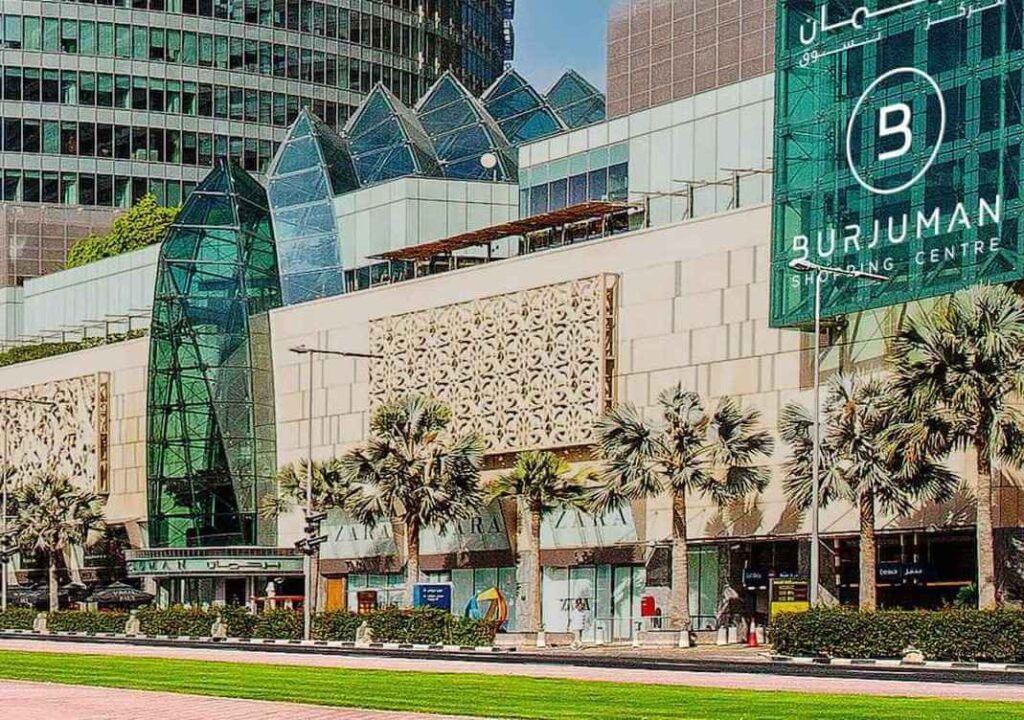
BurJuman refers to two connected things travelers usually mean together: the BurJuman Centre (also called BurJuman Mall) and the BurJuman Metro Station beneath and beside it. Both sit in Al Mankhool, part of the wider Bur Dubai district, one of the oldest and most culturally significant areas of the city. The location places BurJuman within a few minutes of Dubai Creek, the Al Fahidi Historical Neighbourhood, and the traditional trading heart of old Dubai, while still connecting seamlessly to modern business districts such as DIFC and Sheikh Zayed Road via the metro.
The wider BurJuman complex is larger than the mall alone. It spans roughly 2.8 million square feet of mixed-use development that includes the retail centre, a business tower, hotel suites, and residential apartments, developed and owned by the Al Ghurair Group, one of the UAE’s oldest conglomerates.
Why BurJuman Matters in Dubai’s Urban Story
BurJuman is one of the few places in Dubai where you can see the city’s retail evolution in a single visit. It opened as a modern shopping centre in 1991, years before Dubai’s mega-malls redefined the skyline, and it later became one of the metro network’s most important interchange points. That combination of retail heritage and transit centrality is why BurJuman continues to appear in “best Dubai neighbourhoods to explore” and “things to do near Bur Dubai” searches, even as newer districts open elsewhere in the city.
BurJuman Metro Station: The Area’s Transit Backbone
BurJuman Metro Station is a rapid transit interchange serving both the Red Line and Green Line of the Dubai Metro. Along with Union Station, it is one of only a small number of interchange stations in the network, which gives it an unconventional two-level layout: the Red Line runs beneath Sheikh Khalifa Bin Zayed Street, crossing perpendicularly with the Green Line, which runs below Khalid Bin Al Waleed Road.
Station History and Naming
The station opened on 9 September 2009 under its original name, Khalid Bin Al Waleed, as part of the first stretch of the Red Line. In December 2012, the Al Ghurair Group secured the station’s naming rights through the RTA’s Dubai Metro Stations Naming Rights Project, a ten-year sponsorship arrangement that renamed the station BurJuman to align it with the adjacent mall. The rebrand is a useful example of how Dubai’s metro naming-rights program links major private developments to public transit infrastructure, and travelers researching older content may still encounter the “Khalid Bin Al Waleed” name in historical references.
Lines, Connections, and Zone
- Red Line: Connects toward Dubai Marina, Mall of the Emirates, Burj Khalifa/Dubai Mall, Deira City Centre, Union, and both terminals of Dubai International Airport.
- Green Line: Connects toward Al Fahidi, Al Ras, Gold Souk, Al Ghubaiba, Sharaf DG, and Dubai Healthcare City.
- Adjacent stations: Union and ADCB on the Red Line; Sharaf DG and Oud Metha on the Green Line.
- Fare zone: Zone 6.
Because both lines converge here, BurJuman functions as a natural transfer point between old Dubai’s cultural corridor and the newer business and leisure destinations along Sheikh Zayed Road. Passengers heading from the airport toward Bur Dubai’s heritage sites, or from Downtown Dubai toward the Gold Souk, will typically pass through or change trains at BurJuman.
Station Exits and What They Lead To
BurJuman Metro Station has multiple exits, and choosing the right one saves considerable walking time:
| Exit | Best for |
|---|---|
| Exit 1 | Direct access into BurJuman Mall (shopping) |
| Exit 2 | Nearby commercial and office buildings |
| Exit 3 | Tourist attractions, including Dubai Museum and Al Fahidi |
Clear directional signage inside the station guides passengers between the Red and Green Line platforms, and the station includes elevators, ramps, and tactile paths to support travelers with mobility needs.
Getting There by Bus, Taxi, and Ride-Hailing
Multiple RTA bus routes stop at or near BurJuman Metro Station, including routes 2, 6, 9, 19A, 21, 27, 29, 33, 44, and 53, along with several cross-town and airport-linked services. Taxis queue directly outside the station exits, and ride-hailing pickup points are close by, making BurJuman a practical starting point for both short hops around Bur Dubai and longer trips across the city.
Metro Timings and Fares
Dubai Metro generally operates from around 5:00 AM to midnight Monday through Thursday and Saturday, extends to around 1:00 AM on Friday, and opens later at roughly 8:00 AM on Sunday. Fares depend on the number of zones crossed and the type of Nol card used. As an example, a journey from BurJuman to Burj Khalifa/Dubai Mall Metro Station takes about 13 minutes with trains running at short intervals.
Editorial note: Metro operating hours, fares, and train frequency are periodically adjusted by the RTA. Confirm current timings on the official RTA website or the S’hail app before travel.
BurJuman Centre (BurJuman Mall): Dubai’s Retail Pioneer
BurJuman Centre is one of Dubai’s oldest and most historically significant shopping malls. Its North Wing opened to the public on 5 November 1991, making it one of the first large-scale retail centres in the city, alongside early pioneers like Al Ghurair Centre. The original development covered roughly 500,000 square feet and around 150 stores.
Expansion Timeline
- 2002: Al Ghurair Group announced an AED 500 million (about US$135 million) expansion project covering a new South Wing, a luxury residential tower, a hotel building, and an office tower.
- 2004: Construction began on the expansion.
- Early 2007: The South Wing opened, extending the mall from roughly 500,000 to 800,000 square feet.
- 2013–2014: The North Wing closed for renovation and reopened with an expanded food court and new anchor tenants.
- August 2014: A large-format Carrefour hypermarket (around 5,780 square metres) opened in the renovated North Wing, becoming one of the mall’s key anchor stores.
Today, BurJuman houses more than 300 retail stores and over 40 restaurants and cafés across its North and South Wings, positioning it as a “community mall” rather than an ultra-luxury destination, though it still carries a meaningful selection of high-end labels.
Shopping at BurJuman
BurJuman’s retail mix spans three broad tiers, which is part of why it continues to attract both residents and tourists:
- High-street and mainstream fashion: H&M, Zara, Max Fashion, Mango, Splash, Forever 21, Cotton On, Levi’s, Aldo, Clarks, Naturalizer, and Victoria’s Secret.
- Luxury and designer labels: Historically including Louis Vuitton, Dior, Prada, Miu Miu, Christian Louboutin, Fendi, Gucci, and Agent Provocateur, concentrated largely in the North Wing.
- Everyday essentials and electronics: Carrefour Hypermarket for groceries and household goods, Sharaf DG for electronics, and Miniso for household and lifestyle items.
Jewelry and watch boutiques are also a notable part of the mall’s identity, reflecting Dubai’s strong gold and jewelry shopping culture, particularly for visitors from South Asia and the GCC.
Editorial note: Some luxury tenants, including single-flagship stores that were historically associated with BurJuman, have changed over the years as Dubai’s luxury retail scene has consolidated around newer malls. Confirm current store listings on BurJuman’s official directory before publishing specific luxury brand claims.
Dining and Entertainment
BurJuman’s food court, located on the upper level of the North Wing, includes a broad mix of fast-casual options, while additional restaurants and cafés are spread throughout both wings. For entertainment, the mall houses:
- VOX Cinemas BurJuman: A 14-screen multiplex with 2D, 3D, and premium formats, including a dedicated children’s cinema hall.
- Magic Planet: A family entertainment centre with rides, arcade games, and activities for children.
Mall Hours and Access
Store hours are typically 10:00 AM to 10:00 PM from Sunday to Thursday and 10:00 AM to 11:00 PM on Friday and Saturday, with restaurants generally staying open an hour later. Carrefour usually operates on extended hours beyond standard mall timings.
Editorial note: Mall and store operating hours, along with parking rates and validation policies, should be verified against BurJuman’s official website before publication, as these details are commonly updated for holidays and seasonal promotions.
Bur Dubai and Al Mankhool: The Neighbourhood Around BurJuman
BurJuman sits within Al Mankhool, part of the broader Bur Dubai district, one of Dubai’s oldest inhabited areas. Understanding this surrounding neighbourhood helps explain why BurJuman functions as more than a shopping mall; it is a gateway into old Dubai.
Historical and Cultural Landmarks Nearby
- Al Fahidi Historical Neighbourhood: A preserved district of traditional wind-tower architecture, art galleries, and cultural cafés, reachable via Al Fahidi Metro Station one stop from BurJuman on the Green Line.
- Dubai Museum (Al Fahidi Fort): Housed in one of the city’s oldest standing buildings, offering exhibits on Dubai’s pre-oil history and traditional way of life.
- Dubai Creek: A short ride away, where traditional abra boats still ferry passengers between Bur Dubai and Deira, alongside modern waterfront promenades.
- Al Seef: A creekside district blending heritage-style architecture with contemporary retail and dining, roughly 1 to 2 kilometres from BurJuman.
Markets and Everyday Bur Dubai Life
- Gold Souk: A dense cluster of gold and jewelry retailers in Deira, reachable via the Green Line.
- Spice Souk: Adjacent to the Gold Souk, known for spices, dried fruits, and traditional goods.
- Karama Market: A well-known destination for affordable shopping, located a short distance from BurJuman.
This mix of heritage sites, working markets, and modern retail is what makes BurJuman a practical base for both business travelers and tourists who want to explore old Dubai without sacrificing easy transit access to newer parts of the city.
Living and Working Near BurJuman
The BurJuman complex includes a business tower and residential apartments, and the surrounding Al Mankhool and Bur Dubai area is a well-established residential and commercial district with hospitals, gyms, schools, and mid-range hotels. Healthcare access in the area is notably strong, given the proximity of Dubai Healthcare City along the Green Line.
Editorial note: Any specific claims about ongoing redevelopment projects near BurJuman, including reported plans to convert portions of the complex toward residential use, should be verified against official Al Ghurair Group or RTA announcements, as such information changes frequently and current low-authority sources are inconsistent on this point.
How to Plan a Visit to BurJuman
Best Times to Visit
The station and mall are busiest on weekday mornings (roughly 7:30 to 9:30 AM) and early evenings (5:00 to 7:00 PM) due to commuter traffic. Late mornings and early afternoons tend to be calmer for shopping and sightseeing, while weekends bring a different kind of crowd focused on leisure and family entertainment.
Practical Tips for Commuters and Tourists
- Use a Nol Card for faster, cashless entry to the metro system.
- Check the correct exit in advance; Exit 1 connects directly to the mall, while Exit 3 is best for heritage sites.
- Allow extra time when transferring between the Red and Green Lines, since BurJuman’s interchange layout is larger than a standard station.
- Wear comfortable shoes; the distance between some platforms and exits is longer than at single-line stations.
- Combine a metro trip with a short walk or taxi ride to Al Seef or Al Fahidi to round out a half-day itinerary.
Suggested Half-Day Itinerary
- Start at BurJuman Metro Station and take Exit 3 toward Al Fahidi Historical Neighbourhood.
- Spend an hour exploring the wind-tower architecture and Dubai Museum.
- Walk or take a short taxi ride to Al Seef for a creekside lunch.
- Take an abra ride across Dubai Creek toward the Gold and Spice Souks in Deira.
- Return via Green Line to BurJuman and finish the day with shopping or dinner at BurJuman Centre.
Advantages and Limitations of the BurJuman Area
Advantages:
- Direct Red Line and Green Line interchange, minimizing transfers across the city.
- Indoor, weather-protected access between the metro and the mall.
- A practical, non-touristy retail mix alongside genuine heritage sites nearby.
- Strong bus, taxi, and ride-hailing connectivity.
Limitations:
- The station and surrounding roads get genuinely congested during peak commuting hours.
- BurJuman Mall’s layout, split across older and newer wings, can be confusing for first-time visitors.
- The area is not a standalone tourist attraction; its main value is as a transit and retail hub rather than a sightseeing destination in its own right.
FAQs
Is BurJuman a mall, a metro station, or a neighbourhood?
All three. BurJuman refers to BurJuman Centre (the mall), BurJuman Metro Station beneath and beside it, and by extension, the surrounding part of Al Mankhool in Bur Dubai where they sit.
Which metro lines run through BurJuman Station?
BurJuman is an interchange station serving both the Red Line and the Green Line of the Dubai Metro.
What was BurJuman Metro Station called before?
It opened in 2009 as Khalid Bin Al Waleed Station and was renamed BurJuman in 2012 after Al Ghurair Group secured the station’s naming rights.
Which exit should I use for BurJuman Mall?
Exit 1 provides the most direct route into BurJuman Mall; Exit 3 is better suited for heritage attractions like Dubai Museum and Al Fahidi.
How far is BurJuman from Dubai Mall or Burj Khalifa?
By metro, the journey from BurJuman to Burj Khalifa/Dubai Mall Metro Station takes roughly 13 minutes, with trains departing at short intervals throughout the day.
Is BurJuman Mall a luxury shopping destination?
It offers a mixed portfolio spanning high-street brands, everyday essentials, and a selection of designer labels, rather than functioning purely as a luxury mall like some of Dubai’s newer developments.
What are the mall’s opening hours?
Store hours are generally 10:00 AM to 10:00 PM Sunday through Thursday and 10:00 AM to 11:00 PM on Friday and Saturday, though this should be confirmed against BurJuman’s official channels for current holiday hours.
Is BurJuman Centre good for families?
Yes. The mall includes Magic Planet family entertainment, a dedicated children’s cinema hall at VOX Cinemas, and a food court with a wide variety of options.
What historic sites are within walking or short-taxi distance of BurJuman?
Al Fahidi Historical Neighbourhood, Dubai Museum, Dubai Creek, and Al Seef are all reachable within minutes by metro, taxi, or on foot.
Is BurJuman Metro Station accessible for people with mobility needs?
Yes. The station includes elevators, ramps, and tactile paths designed to support passengers with mobility challenges.
What bus routes serve the BurJuman area?
Multiple RTA routes stop at or near BurJuman, including routes 2, 6, 9, 19A, 21, 27, 29, 33, 44, and 53, connecting the area to Al Ghubaiba Bus Station, Rashidiya, Al Quoz, and other districts.
Can I reach Dubai International Airport directly from BurJuman?
Yes. The Red Line connects BurJuman directly to both Terminal 1 and Terminal 3 of Dubai International Airport, without requiring a transfer.
Conclusion
BurJuman occupies a distinctive place in Dubai’s urban landscape: it is simultaneously a transit interchange, a retail pioneer, and a gateway into the historic streets of Bur Dubai. For commuters, it offers one of the city’s most useful metro connections. For shoppers, it delivers a practical, well-rounded mix of stores without the scale of Dubai’s mega-malls. For visitors, it sits within easy reach of the museums, souks, and waterfront that define old Dubai. Understanding how the station, the mall, and the surrounding neighbourhood fit together makes it much easier to plan an efficient, well-rounded visit to this part of the city.

Usman Ali is a full-time content writer and financial specialist with over 6 years of experience living and working in the UAE. He focuses on business finance, insurance, investments, and corporate financial strategies, delivering authoritative content tailored to entrepreneurs and professionals.
Ali combines in-depth industry research with practical insights, helping readers understand complex financial and insurance topics in a simple, actionable way. His content is designed to build trust, authority, and long-term value for business-focused audiences.