Dubai Creek Guide 2026: Abras, Souks, Al Seef & the Creek Harbour Skyline
Dubai Creek (Khor Dubai) is the natural saltwater inlet that separates Deira from Bur Dubai and gave rise to the city itself. Visitors cross it by traditional abra boat for AED 1 per person, explore the Gold and Spice Souks on the Deira bank, and walk the heritage lanes of Al Fahidi and Al Seef on the Bur Dubai side. Further inland, the Creek opens into Dubai Creek Harbour, a modern waterfront district built around the long-delayed Dubai Creek Tower.
Long before Burj Khalifa pierced the skyline, Dubai Creek was the reason Dubai existed at all. This narrow, winding saltwater inlet drew pearl divers, textile traders, and dhow captains from India, Persia, and East Africa, and it remains the single best place in the city to understand how a fishing and pearling settlement became a global metropolis in under a century.
Today, a visit to Dubai Creek can mean two very different experiences. It can mean a slow, one-dirham abra crossing between the Gold Souk in Deira and the wind-tower houses of Al Fahidi in Bur Dubai – an experience that costs less than a bottle of water and hasn’t fundamentally changed in decades. Or it can mean standing in Dubai Creek Harbour, a modern master-planned district upstream where cranes are once again rising around the long-paused Dubai Creek Tower.
This guide covers the entire Creek: its geography and history, the abra crossing and its fares, the neighborhoods on both banks, the newer Creek Harbour development, dhow cruises and dining, and everything else you need to plan a visit in 2026.
What Is Dubai Creek? Geography and Historical Context
Dubai Creek, known in Arabic as Khor Dubai, is a natural tidal saltwater inlet that cuts roughly 14 kilometers inland from the Arabian Gulf. It splits the historic core of the city into two banks: Deira to the north and Bur Dubai to the south. For centuries this waterway was Dubai’s only real infrastructure – the harbor, the marketplace, and the transport network all at once.
Dredging projects through the 20th century deepened and widened the Creek so larger dhows and, later, commercial vessels could navigate it, cementing Dubai’s role as a regional trading hub well before oil revenue transformed the emirate. Further upstream, the Creek was extended artificially to link with the Arabian Gulf a second time, creating the Ras Al Khor area and, eventually, the man-made basin now anchoring Dubai Creek Harbour.
The Creek also carries ecological significance. Its upper reaches feed the Ras Al Khor Wildlife Sanctuary, a protected wetland that hosts flamingos, herons, and dozens of other migratory bird species directly across the water from the glass towers of Creek Harbour – a genuinely striking contrast that few first-time visitors expect.
Crossing the Creek by Abra: Fares, Stations, and Etiquette
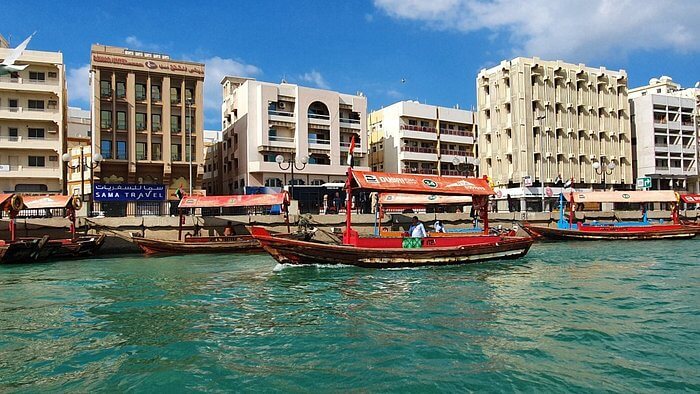
The abra – a small, flat-bottomed wooden motorboat – is the most authentic and least expensive experience Dubai offers. The standard commuter crossing between Deira and Bur Dubai costs AED 1 per person, paid in cash directly to the driver once the boat has pushed off, with no ticket, booking, or Nol card required, and the crossing itself takes about five minutes.
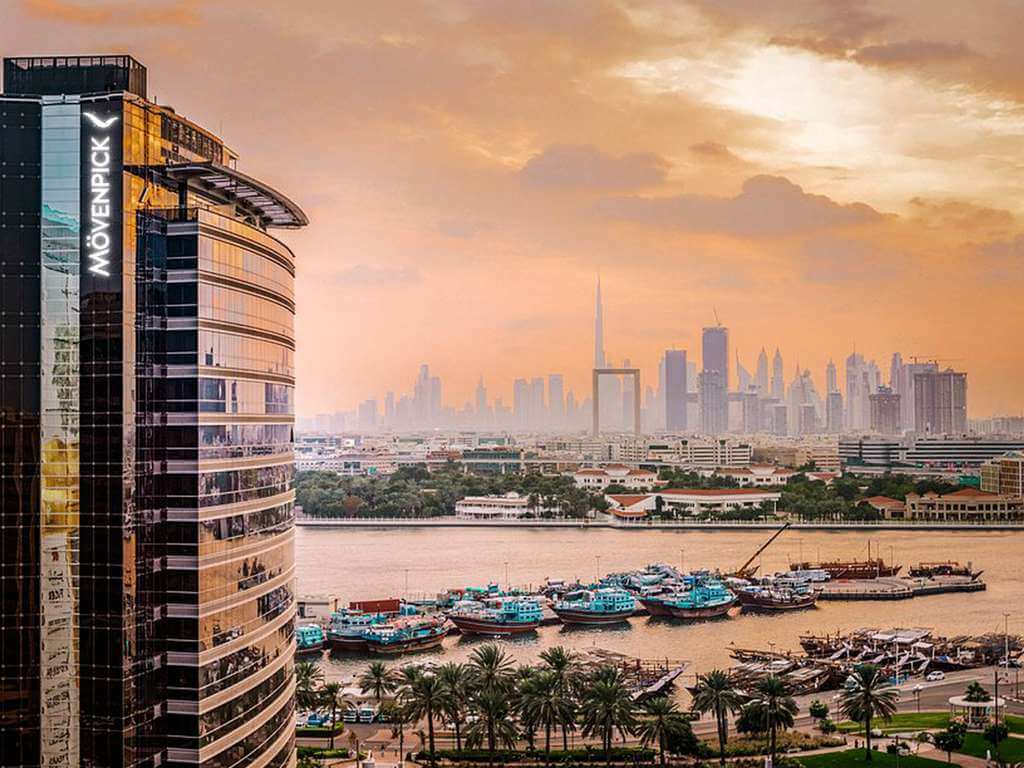
Along the way you’ll pass modern glass towers like the Deira Twin Towers reflected in the water, as well as attractions such as Creek Park, the Dubai Dolphinarium, Al Seef, and the Museum of Illusion.
Main Abra Routes
The most popular and frequent routes run between Al Ghubaiba (Bur Dubai) and Deira Old Souk, and between Al Seef (Bur Dubai) and Dubai Old Souk (Deira), making them ideal for reaching the Gold Souk, Spice Souk, and the textile markets.Additional abra services extend further along the Creek to newer areas such as Al Jaddaf and Dubai Festival City, offering a different perspective and a practical way to reach these developments from the historic core.
For first-timers, Al Ghubaiba Abra Station is a reliable place to start, and it’s worth going earlier in the day, since the area gets considerably busier in the evenings and on weekends when locals gather nearby to eat, shop, and socialize.
Private Abra Charters
If you’d rather linger rather than commute, hiring an entire boat is straightforward and doesn’t require advance booking. A private charter runs roughly AED 120–150 per hour, negotiated directly with the driver at the station.A private tour lets you ask the driver to slow down for photos or steer toward landmarks such as the Dubai Chamber of Commerce building or the historic Al Maktoum Bridge, and it suits families or groups who want a relaxed pace rather than the rush of the commuter line.
Payment Notes
Traditional motorized abras generally do not accept credit cards, Nol transport cards, or mobile payments at the point of boarding, so carrying small cash denominations is essential. Some newer electric abras operating on Dubai Water Canal and Dubai Fountain Lake do support Nol cards, but the classic Creek crossing remains a cash-only, pay-as-you-board experience – part of its charm.
Quick abra reference table
| Detail | Information |
|---|---|
| Standard fare | AED 1 per person, one-way |
| Payment method | Cash only, paid on board |
| Crossing time | Approximately 5 minutes |
| Operating hours | Early morning until roughly midnight |
| Private charter | ~AED 120–150 per hour, negotiated on-site |
| Main stations | Al Ghubaiba, Al Sabkha, Dubai Old Souk, Al Seef |
Editorial note: Fares, hours, and station names should be verified against RTA’s official Dubai Taxi/Marine Transport channels before publishing, as abra pricing and route names are periodically adjusted.
What to See on the Deira Bank
Deira is the older, more commercial side of the Creek, and its identity is built around two adjoining marketplaces.
Gold Souk is a covered market of several hundred jewelry retailers, famous for window displays stacked with gold jewelry, including some of the largest gold rings ever certified. Prices are generally negotiable and tied to the daily gold rate, so it’s worth checking current gold prices before shopping seriously.
Spice Souk sits a short walk from the Gold Souk and fills narrow lanes with sacks of saffron, cardamom, frankincense, dried limes, and rose petals. It’s one of the few places in Dubai where the sensory experience – the smell alone – does most of the selling.
Beyond the souks, the Deira waterfront offers views back across the Creek toward Bur Dubai’s wind-tower skyline, and it connects easily via abra or a short walk to Al Sabkha and Baniyas Road, both useful orientation points for first-time visitors.
What to See on the Bur Dubai Bank
Bur Dubai is where Dubai’s heritage preservation efforts are most visible, concentrated in two adjoining zones.
Al Fahidi Historical Neighbourhood
This restored quarter of coral-stone buildings and wind-tower (barjeel) architecture is Dubai’s best-preserved historic district. Narrow shaded lanes connect small museums, art galleries, and courtyard cafés. The Dubai Museum, housed inside the Al Fahidi Fort – the city’s oldest surviving building, dating to 1787 – has been closed since 2021 for a major restoration, and while authorities indicated in early 2026 that it would reopen soon, no confirmed date has been announced. Until it reopens, visitors can still view the fort’s coral-stone exterior and cannons from outside.
Al Seef
Al Seef is a waterfront district on the Bur Dubai bank that blends heritage architecture with contemporary cafés, boutique shops, and art galleries, capturing Dubai’s transformation from a small fishing village into a global city. It’s designed in two distinct halves – one styled after old Dubai with sandy paths and traditional facades, the other a modern promenade with restaurants and retail – making it a natural stop either before or after an abra ride.
Textile Souk (Old Souk)
On the Bur Dubai bank beside the abra station, the Textile Souk runs under a restored wooden arcade selling fabrics, pashminas, scarves, and souvenirs, and is generally smaller and more relaxed than Deira’s souks. Bargaining is expected here, as it is throughout the Creek’s markets.
Dubai Creek Harbour: The Modern Extension of the Creek
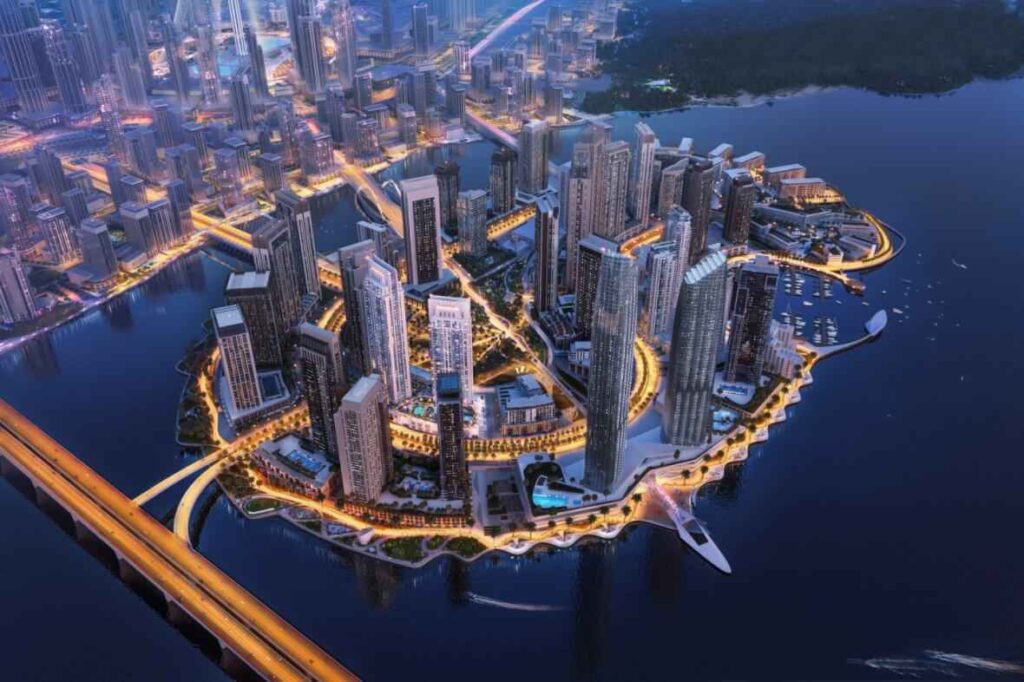
Where the historic Creek ends, its modern successor begins. Dubai Creek Harbour is a large-scale waterfront district developed jointly by Emaar Properties and Dubai Holding, sited upstream from the traditional creek mouth and directly across the water from the Ras Al Khor Wildlife Sanctuary. At roughly 6 square kilometers, the district is about twice the size of Downtown Dubai and is already home to thousands of residents.
Dubai Creek Tower: 2026 Status
The centerpiece of the district is the still-unfinished Dubai Creek Tower, designed by the late Spanish-Swiss architect Santiago Calatrava. The tower draws its form from the minarets of mosques and the lily flower, blending cultural heritage with modern design.Construction broke ground in 2016 and the foundation – built on 145 barrette piles – was completed by 2018, but work was formally suspended in April 2020 due to the pandemic.
The tower has since undergone a design revision that moves away from the original goal of surpassing Burj Khalifa in height, instead emphasizing architectural beauty and sustainable design as a modern minaret and symbolic centerpiece for the district. It is intended to anchor the future Dubai Square project, a mega-mall integrating electric-vehicle infrastructure planned for completion within roughly three years of restart.
In January 2026, Emaar founder Mohamed Alabbar confirmed at the Dubai International Project Management Forum that a construction tender for the redesigned tower would be issued within three months, and since the foundation is already in place, vertical construction can begin as soon as a contractor is appointed.Estimated completion currently sits at some point after 2030, with the exact final height still undisclosed by the developer.
Editorial note: Because this is an active construction project, exact tender outcomes, contractor announcements, and completion timelines should be verified against Emaar’s official investor updates before publishing.
What’s Already Built at Creek Harbour
The delivered core of the district includes Creek Island – home to Dubai Creek Residences, Creek Horizon, Creek Edge, Address Harbour Point, and Palace Residences – along with most of the Creek Beach lagoon cluster, while infill towers, later phases of The Cove, and a newer Green Gate district are still being handed over through 2029.Thousands more homes – an estimated 7,217 units – are expected to complete across the district by 2029 alone.
For visitors rather than investors, Creek Harbour today offers a landscaped waterfront promenade, views across to the wildlife sanctuary, and a preview of what the finished Creek Tower district is meant to become – a useful contrast to the historic Deira and Bur Dubai banks a short drive downstream.
Dhow Cruises and Creek Dining
A traditional dhow dinner cruise remains one of the most popular ways to experience the Creek after dark, gliding past the Gold Souk, Deira waterfront, and Al Seef with the skyline lit up on both banks. Cruises typically run one to two hours and combine a buffet dinner with live entertainment; prices and inclusions vary significantly by operator, so it’s worth comparing a handful of licensed operators rather than the first one offered by a street tout.
For a lower-cost, self-guided alternative, several waterfront restaurants along Al Seef and the Deira corniche offer Creek views without the cruise price tag, and pairing dinner with a sunset abra ride achieves a similar effect for a fraction of the cost.
Best Time to Visit Dubai Creek
The Creek is enjoyable year-round, but conditions shift considerably by season:
- November to March – Pleasant daytime temperatures make walking between the souks and Al Fahidi comfortable at any hour.
- April to May and September to October – Warm but manageable, especially with an early morning or evening visit.
- June to August – Daytime heat and humidity are intense; plan abra rides and souk walks for early morning or after sunset.
Sunset is widely considered the best time for an abra ride, when the skyline views across the water are at their most dramatic. Weekday mornings are the quietest time to explore the souks and Al Fahidi without heavy foot traffic.
Common Mistakes First-Time Visitors Make
- Overpaying for a “tour.” Some touts near the abra stations approach tourists offering inflated private tour rates. The standard commuter crossing costs AED 1; private charters should be negotiated directly with a licensed abra operator at the station, not through a street intermediary.
- Skipping the Deira side entirely. Many visitors treat Bur Dubai’s Al Fahidi and Al Seef as the whole experience and skip the Gold and Spice Souks across the water, missing half of what makes the Creek worthwhile.
- Expecting the Dubai Museum to be open. As of early 2026 it remains closed for restoration; check current status before building an itinerary around it.
- Visiting only during peak midday heat. Between June and August, midday visits can be genuinely uncomfortable; shift the itinerary to morning or evening.
- Confusing Dubai Creek with Dubai Water Canal. The Water Canal is a separate, newer artificial waterway near Jumeirah and Business Bay; the historic Creek is the older Deira–Bur Dubai inlet covered in this guide.
Dubai Creek vs. Dubai Water Canal: Quick Comparison
| Feature | Dubai Creek | Dubai Water Canal |
|---|---|---|
| Origin | Natural tidal inlet | Man-made extension completed 2016 |
| Location | Deira / Bur Dubai | Business Bay to Jumeirah |
| Historic role | Original trading harbor | Modern connector and lifestyle destination |
| Main transport | Traditional wooden abras | Electric abras and water taxis |
| Character | Heritage souks, old Dubai | Contemporary promenade, dining, skyline views |
FAQs
1. What is Dubai Creek called in Arabic?
Dubai Creek is known locally as Khor Dubai, “khor” being the Arabic word for a natural inlet or creek.
2. How much does an abra ride across Dubai Creek cost?
The standard commuter crossing costs AED 1 per person, paid in cash directly to the driver once the boat departs.
3. Can I pay for an abra with a Nol card or credit card?
Traditional Creek abras are generally cash-only. Some newer electric abras on separate routes, such as Dubai Fountain Lake and Al Seef’s modern stretch, accept Nol cards.
4. How long does the abra crossing take?
Around five minutes for the standard Deira–Bur Dubai crossing.
5. Is the Dubai Museum at Al Fahidi Fort open in 2026?
Not as of early 2026. It has been closed since 2021 for restoration, with no confirmed reopening date announced; check current status before visiting.
6. What’s the difference between Al Seef and Al Fahidi?
Al Fahidi is the historic wind-tower quarter with museums and galleries in restored coral-stone buildings. Al Seef is the adjacent waterfront promenade blending old-Dubai styling with modern cafés, shops, and dining.
7. Where does Dubai Creek Harbour fit relative to the historic Creek?
Creek Harbour sits upstream from the traditional creek mouth, near Ras Al Khor, and is a separate modern master-planned district rather than part of the historic Deira/Bur Dubai souk area.
8. Is the Dubai Creek Tower finished?
No. Its foundation was completed in 2018, but construction was paused in 2020. As of early 2026 a construction tender was expected to be issued, with completion estimated well beyond 2030.
9. What can I see near Dubai Creek Harbour besides the tower site?
The Ras Al Khor Wildlife Sanctuary sits directly across the water and is a notable spot for flamingo and migratory bird viewing, alongside the district’s completed residential and waterfront areas.
10. Can I hire an abra for a private tour?
Yes. Private charters typically run around AED 120–150 per hour and can be arranged directly with a driver at any main abra station.
11. What souks are on each side of the Creek?
The Gold Souk and Spice Souk are on the Deira side. The Textile Souk (Old Souk) is on the Bur Dubai side, near the Al Fahidi and Al Seef area.
12. Is Dubai Creek worth visiting if I’ve already seen Downtown Dubai and the Marina?
Yes – the Creek offers the historical counterpoint to Dubai’s modern skyline, and the contrast between the two is part of what makes the city’s story understandable in a single afternoon.
Conclusion
Dubai Creek is not a single attraction – it’s the connective thread running through the entire history of the city, from the pearling economy that built Deira and Bur Dubai to the still-unfinished tower rising at Creek Harbour. A single AED 1 abra ride does more to explain how Dubai became what it is than almost any other experience in the city, and pairing that crossing with the souks, Al Fahidi’s heritage lanes, and a look at the modern Creek Harbour skyline gives visitors a genuinely complete picture of old and new Dubai in one trip.

Sara is a UAE-based banking and accounting expert with over 4 years of professional experience in the financial sector. Her expertise spans retail banking, financial reporting, compliance, and practical money management topics relevant to individuals and businesses in the UAE.
She contributes clear, accurate, and well-researched financial content, simplifying complex banking and accounting concepts for everyday readers. Sara’s writing reflects strong industry knowledge, regulatory awareness, and a commitment to financial accuracy and transparency.