Dubai Festival City Area Guide: Living, Shopping, Schools and Metro Access (2026)
Dubai Festival City is a 5.2-million-square-metre mixed-use community on the Dubai Creek waterfront in Al Garhoud, developed by Al-Futtaim. It combines the 400-outlet Dubai Festival City Mall, the free IMAGINE show, IHG hotels, schools, a marina and family-focused housing, roughly 10 minutes from Dubai International Airport.
Few Dubai neighbourhoods let you shop, dine, study and watch a record-breaking light show without leaving the district. Dubai Festival City does exactly that. Al-Futtaim planned it as a “city within a city” on the banks of Dubai Creek, and nearly two decades after the mall opened, it remains one of the emirate’s most established family communities.
This guide explains what Dubai Festival City is, how to reach it today, what its homes cost, and how the coming Dubai Metro Blue Line could change daily life here. It also covers schools, hotels, entertainment, honest drawbacks and practical tips for residents, investors and visitors.
What Is Dubai Festival City?
Dubai Festival City (often shortened to DFC) is a master-planned development that covers about 5.2 million square metres along Dubai Creek. Al-Futtaim Real Estate developed it, and the group still owns and manages large parts of it. According to Wikipedia’s summary of the project, the district includes residential neighbourhoods, offices, a marina, a golf course, a 3.3-kilometre waterfront promenade and a hotel cluster with more than 1,600 rooms.
One point of confusion is worth clearing up early. “Dubai Festival City” is the whole community, while “Dubai Festival City Mall” is the shopping and entertainment centre inside it. Searchers use both terms, and many competitor pages blur the two. This guide separates them so that you can find what you need quickly.
Dubai Festival City at a Glance
| Feature | Detail |
|---|---|
| Developer | Al-Futtaim Real Estate |
| Size | About 5.2 million sq m |
| Location | Along Dubai Creek, Al Garhoud, close to Dubai International Airport (DXB) |
| Retail anchor | Dubai Festival City Mall (400+ outlets, including IKEA) |
| Signature attraction | IMAGINE, a free nightly water, laser and projection show |
| Hotels | InterContinental, Crowne Plaza, InterContinental Residence Suites and Holiday Inn |
| Schools | Deira International School and Universal American School |
| Current metro access | No station in the district; Blue Line station planned for 2029 |
How the District Developed
The retail story began in November 2005, when the Middle East’s largest IKEA opened on the site. Dubai Festival City Mall officially launched on 22 January 2007. In 2014, Al-Futtaim announced a redevelopment worth between AED 1.2 billion and AED 1.5 billion. The work finished in phases between 2015 and 2017 and added Festival Square, waterfront restaurants and an entertainment complex. The IMAGINE show debuted in December 2016.
Residential growth followed a similar pattern. Al Badia Residences formed the early core. Newer leasing communities, including Al Badia Living (announced in September 2024) and Al Badia Villas (announced in January 2026), have since extended the offer. Together they show that Al-Futtaim is still investing in the district rather than treating it as a finished project.
Location and Getting Around Dubai Festival City
Location is the first thing most people ask about, and it is where Dubai Festival City needs the most honest explanation. The district sits on the Deira side of Dubai Creek. The airport is close, and the road links are strong. Rail access, however, is still a work in progress.
Reaching Dubai Festival City by Car
Drivers usually take the Al Rebat Street exit from Sheikh Zayed Road towards Al Garhoud. Al Rebat Street (D83) is the main approach, and the airport is roughly a 10-minute drive away in normal traffic. Several other Dubai destinations are within a short drive, including Downtown Dubai, Mirdif and Jumeirah, although peak-hour traffic around Al Garhoud can lengthen those trips.
Public Transport Today
The most important fact for residents and visitors is this: there is currently no Dubai Metro station inside Dubai Festival City. Some property portals suggest otherwise, and at least one popular area guide describes a dedicated “Dubai Festival City Station.” That station is planned, not built. It belongs to the Blue Line, which is not due to open until 2029.
Until then, the practical options are:
- Metro plus a short ride. The closest existing stop is Creek Station on the Green Line in Al Jaddaf. From there, a taxi or bus completes the journey.
- Buses. Third-party guides list several RTA routes serving the mall area, including 24, 44, 53, 64A, F58 and 103. Route numbers change, so confirm them in the RTA app before travelling.
- Marine transport. RTA lists a marine service (route BM2) that links Al Jaddaf Marine (Creek) with Dubai Festival City Marine. The ride is scenic and less crowded than the road.
The Dubai Metro Blue Line: What It Means for Dubai Festival City
The Blue Line is the biggest infrastructure story for the district. RTA is building a 30-kilometre line with 14 stations and has scheduled its opening for 9 September 2029, the 20th anniversary of the Dubai Metro. The contract, worth AED 20.5 billion, went to a consortium of MAPA, Limak and CRRC.
The line splits into two routes. The 21-kilometre first route starts at Creek Station on the Green Line, then serves Dubai Festival City, Dubai Creek Harbour and Ras Al Khor before continuing to International City, Dubai Silicon Oasis and Dubai Academic City. The second route links the Red Line at Centrepoint (Al Rashidiya) with Mirdif, Al Warqa and International City. Between Al Jaddaf and Creek Harbour, trains will use a 1.3-kilometre bridge, the first metro crossing over Dubai Creek.
RTA has said that properties near the line could gain up to 25 per cent in value. Treat that as an official forecast rather than a guarantee. Still, the impact on nearby areas has already appeared in the data: Bayut and Dubizzle reported that Dubai Silicon Oasis recorded the strongest apartment price-per-square-foot jump in 2025, and Gulf News linked that gain to Blue Line news.
For Dubai Festival City, the upside is practical. Rail access will reduce dependence on cars and taxis, connect the district with the Green Line for Deira and Bur Dubai, and open direct routes towards the eastern growth corridor. It also gives commuters a cleaner way to reach the wider network without driving to Sheikh Zayed Road.
Dubai Festival City Mall and Festival Bay
The mall is the district’s public face, and it explains why so many visitors arrive for one errand and stay for the evening.
Shopping and Dining
Dubai Festival City Mall houses more than 400 outlets. IKEA remains the flagship anchor, alongside fashion names such as Zara, H&M, Marks & Spencer, Nike and Adidas. Newer additions keep the mix fresh. For example, EL&N London opened in June 2024, and Korea 360, a permanent Korean-culture retail hub, launched on 11 April 2025.
Dining is a genuine strength. Festival Bay, the waterfront promenade, offers around 50 restaurants and cafés, and the mall also operates one of Dubai’s largest food courts, Market Island. Many terraces face the water, so you can eat with a view of the evening show.
The IMAGINE Show
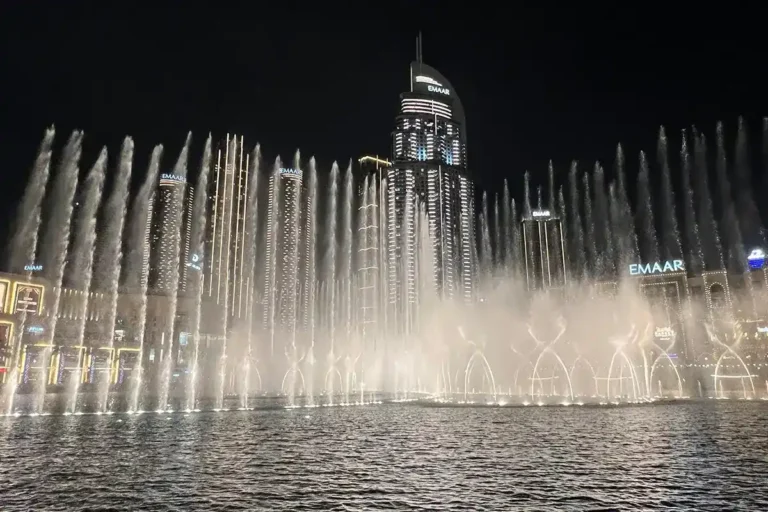
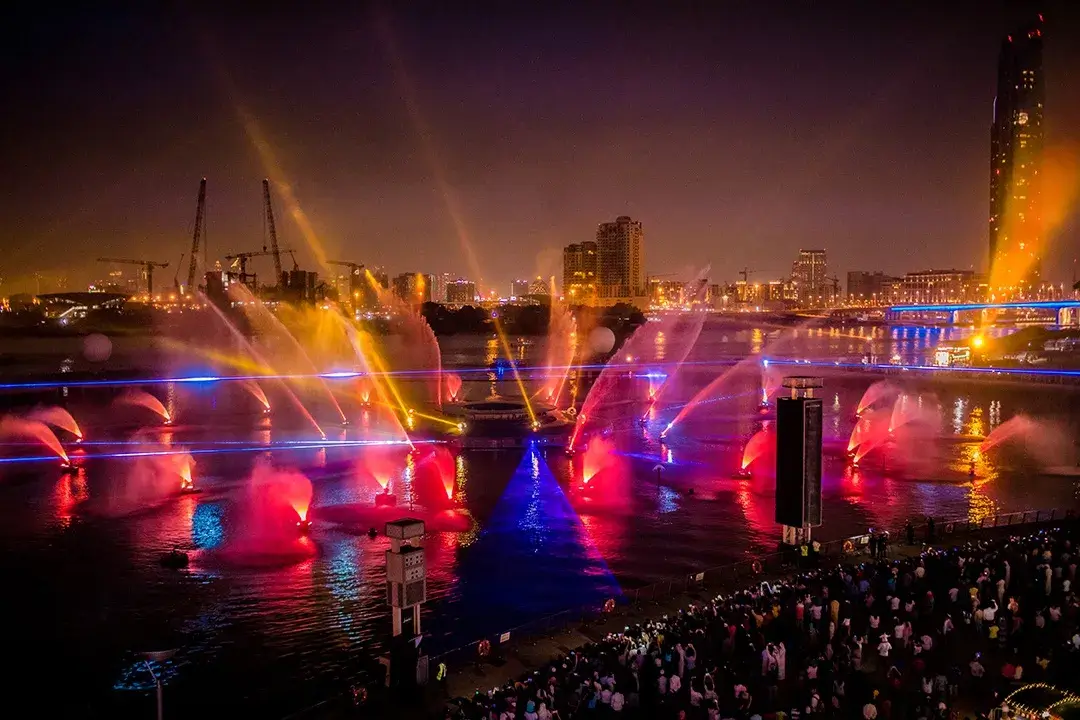
IMAGINE is the reason many tourists visit. It combines about 30 fountains, a giant water screen, lasers, fire effects, projection mapping on the InterContinental façade and choreographed music. The show holds two Guinness World Records: one for the largest water-screen projection and one for the largest permanent projection-mapping surface. The official site cites more than 2.5 million lumens of light.
Entry is free. The mall’s own guide lists shows from 7 pm to 10 pm on Monday to Thursday and from 7 pm to 11 pm on Friday to Sunday. Story sequences such as The Pirate’s Tale, Hathi’s Garden, Stardancer and A Child’s Dream rotate through the programme. Because timings can change with the season and special events, check the mall’s official channels before you go.
Family Entertainment
Beyond shopping, the mall offers a large VOX Cinemas multiplex, the BounceX trampoline park, and Fabyland, a 70,000-square-foot family entertainment centre. Families with young children can plan a full day without moving the car.
Practical Visiting Tips
Free covered parking is available, although sources quote different capacities (between 8,000 and more than 10,000 spaces), so treat the exact figure with caution. Valet options exist at select entrances. On weekends and public holidays, arrive early to secure a good viewing spot for IMAGINE. If you dislike the crowds of Dubai Mall, you may find this waterfront setting calmer, though it is busiest on Friday and Saturday evenings.
Living in Dubai Festival City
For residents, the appeal is straightforward. Homes here tend to be larger and lower-rise than in newer high-rise districts, and the streets are greener. Bayut describes the area as one of Dubai’s most prestigious, family-oriented communities, and the mix of apartments, townhouses and villas supports that reputation.
Residential Communities Compared
| Community | Property types | Key notes |
|---|---|---|
| Al Badia Residences | 1- to 4-bedroom apartments; townhouses and villas | Mediterranean-style, low-rise buildings across roughly 22 buildings; generous layouts |
| Al Badia Hillside Village | Apartments and townhouses | Established part of the Al Badia district |
| Al Badia Living | 1- to 4-bedroom apartments | 340+ units launched for leasing in September 2024 with resort-style facilities |
| Al Badia Terraces | 1- to 3-bedroom apartments | Mid-rise towers with roof gardens; 1-bedrooms start at about 749 sq ft |
| Al Badia Villas | 3- to 5-bedroom smart villas | 107 homes on about three hectares of parkland; leasing began 5 January 2026 |
Residents also use Al Areesh Club, which offers a gym, tennis and squash courts, a sauna and steam rooms. The club hosts community events; in June 2026, for example, a Father’s Day e-gaming afternoon drew more than 200 residents.
Rents and Sale Prices
Prices shift quickly, so use the figures below as a starting point and verify them against current listings and the Dubai Land Department (DLD) records.
According to Property Finder (June 2026), one-bedroom apartments in Al Badia Residences average around AED 100,000 a year, while two-bedroom units range from about AED 149,000 to AED 162,000. In Al Badia Living, rents start at about AED 152,000 a year and average roughly AED 179,000, according to Property Finder’s listings for that community.
On the sales side, Property Finder’s trailing 12-month data for Al Badia Residences shows an average price of about AED 1,160 per square foot and an average price of roughly AED 2.6 million. The data also shows year-on-year declines of about 3.9 per cent in price per square foot and about 15.5 per cent in average price. This is a small sample of listings, so it does not describe the whole district, but it does signal that buyers here currently have more room to negotiate than in fast-rising areas.
For context, TruHauz’s June 2026 market snapshot puts Dubai Creek Harbour at roughly AED 2,050 per square foot, and a separate April 2026 dataset from Real Estate Club Dubai gives a citywide apartment average of about AED 1,600. These sources use different methods, so compare them cautiously. Even so, they suggest that Dubai Festival City apartments are priced well below the newer waterfront towers next door, while offering considerably more floor space. Two-bedroom apartments in Al Badia commonly measure between 1,900 and 2,300 square feet.
What Returns Can Investors Expect?
Dubai’s average gross rental yield sits near 6.3 per cent to 7 per cent, depending on the source and month. As a rough illustration only, a two-bedroom apartment listed at AED 2.4 million to AED 2.5 million and renting for AED 149,000 to AED 162,000 implies a gross yield of about 6 per cent to 6.75 per cent. That is a back-of-the-envelope calculation from separate data points, not a published market yield.
Remember to subtract service charges, which typically run from AED 10 to AED 32 per square foot per year for apartments across Dubai, and to check the RERA rental index before setting or accepting a rent.
Advantages and Disadvantages
Advantages: larger homes, mature landscaping, walkable waterfront areas, strong school access, proximity to the airport, and a genuine community atmosphere. The forthcoming Blue Line adds a long-term rail advantage.
Disadvantages: no metro today, traffic around Al Garhoud at peak hours, and some older buildings that lack the finishes of new towers. In addition, the district feels quieter after the mall closes than dense districts such as Dubai Marina.
Schools, Healthcare and Community Life
Education is a genuine draw. Two schools were built as part of the original master plan, and both are run by the Al Futtaim Education Foundation as not-for-profit institutions.
Deira International School follows a British and IB curriculum on an 80,000-square-metre campus. It has held the KHDA’s highest “Outstanding” rating since the 2022–23 inspection round. Published annual fees are around AED 44,616 to AED 89,889, according to DXB Schools.
Universal American School opened in 2005 and offers a US and IB curriculum. WhichSchoolAdvisor reports a KHDA rating of “Very Good,” with fees of roughly AED 44,000 to AED 73,000 per year, according to dubaischoolguide.com.
Fees and ratings change every year, so confirm them on the KHDA directory before you commit. For healthcare, residents typically combine clinics inside the community with hospitals in nearby Garhoud and Deira; check the Dubai Health Authority (DHA) facility directory for current options and insurance networks.
Where to Stay: Hotels in Dubai Festival City
Visitors can choose from the IHG cluster on the creek, which includes the InterContinental Dubai Festival City, Crowne Plaza Dubai Festival City, the InterContinental Residence Suites and a Holiday Inn. Together they offer more than 1,600 rooms. The location suits travellers who want quick airport access, a mall on the doorstep and free evening entertainment, but it is less convenient for sightseeing in Downtown Dubai or Dubai Marina without a car or taxi.
Dubai Festival City Compared with Nearby Areas
| Area | Character | Metro access |
|---|---|---|
| Dubai Festival City | Low-rise, family-focused, mall and waterfront | None today; Blue Line station planned for 2029 |
| Dubai Creek Harbour | Newer, high-rise waterfront district | Blue Line station planned for 2029 |
| Al Jaddaf | Central, well connected to the Green Line | Creek Station (existing) |
The comparison shows the trade-off clearly. Al Jaddaf offers rail today, Creek Harbour offers newer towers and a bigger price tag, and Dubai Festival City offers space, schools and an established community.
Common Mistakes to Avoid
The first mistake is assuming a metro station exists. Check RTA before you sign a lease. The second is confusing the mall with the community when comparing prices or reading listings. The third is relying on a single portal’s price data, since listing samples in one community can be thin. Finally, tenants and buyers should always check the Ejari registration, service charges and building age rather than judging homes by the district’s reputation alone.
Future Outlook
Three trends will shape the district over the next few years. First, the Blue Line will bring rail access by 2029, and RTA expects about 200,000 daily riders across the line by 2030, according to a Driven Properties summary. Second, Al-Futtaim keeps adding leasing stock, as the 2026 Al Badia Villas launch shows. Third, Dubai’s 2040 Urban Master Plan favours the “20-minute city” model, in which daily needs are reachable within a short trip. Dubai Festival City already fits that idea better than many newer districts.
Actionable Recommendations
For families: shortlist homes by school-run distance first, then compare Al Badia Residences apartments, Al Badia Villas and townhouses by space and garden access.
For investors: model net yield after service charges, compare listing data with DLD transaction records, and treat Blue Line uplift as a possible bonus rather than the base case.
For visitors: plan the evening around the IMAGINE show, book a waterfront table early, and use a taxi or ride-hailing service from the nearest metro station.
For first-time renters: check Ejari registration, request the current rental index reference, and inspect building condition, especially in older blocks.
FAQs
1. What is Dubai Festival City known for?
It is known for Dubai Festival City Mall, the IKEA flagship, the free IMAGINE show, the creekside promenade, Al Badia residential communities and two well-regarded schools.
2. Where is Dubai Festival City located?
It sits along Dubai Creek in Al Garhoud, on the Deira side of the creek, roughly a 10-minute drive from Dubai International Airport.
3. Is there a metro station at Dubai Festival City?
Not yet. The nearest existing station is Creek on the Green Line in Al Jaddaf. A Dubai Festival City station is planned on the Blue Line, which is scheduled to open on 9 September 2029.
4. How do I get to Dubai Festival City without a car?
Take the Green Line to Creek Station and continue by taxi or bus, use one of the RTA bus routes serving the area, or try the marine service between Al Jaddaf Marine and Dubai Festival City Marine.
5. Is the IMAGINE show free?
Yes. The show is free to watch at Festival Bay. The mall lists performances from 7 pm each evening, with later finishes on Friday to Sunday. Check the official schedule before visiting.
6. Is parking free at Dubai Festival City Mall?
Yes, covered parking is free. Valet service is available at selected entrances for a fee. Reported capacity figures vary by source.
7. Is Dubai Festival City a good area for families?
Yes. Its low-rise housing, larger apartments and villas, schools within the community and family attractions make it one of Dubai’s more family-friendly areas.
8. How much does it cost to rent in Dubai Festival City?
Recent Property Finder data shows one-bedroom apartments in Al Badia Residences averaging about AED 100,000 a year and two-bedroom units around AED 149,000 to AED 162,000. Al Badia Living starts near AED 152,000. Prices vary by building and season.
9. Are there villas in Dubai Festival City?
Yes. Al Badia Residences includes townhouses and villas, and Al-Futtaim launched 107 smart three- to five-bedroom Al Badia Villas for leasing in January 2026.
10. Which schools are in Dubai Festival City?
Deira International School (British and IB curriculum, rated Outstanding by KHDA) and Universal American School (US and IB curriculum, rated Very Good) are both located in the district.
11. Is Dubai Festival City a good place to invest?
It can suit long-term investors who value larger units and stable family demand. Compare net yields after service charges, review DLD data, and consider the Blue Line as a potential upside rather than a certainty.
12. How far is Dubai Festival City from Downtown Dubai?
Road distances of roughly 14 to 15 kilometres are typical, with drive time depending on traffic. The journey usually takes 15 minutes or more in normal conditions and longer at peak times.
Conclusion
Dubai Festival City succeeds because it offers a complete lifestyle in one place. Residents get spacious low-rise homes, established schools and a mall with genuine entertainment. Visitors get a free waterfront spectacle, wide dining choices and quick airport access. The main weakness, the lack of a metro station, is temporary, since the Blue Line is scheduled to arrive in 2029.
If you value space, community and convenience over a skyline address, Dubai Festival City deserves a serious look. Verify current rents, school fees and transport details before you commit, and you will be well placed to enjoy what this creekside district does best.

Sara is a UAE-based banking and accounting expert with over 4 years of professional experience in the financial sector. Her expertise spans retail banking, financial reporting, compliance, and practical money management topics relevant to individuals and businesses in the UAE.
She contributes clear, accurate, and well-researched financial content, simplifying complex banking and accounting concepts for everyday readers. Sara’s writing reflects strong industry knowledge, regulatory awareness, and a commitment to financial accuracy and transparency.