World Trade Centre Dubai Area Guide 2026: Everything You Need to Know
Dubai World Trade Centre (DWTC) is a mixed-use business district on Sheikh Zayed Road, anchored by the 149-metre Sheikh Rashid Tower, built in 1979. Positioned between Downtown Dubai and DIFC, the area combines exhibition halls, offices, hotels, and residences, and has hosted major events such as GITEX for decades. It is served directly by the World Trade Centre Metro Station on the Red Line.
Few addresses in the Middle East carry the commercial weight of the World Trade Centre in Dubai. Wedged between Downtown Dubai and the Dubai International Financial Centre (DIFC) along Sheikh Zayed Road, this district has spent nearly five decades shaping how the region does business, hosts events, and welcomes global investment.
This 2026 area guide walks through what Dubai World Trade Centre actually is, why it matters, how to get there, what happens inside its halls today, and what living or working nearby looks like. Whether you’re researching the neighbourhood for a property decision, planning to attend an exhibition, or simply curious about one of Dubai’s founding landmarks, this guide is built to answer every reasonable follow-up question in one place.
What Is Dubai World Trade Centre?
Dubai World Trade Centre refers to two overlapping things, and understanding the difference matters for anyone researching the area.
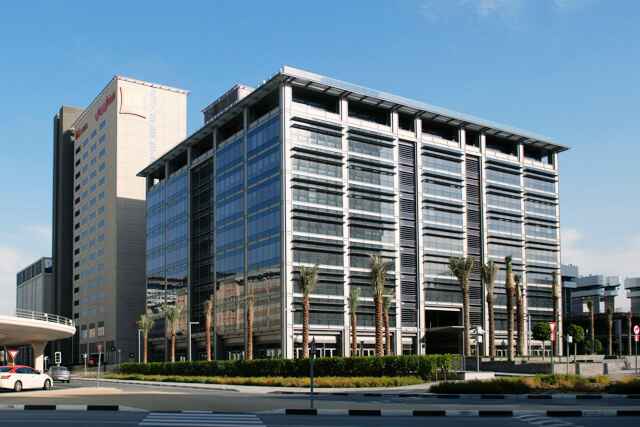
First, it is a physical building: Sheikh Rashid Tower, a 39-storey, 149-metre skyscraper that opened in 1979 as the tallest building in the Middle East at the time. Commissioned by the late Sheikh Rashid bin Saeed Al Maktoum, it was Dubai’s first real skyscraper and a deliberate statement of the emirate’s ambitions before oil revenue had fully matured the city’s skyline.
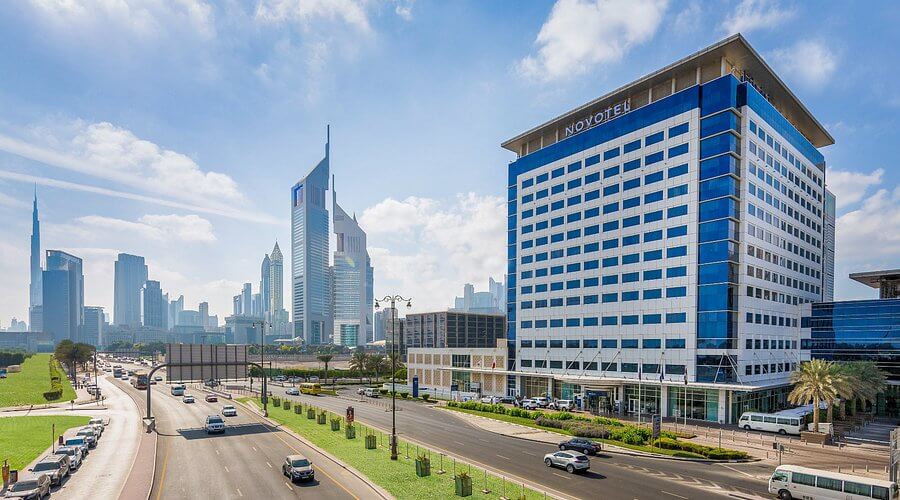
Second, and more relevant today, it is a business district and events organisation. Over the decades, the original tower has grown into a 1.3 million square foot complex that includes the Dubai International Convention and Exhibition Centre (DICEC), the Convention Tower, multiple exhibition halls, hotels (Novotel and Ibis are located directly on the exhibition grounds), and surrounding office and residential towers.
DWTC, the organisation, also operates as the entity behind Dubai’s exhibition and convention calendar, managing halls that have hosted some of the region’s largest trade shows for more than 40 years.
World Trade Centre Location and Connectivity
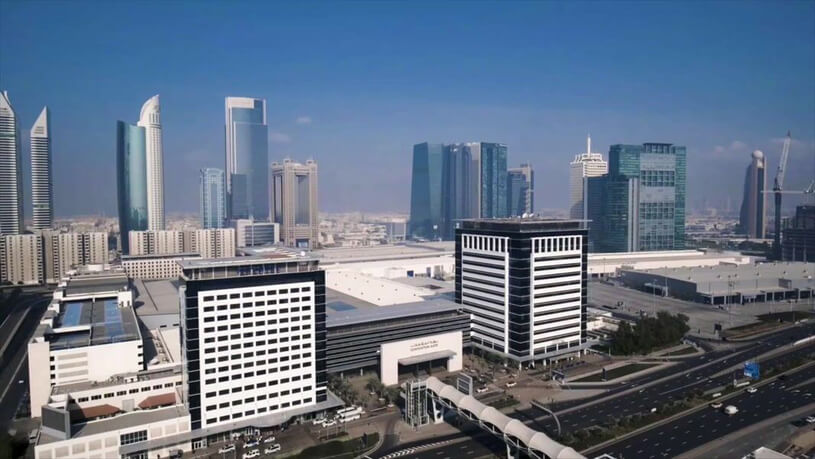
World Trade Centre sits directly on Sheikh Zayed Road, Dubai’s primary commercial artery, in the area officially known as Trade Centre 2. It sits between the bustling districts of Downtown Dubai and DIFC, with Dubai International Airport just a short drive away.
This positioning is one of the area’s biggest practical advantages. The area’s central location makes it a prime choice for professionals who need quick access to business centres, as well as for residents who value being close to the city’s top attractions and amenities. Nearby landmarks include the Museum of the Future, Emirates Towers, Downtown Dubai, and Zabeel Park.
Getting there:
| Mode | Details |
|---|---|
| Metro | World Trade Centre Station, Red Line, opened 15 May 2010 |
| Nearby stations | Emirates Towers (one stop toward Downtown) and Max |
| Road | Direct access from Sheikh Zayed Road; parking available on-site during events |
| Bus | Feeder routes F11 and F28 connect to Al Satwa and Financial Centre |
| Airport | Roughly 15–20 minutes by car from Dubai International Airport (DXB), traffic-dependent |
Editorial note: Travel times, parking capacity, and specific bus routes should be verified against the RTA Dubai website before publishing, as service details can change.
A Brief History of Dubai World Trade Centre
Understanding the area’s history explains why it still functions the way it does today.
- 1979: Sheikh Rashid Tower opens as a 39-floor, 149-metre tower – the tallest building in the Middle East and one of the first modern skyscrapers in the Gulf.
- 1980s–1990s: The complex expands with dedicated exhibition halls as Dubai begins actively courting international trade fairs and conventions.
- 2000s: Additional halls, the Sheikh Saeed Halls, and Za’abeel Halls are added to keep pace with growing demand from global exhibitors.
- 2010: The World Trade Centre Metro Station opens on the Red Line, dramatically improving public transport access to the district.
- 2020s: DWTC hosts pandemic-era health protocols for major events and continues expanding hall capacity, including the Al Multaqa Ballroom.
- 2026: A structural shift takes place in Dubai’s events calendar – GITEX Global, DWTC’s flagship technology exhibition since the 1980s, relocates to the Dubai Exhibition Centre at Expo City Dubai for the first time, running 7–11 December 2026 instead of its traditional October slot. This is a significant change for anyone researching DWTC’s event calendar, since GITEX had been synonymous with the World Trade Centre for over four decades.
This last point is worth emphasising for anyone using outdated information: as of 2026, GITEX Global no longer takes place at the World Trade Centre. DWTC continues to host a substantial roster of other exhibitions, conferences, and government events, but this particular flagship show has moved venues. Always confirm the current host venue for any specific event before travelling.
What Happens Inside Dubai World Trade Centre Today
DWTC remains one of the busiest events venues in the Middle East, even without GITEX. The complex’s halls and conference spaces are used for:
- International trade fairs and B2B exhibitions across sectors like jewellery, construction, healthcare, and food
- Government and diplomatic summits and conferences
- Concerts and large-scale entertainment events
- Corporate conferences and product launches
Its expansive exhibition halls, equipped with flexible configurations, provide a platform for showcasing products and fostering networking opportunities. Multipurpose halls can hold between roughly 5,000 and 12,000 visitors at a time, and the Al Multaqa Ballroom offers a theatre-style capacity of 760 delegates, alongside two large conference halls sized for both major gatherings and smaller trade fairs.
Editorial note: Exact hall capacities and event calendars change frequently. Verify current figures and the up-to-date events schedule on the official DWTC website (dwtc.com) before publishing.
Living and Working in World Trade Centre
Beyond exhibitions, World Trade Centre is also a functioning residential and commercial neighbourhood.
Residential profile: The area offers apartments and duplexes, generally ranging from one to four bedrooms, positioned toward the higher end of Dubai’s rental and sales market given the central location.
Commercial profile: The district houses corporate offices, government-linked entities, and business support services, benefiting from proximity to DIFC’s financial institutions and Downtown Dubai’s commercial towers.
Who it suits: Professionals who prioritise a short commute to Sheikh Zayed Road’s business corridor, frequent travellers who value quick airport access, and residents who want central-Dubai convenience without committing to Downtown’s premium pricing.
Editorial note: Rental and sale price figures fluctuate with Dubai’s property cycle. Any specific AED figures should be sourced from a live portal such as Bayut, Property Finder, or the Dubai Land Department before publishing.
World Trade Centre vs. Downtown Dubai vs. DIFC
Since these three districts sit almost back-to-back along Sheikh Zayed Road, it helps to compare them directly.
| Feature | World Trade Centre | Downtown Dubai | DIFC |
|---|---|---|---|
| Primary identity | Exhibitions and business hub | Tourism, retail, iconic landmarks | Financial and legal services hub |
| Anchor landmark | Sheikh Rashid Tower / DWTC halls | Burj Khalifa, Dubai Mall | Gate Building, DIFC courts |
| Best suited for | Business travellers, event attendees | Tourists, luxury residents | Finance professionals |
| Metro access | World Trade Centre Station | Burj Khalifa/Dubai Mall Station | Financial Centre Station |
The three districts function as one continuous business corridor, which is why itineraries and relocation decisions often consider them together rather than in isolation.
Common Mistakes to Avoid
- Assuming GITEX still happens at DWTC in 2026. As noted above, it has relocated to Expo City Dubai.
- Confusing World Trade Centre Metro Station with Emirates Towers Station. They are one stop apart; check which one is actually closest to your specific destination inside the complex.
- Underestimating event-day traffic. Sheikh Zayed Road around DWTC can see significant congestion during major exhibitions — the metro is usually the more reliable option.
- Booking hotels without checking the events calendar. Rates near DWTC rise sharply during major conventions.
Future Outlook
With GITEX now hosted at Expo City Dubai, DWTC’s own halls are expected to refocus on mid-sized exhibitions, government events, and sector-specific trade shows, while continuing incremental upgrades to conference infrastructure such as the Al Multaqa Ballroom. The broader Sheikh Zayed Road corridor – spanning World Trade Centre, DIFC, and Downtown Dubai — remains central to Dubai’s positioning as a global business and MICE (Meetings, Incentives, Conferences, and Exhibitions) hub.
Frequently Asked Questions
1. What is Dubai World Trade Centre known for?
It’s known for being Dubai’s original skyscraper (1979) and the region’s longest-running exhibition and convention hub, having hosted decades of major trade shows and government events.
2. Is World Trade Centre the same as Downtown Dubai?
No. They are neighbouring but distinct districts. World Trade Centre is centred on Sheikh Rashid Tower and DWTC’s exhibition halls; Downtown Dubai is centred on Burj Khalifa and Dubai Mall.
3. How do I get to Dubai World Trade Centre by metro?
Take the Red Line to World Trade Centre Station, which opened in 2010 and sits directly on Sheikh Zayed Road next to the complex.
4. Does GITEX still take place at Dubai World Trade Centre?
No. From 2026, GITEX Global moved to the Dubai Exhibition Centre at Expo City Dubai, ending its long-standing run at DWTC.
5. What events are still held at Dubai World Trade Centre?
DWTC continues to host a range of trade fairs, conferences, government summits, and concerts across its various halls, though its highest-profile former tenant, GITEX, has relocated.
6. Is World Trade Centre a good area to live in Dubai?
It suits professionals who want central access to Sheikh Zayed Road’s business corridor and a short commute to DIFC and Downtown Dubai, though it is generally priced at the higher end of the market.
7. How old is the Dubai World Trade Centre tower?
Sheikh Rashid Tower opened in 1979, making it one of Dubai’s oldest skyscrapers.
8. How tall is the original World Trade Centre tower?
It stands 149 metres tall across 39 floors above ground.
9. What is the nearest metro station to Dubai World Trade Centre?
World Trade Centre Station on the Red Line is the closest, with Emirates Towers Station one stop away as an alternative.
10. Can tourists visit Dubai World Trade Centre?
Yes, though it functions primarily as a business and exhibition venue rather than a tourist attraction; visits are typically tied to a specific event or conference.
11. What other business districts are near World Trade Centre?
DIFC and Downtown Dubai are both immediately adjacent along Sheikh Zayed Road, forming a continuous business corridor.
12. How far is Dubai World Trade Centre from the airport?
It’s roughly a 15–20 minute drive from Dubai International Airport (DXB), depending on traffic. (Verify current drive-time estimates before publishing.)
Conclusion
Dubai World Trade Centre is where the emirate’s modern business identity effectively began — a 1979 skyscraper that grew into a sprawling events and commercial district at the heart of Sheikh Zayed Road. While 2026 brings a notable change with GITEX’s move to Expo City Dubai, DWTC’s role as a central business address, residential option, and exhibition venue remains firmly intact, anchored by strong metro connectivity and its position between Downtown Dubai and DIFC.

Shahzeen Usman is a full-time content writer based in the UAE, with over 5 years of local experience covering travel, lifestyle, and destination-focused stories. She specializes in creating engaging, research-driven content that highlights hidden gems, cultural insights, and travel trends across the Emirates and beyond.
With a deep understanding of UAE tourism, Shahzeen brings authentic perspectives to her writing, helping readers discover meaningful travel experiences. Her work combines storytelling with SEO best practices, making her content both informative and search-engine friendly.