Palm Jumeirah Area Guide 2026: Everything to Know About Dubai’s Iconic Island
Palm Jumeirah is a palm-tree-shaped artificial island off the coast of Dubai, built by Nakheel between 2001 and 2007. It stretches roughly 5 kilometers into the Arabian Gulf and holds a trunk, 17 fronds, and an 11-kilometer crescent breakwater. The island is home to Atlantis The Palm, Aquaventure Waterpark, The Pointe, Nakheel Mall, The View at The Palm, and dozens of luxury resorts, private beaches, and residential towers.
Few places on Earth announce a city’s ambition the way Palm Jumeirah announces Dubai’s. Visible from space and instantly recognizable from a plane window, this man-made island has become shorthand for the emirate itself – a symbol of engineering audacity wrapped around a very real neighborhood where 80,000-plus people live, vacation, and unwind.
Whether you’re planning a first trip to Dubai, scouting a property investment, or simply trying to figure out whether Palm Jumeirah deserves a full day or just a sunset drive-through, this guide covers it all: the island’s layout, its top attractions, where to stay and eat, how to get around, and what’s genuinely worth your time in 2026.
What Is Palm Jumeirah? Understanding the Island’s Layout
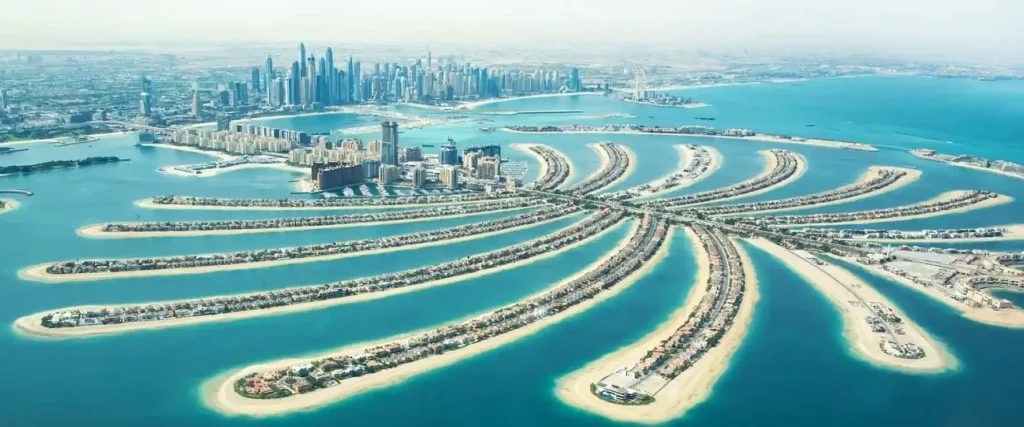
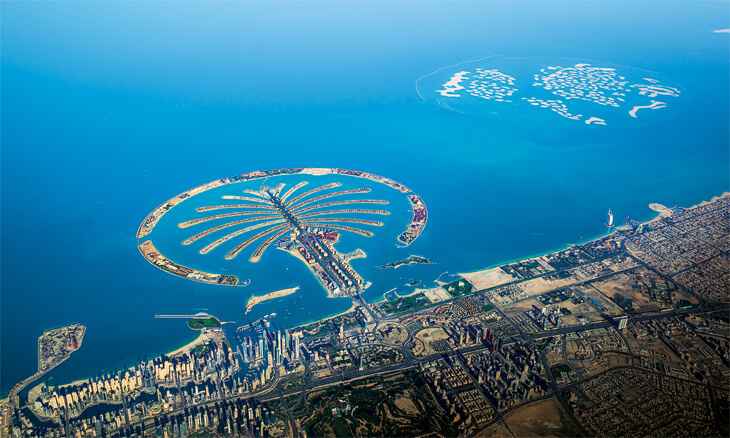
Palm Jumeirah isn’t a single beach or resort – it’s an entire district shaped like a date palm, and understanding its four parts makes every other section of this guide easier to follow.
The Trunk
The trunk is the palm’s “stem” and the island’s main entry point from Sheikh Zayed Road. It houses the Palm Monorail, along with shopping malls, cafés, and residential towers. This is where Nakheel Mall, The Palm Tower, and Golden Mile sit, and it’s the part of the island most visitors pass through first.
The Fronds
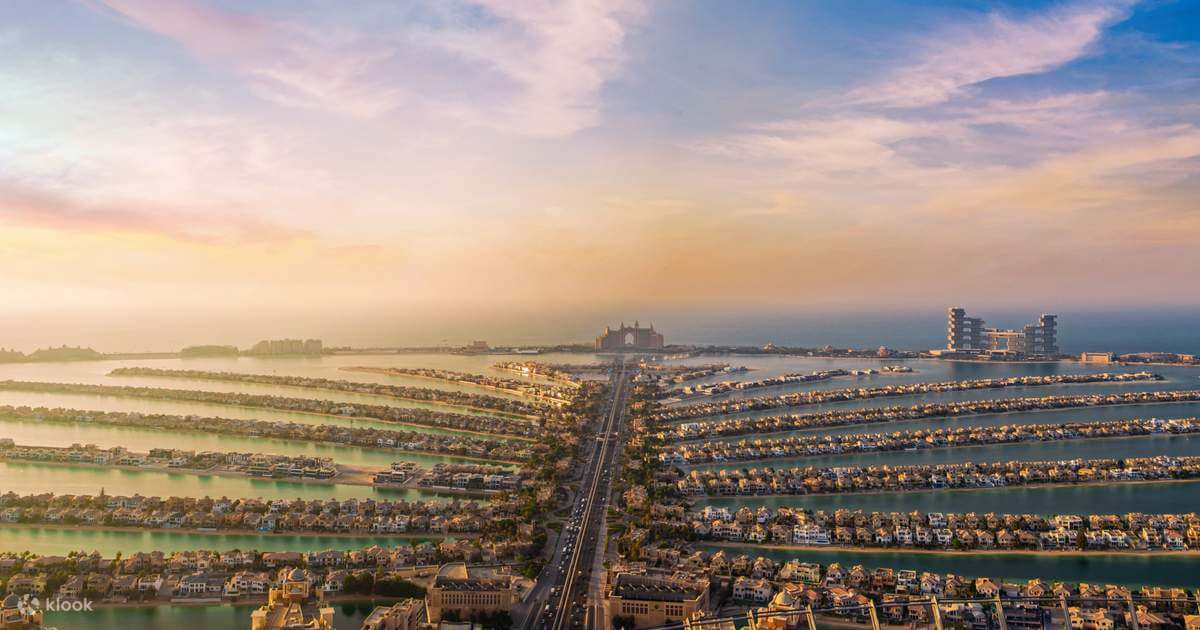
Branching off the trunk are the fronds – 14 to 17 low-rise residential branches lined with private villas, each with direct beach access. These are almost entirely residential and gated, so they’re best appreciated from above (a helicopter tour, skydive, or the boardwalk) rather than up close.
The Crescent (Breakwater)
The crescent, also called the breakwater, encircles the palm and is home to the island’s flagship resorts, including Atlantis, The Palm, along with the scenic Crescent Boardwalk. This 11-kilometer arc absorbs wave energy and protects the fronds, while doubling as Dubai’s most concentrated stretch of five-star hospitality.
The Spine
A central spine runs down the middle of the island, connecting the trunk to the crescent through an underwater tunnel. Most visitors experience this as the drive or monorail ride beneath the Arabian Gulf en route to Atlantis.
Together, these four zones form what Nakheel and Britannica describe simply: apartments, retail facilities, and a handful of hotels sit on the trunk, closely packed villas line the long fronds, and most hotels and resorts occupy the crescent.
A Brief History: How Palm Jumeirah Was Built
Understanding Palm Jumeirah’s backstory adds context to why the island looks and functions the way it does today.
Nakheel, a real estate company now owned by the Dubai government, developed the island, with the master plan drawn up by American architecture firm Helman Hurley Charvat Peacock. Work began in 2001, basic land and infrastructure were in place by 2004, building construction started in 2006, and the first residents moved in during 2007.
The scale of the reclamation project was staggering. Instead of standard concrete foundations, builders used roughly 7 million tons of rock blasted from the Hajar Mountains, combined with about 120 million cubic meters of sand dredged from the Gulf seabed. By one estimate, that much rock and sand could build a two-meter-wide wall circling the globe three times.The exposed, open-sea side of the crescent was reinforced with stone and boulders brought from the mainland to withstand wave action.
Growth followed quickly once the island opened. By late 2007, roughly 500 families were already living on Palm Jumeirah, and by the end of 2009 the crescent had 28 open hotels.The island is technically not a true island in the strictest sense, since it connects to mainland Dubai via a 1.4-kilometer bridge, alongside a six-lane underwater tunnel linking the trunk to the crescent.
Palm Jumeirah by the Numbers
| Metric | Figure |
|---|---|
| Construction period | 2001–2007 |
| Developer | Nakheel (Dubai government-owned) |
| Master plan architect | Helman Hurley Charvat Peacock |
| Length into the Gulf | Approximately 5 km |
| Number of fronds | 16–17 (sources vary) |
| Crescent breakwater length | 11 km |
| Current resident population | Approximately 80,000 |
| Residential units | 10,000+ |
| Hotels on the crescent (2009 baseline) | 28 |
Editorial note: Population, unit counts, and hotel numbers change as new developments complete. Verify current figures against Dubai Land Department or Nakheel’s official releases before publishing.
This engineering backstory isn’t just trivia — it explains why Palm Jumeirah today feels less like a single attraction and more like a fully built city district, with its own transport spine, retail core, and coastline. That infrastructure is exactly what shapes the experience of visiting.
Top Things to Do on Palm Jumeirah
With the layout in mind, here’s what actually fills a Palm Jumeirah itinerary — from headline attractions to quieter, free alternatives.
Atlantis, The Palm and Aquaventure Waterpark
No Palm Jumeirah guide starts anywhere else. Atlantis, The Palm anchors the tip of the crescent with its fairy-tale-style architecture, the thrilling Aquaventure Waterpark, and The Lost Chambers Aquarium.Aquaventure is regularly ranked among the largest water parks in the world and holds the record for the most water slides at a single park, including a slide that runs through a shark-filled tunnel. Beyond the slides, visitors can book dolphin swim and interaction experiences, and every waterpark ticket includes access to the park’s beach and pool areas.
The Lost Chambers Aquarium
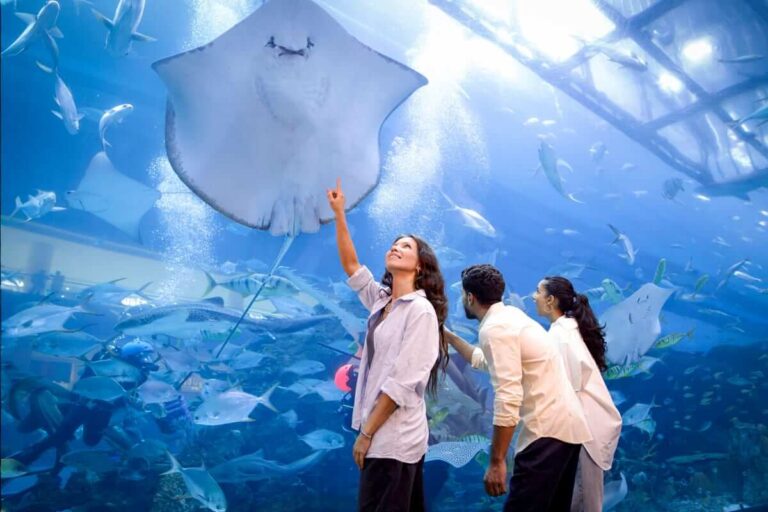
Set beneath Atlantis, this aquarium recreates the mythical lost city of Atlantis across underwater tunnels and marine habitats, and it can be combined with Aquaventure tickets or booked separately for snorkeling and diving sessions with resident marine life.
The Pointe and the Palm Fountain
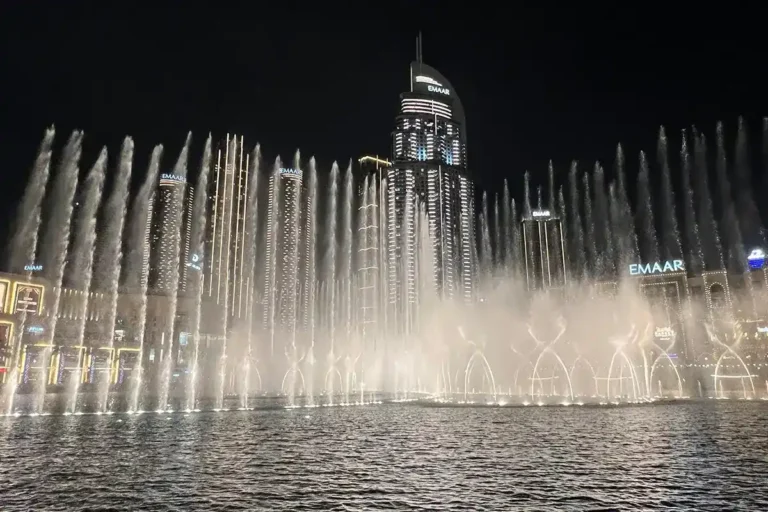
Located at The Pointe, the Palm Fountain show is a must-see, billed as the world’s largest and most advanced dancing fountain, spread across more than 14,000 square meters of waterfront. The Pointe itself is a waterfront dining and entertainment strip that offers a spectacular view of Atlantis, making it one of the best free things to do on the island after dark.
The View at The Palm
Perched on the 52nd floor of The Palm Tower, The View at The Palm is an observation deck offering a 360-degree panorama over Palm Jumeirah, the coastline, and Dubai’s skyline. It’s the single best way to visually grasp the island’s palm-tree shape without booking a helicopter or skydive.
Palm Jumeirah Boardwalk
Stretching along the trunk, the boardwalk delivers sweeping views of the Arabian Gulf and Dubai’s skyline, and it’s entirely free. It’s the go-to option for a sunrise walk, a sunset run, or simply people-watching with a skyline backdrop.
Palm West Beach
A public, sandy stretch where visitors can stroll for boardwalk views, sunbathe, and swim without paying for resort access. It’s lined with casual cafés and beach clubs, making it the practical choice for travelers who want a beach day without a five-star price tag.
The Palm Monorail
A $400 million, 5.4-kilometer monorail was built to carry up to 6,000 passengers per hour in each direction along the trunk, connecting the mainland tram network to the crescent’s hotels. It remains the easiest car-free way to reach Atlantis and back.
Skydiving Over the Palm
For a bird’s-eye view with an adrenaline kick, tandem skydives departing near the Palm let jumpers see the full fan-shaped layout of the fronds from thousands of feet up — widely considered one of the best aerial vantage points of the island.
Nakheel Mall and Golden Mile
Sitting on the trunk, Nakheel Mall rounds out the island’s retail and dining scene with international brands, a rooftop garden, and direct monorail access, while the Golden Mile strip nearby offers a quieter, community-feel alternative to the crescent’s resort dining.
Where to Stay on Palm Jumeirah
Accommodation on the island splits cleanly by zone, and that split should drive your booking decision.
On the crescent, expect the island’s most famous five-star names – Atlantis, The Palm and Waldorf Astoria are among the major hotels here, alongside newer additions built to compete on spectacle, such as multi-tower resorts connected by sky pools. Crescent hotels put you closest to Aquaventure, The Lost Chambers, and the open Gulf-facing beach, but you’ll pay a premium and rely more on taxis, shuttles, or the monorail to reach the mainland.
On the trunk, international hotel brands such as Fairmont and Viceroy operate alongside residential apartment towers, offering easier access to Sheikh Zayed Road, Nakheel Mall, and the boardwalk, usually at a lower nightly rate than crescent properties.
On the fronds, accommodation is almost entirely private villa rentals, ideal for families or groups wanting a private pool and direct beach frontage away from hotel foot traffic.
Advantages and Disadvantages by Zone
| Zone | Best For | Trade-off |
|---|---|---|
| Crescent | Resort experience, beach access, nightlife | Higher cost, more traffic to reach |
| Trunk | Value, mall access, monorail convenience | Fewer private-beach options |
| Fronds | Privacy, villa living, families/groups | Limited walkability, car-dependent |
Where to Eat on Palm Jumeirah
Dining ranges from casual boardwalk cafés to some of Dubai’s most photographed restaurants. Both budget-friendly meals and celebrity-chef restaurants exist side by side on the island, so the choice comes down to setting rather than availability.
- The Pointe delivers the widest concentration of mid-range and upscale restaurants with direct fountain and Atlantis views.
- Nakheel Mall offers food-court and casual sit-down options for a quick, affordable meal between activities.
- Crescent resort restaurants (inside Atlantis and neighboring hotels) house Dubai’s highest-profile celebrity-chef openings, best booked in advance for dinner.
- Palm West Beach cafés suit a relaxed, beachfront breakfast or lunch without a resort reservation.
How to Get to Palm Jumeirah
Palm Jumeirah sits roughly 20–30 minutes from Downtown Dubai, and there are three practical ways to reach it:
- Taxi or ride-hail – taxis are widely available across Dubai and can take visitors directly to any point on the island, making this the simplest option for most travelers.
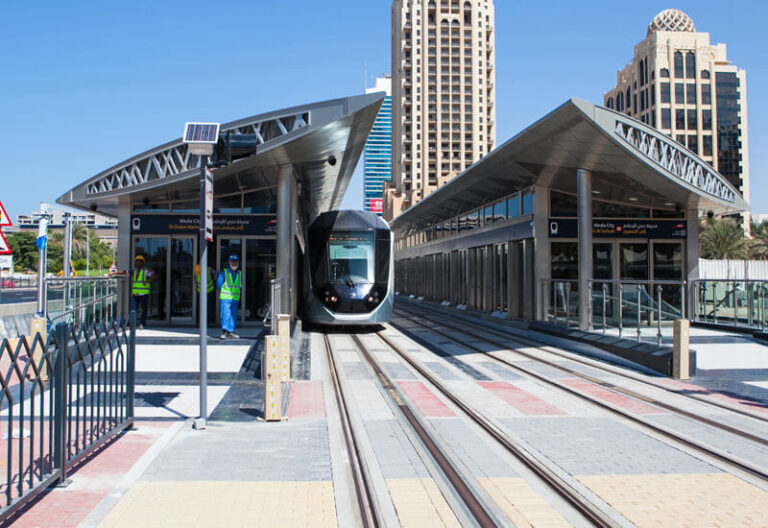
- Dubai Tram + Palm Monorail – take the tram to Al Sufouh station, then transfer to the Palm Monorail for the ride down the trunk to the crescent.
- Self-drive via Sheikh Zayed Road – the most flexible option for visitors combining Palm Jumeirah with other stops in New Dubai, such as Dubai Marina or JBR.
Editorial note: Confirm current monorail fares, tram connection points, and taxi flat-rate ranges against RTA’s official site before publishing, as fares are periodically revised.
Best Time to Visit Palm Jumeirah
October through April brings pleasant weather in the 20–30°C range, ideal for outdoor activities and beach visits. Midweek mornings tend to be quieter at Aquaventure and the boardwalk, while weekends and public holidays draw the heaviest crowds to The Pointe and Palm West Beach. Summer months (June–September) are viable for travelers focused on indoor attractions, resort pools, or evening activities, since daytime heat and humidity make extended outdoor exploration less comfortable.
Common Mistakes First-Time Visitors Make
- Underestimating travel time within the island. The trunk-to-crescent distance is longer than it looks on a map; budget at least 20–30 minutes each way if driving during peak hours.
- Assuming all beaches are private. Palm West Beach and the boardwalk are public and free; resort beaches typically require a room booking or day-pass purchase.
- Skipping advance tickets. Aquaventure, The Lost Chambers, and The View at The Palm all see long queues without pre-booked, timed-entry tickets, particularly during winter high season.
- Trying to see everything in one visit. Palm Jumeirah rewards a slower pace; pairing one major attraction (Atlantis or The View) with the boardwalk and a Pointe dinner makes for a fuller day than rushing between multiple paid attractions.
Palm Jumeirah’s Future: What’s Next
Nakheel’s next mega-project puts Palm Jumeirah’s own scale in perspective. Palm Jebel Ali, set to be twice the size of Palm Jumeirah, is scheduled for completion by the end of 2028 and will eventually include seven islands, 16 fronds, and more than 90 kilometers of new beachfront.The first Palm Jebel Ali properties are expected to be handed over to owners in 2027, positioning it as Palm Jumeirah’s larger sibling rather than a replacement – Palm Jumeirah remains Dubai’s established, fully operational palm island, while Jebel Ali represents the next phase of the same reclamation strategy.
On Palm Jumeirah itself, ongoing hospitality and retail investment continues to add new dining concepts, beach clubs, and residential towers along the trunk and crescent, reinforcing the island’s position as one of Dubai’s most consistently evolving districts rather than a finished, static attraction.
FAQs
1. What is Palm Jumeirah known for?
Palm Jumeirah is known for being the world’s largest man-made island shaped like a palm tree, home to Atlantis, The Palm, Aquaventure Waterpark, luxury villas, and some of Dubai’s most photographed skyline views.
2. Is Palm Jumeirah a real island?
Yes, though technically it connects to the mainland via a bridge rather than sitting fully offshore, so some sources describe it as a peninsula-like reclaimed landmass rather than a true isolated island.
3. How do you get to Palm Jumeirah without a car?
Take the Dubai Tram to Al Sufouh station, then transfer to the Palm Monorail, which runs down the trunk to the crescent near Atlantis.
4. Is Palm Jumeirah worth visiting?
Yes – between Aquaventure Waterpark, the free boardwalk, The Pointe’s fountain show, and The View at The Palm’s observation deck, the island offers activities across most budgets and interests.
5. Can you visit Palm Jumeirah for free?
Yes. The boardwalk, Palm West Beach, The Pointe promenade, and window-shopping at Nakheel Mall don’t require an entrance fee.
6. How long do you need to see Palm Jumeirah?
A single day is generally enough to cover the highlights; a half-day works if you’re focusing on just one major attraction plus the boardwalk.
7. What is the difference between Palm Jumeirah and Palm Jebel Ali?
Palm Jumeirah is Dubai’s original, fully developed palm island, while Palm Jebel Ali is a newer, larger project under active construction and expected to be roughly twice the size once complete.
8. Where is the best view of Palm Jumeirah?
The View at The Palm, on the 52nd floor of The Palm Tower, offers the clearest 360-degree panorama of the island’s full palm shape.
9. Can you swim with dolphins on Palm Jumeirah?
Yes, dolphin swim and interaction experiences are available at Atlantis, The Palm, typically bundled with Aquaventure Waterpark access.
10. Is Palm Jumeirah good for families?
Yes – Aquaventure Waterpark and The Lost Chambers Aquarium are consistently ranked among the top family activities on the island.
11. What is The Pointe on Palm Jumeirah?
The Pointe is a waterfront dining and entertainment complex at the base of the crescent, known for its restaurant selection and the large-scale Palm Fountain show.
12. When was Palm Jumeirah built?
Construction began in 2001, with basic infrastructure complete by 2004, buildings underway from 2006, and the first residents arriving in 2007.
Conclusion
Palm Jumeirah earns its reputation honestly: it’s a genuine feat of marine engineering that has matured into a fully lived-in Dubai neighborhood, not just a postcard shape visible from an airplane window. Whether the goal is a thrill-filled day at Aquaventure, a quiet sunset walk on the boardwalk, or scouting a future villa purchase, the island rewards visitors who take the time to understand its trunk-frond-crescent layout before they arrive. As Nakheel’s next project, Palm Jebel Ali, begins to take shape offshore, Palm Jumeirah remains the benchmark against which Dubai’s future island developments will be measured.

Shahzeen Usman is a full-time content writer based in the UAE, with over 5 years of local experience covering travel, lifestyle, and destination-focused stories. She specializes in creating engaging, research-driven content that highlights hidden gems, cultural insights, and travel trends across the Emirates and beyond.
With a deep understanding of UAE tourism, Shahzeen brings authentic perspectives to her writing, helping readers discover meaningful travel experiences. Her work combines storytelling with SEO best practices, making her content both informative and search-engine friendly.