Dubai International Airport Guide 2026: Terminals, Transport, and What to Know Before You Fly
Dubai International Airport (DXB) is the world’s busiest airport for international passenger traffic, handling a record 95.2 million travellers in 2025. Located in Al Garhoud, about 4.6 km east of central Dubai, it operates three terminals – Terminal 1, Terminal 2, and the Emirates-dedicated Terminal 3 — connected to the city via the Dubai Metro Red Line, taxis, and ride-hailing services.
Few airports anywhere in the world move as many people, as consistently, as Dubai International Airport. Whether you’re transiting through on an Emirates long-haul connection, flying in for a weekend in Downtown Dubai, or catching a budget flydubai hop across the region, DXB is likely to be your first – and lasting – impression of the city. Understanding how Dubai International Airport is laid out, how to move between its terminals, and how it connects to landmarks like Sheikh Zayed Road, Downtown Dubai, and Dubai Marina can save you real time and stress.
This guide covers everything travellers need in 2026: terminal-by-terminal breakdowns, transport options, the record-breaking passenger numbers behind the airport’s reputation, and what’s changing as Dubai prepares for its long-term shift toward Al Maktoum International Airport (DWC).
Where Is Dubai International Airport Located?
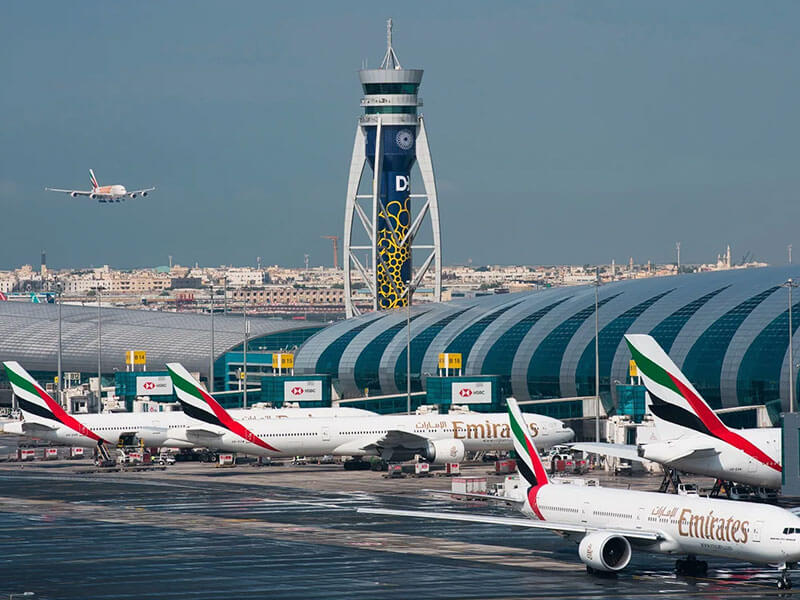
DXB sits in the Al Garhoud district, roughly 4.6 km (2.9 miles) east of Dubai Creek and the historic core of the city, and around 15 km from Downtown Dubai. This central location – unusually close to the city for an airport of its size – is both DXB’s greatest advantage and its biggest long-term constraint. Being minutes from Downtown Dubai, DIFC, and Dubai Marina makes arrivals and departures fast, but the surrounding highways and dense residential development also mean the airport has effectively run out of room to expand physically, a point Dubai Airports’ own leadership has raised repeatedly when discussing the emirate’s aviation future.
Dubai International Airport by the Numbers: 2025-2026 Passenger Traffic
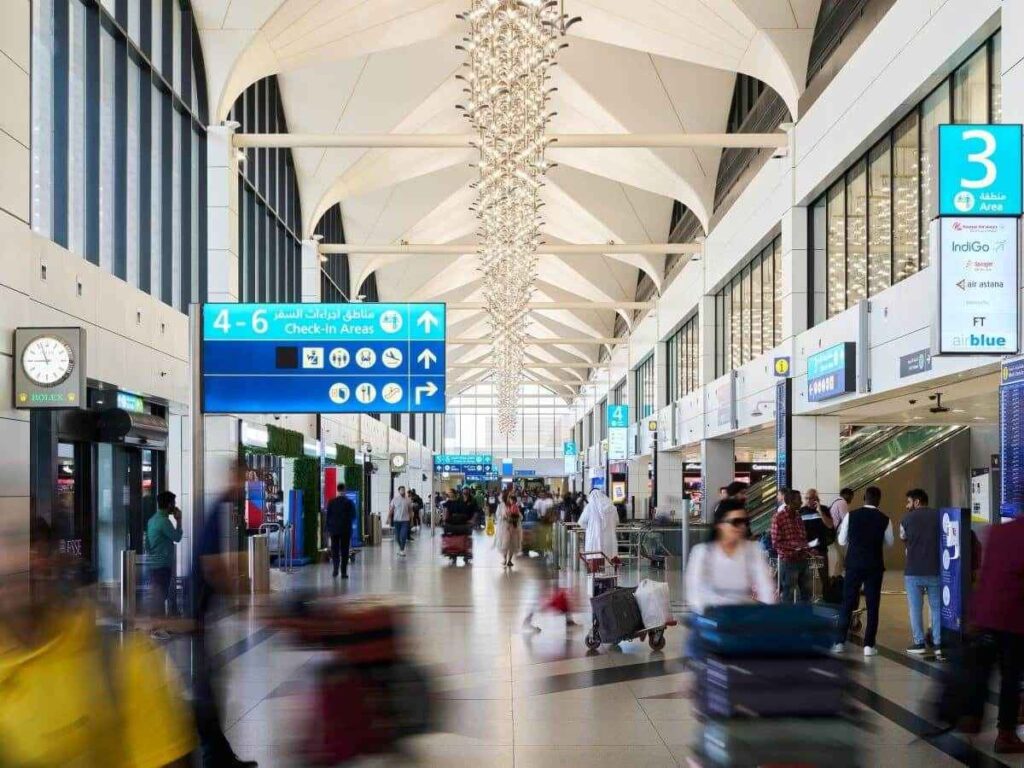
DXB’s scale is what defines the experience of flying through it. In 2025, the airport handled a record 95.2 million passengers, up 3.1% year-on-year, making it the highest annual international passenger traffic ever recorded by any airport globally. The fourth quarter of 2025 alone brought 25.1 million passengers, a 5.9% increase on the same period the year before, while December set a new monthly record of 8.7 million travellers.
Some context on how quickly that growth has compounded: DXB served 86.9 million passengers in 2023, 92.3 million in 2024, and is now projected to reach 99.5 million in 2026 – putting it within striking distance of the 100-million mark. The airport connected travellers to close to 300 destinations across around 110 countries in 2025, served by more than 100 international airlines. India was the single largest source market, followed by Saudi Arabia and the United Kingdom, while London remained DXB’s busiest individual city route.
Dubai Airports CEO Paul Griffiths has described this consistency – rather than any single peak – as the real story: DXB now operates “at the edge of physical capacity” as a matter of routine, supported by a data-sharing platform called oneDXB that coordinates airlines, ground handlers, immigration, customs, and police in real time to manage stand allocation, baggage handling, and security lanes.
Terminal Guide: T1, T2, and T3 Explained
DXB is organised into three terminals, split by airline and route type rather than by arrival or departure.
Terminal 1 serves the majority of DXB’s international carriers outside of Emirates and flydubai’s long-haul operations – well over 60 airlines route through this terminal, which also connects to Concourse D via an automated people mover.
Terminal 2 is DXB’s dedicated home for flydubai and a cluster of regional carriers. It sits on the opposite side of the airfield from Terminals 1 and 3 and is not linked to them airside, meaning passengers connecting through Terminal 2 need to use landside transport – an RTA shuttle bus or a short taxi ride – rather than walking between concourses.
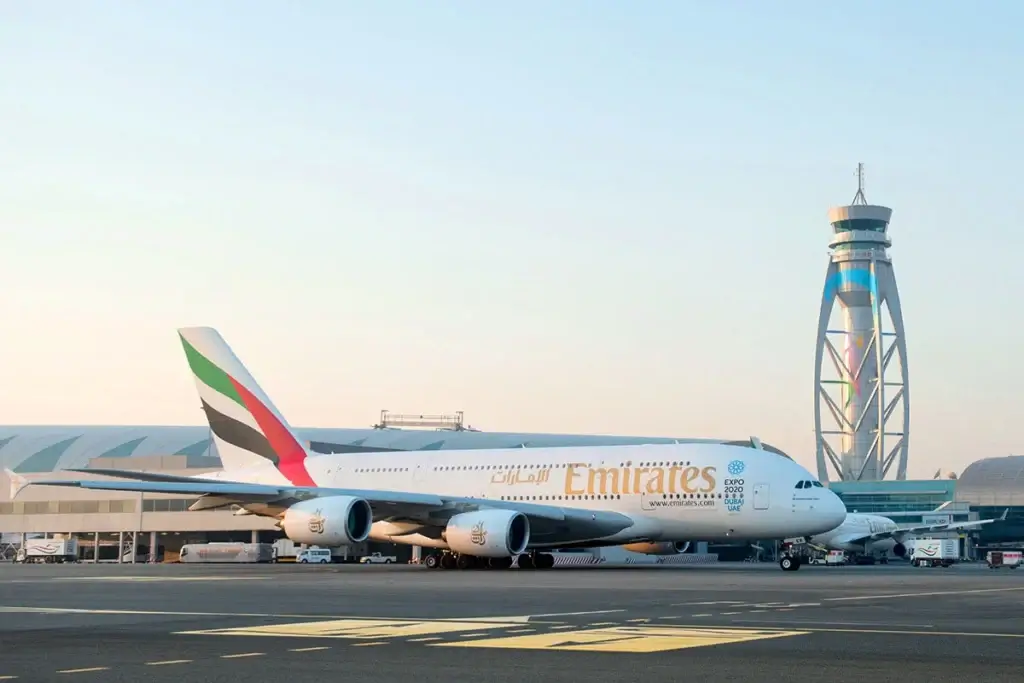
Terminal 3 is exclusively for Emirates and select flydubai long-haul flights, and it’s one of the largest airport terminal buildings in the world, split into Concourses A, B, and C. Concourse A is dedicated to Emirates’ A380 fleet and connects to the rest of Terminal 3 via an underground train. Terminal 3 and Terminal 1 are airside-linked, which allows many connecting passengers to move between them without re-clearing immigration.
| Terminal | Main Airlines | Airside Link to Other Terminals | Best For |
|---|---|---|---|
| Terminal 1 | 60+ international carriers | Linked to Terminal 3 | Most non-Emirates international flights |
| Terminal 2 | flydubai, regional carriers | Not linked (landside only) | Budget and regional connections |
| Terminal 3 | Emirates, select flydubai long-haul | Linked to Terminal 1 | Emirates passengers, A380 flights |
Getting To and From Dubai International Airport
DXB’s proximity to central Dubai gives travellers several genuinely fast options for reaching the city, though the right choice depends on your terminal and the time of day.
Dubai Metro (Red Line): The most cost-effective way to reach Terminals 1 and 3 directly, with stations built into both terminals. A reloadable Nol card is required and can be purchased at any station. Terminal 2 is not directly served by the Red Line; travellers connect via the Green Line to the Airport Freezone or Al Qiyadah stations, followed by a short feeder bus.
Taxis and ride-hailing: RTA taxis operate 24/7 from designated ranks at all three terminals, and both Careem and Uber run app-based pickup zones. During peak evening traffic on Sheikh Zayed Road (roughly 5:00–7:00 PM), the Metro can actually be faster than a taxi for reaching Terminals 1 and 3.
Hotel and private transfers: Many hotels along the Sheikh Zayed Road corridor and in Downtown Dubai offer scheduled limousine or shuttle transfers, and Emirates provides complimentary chauffeur service for First and Business Class passengers.
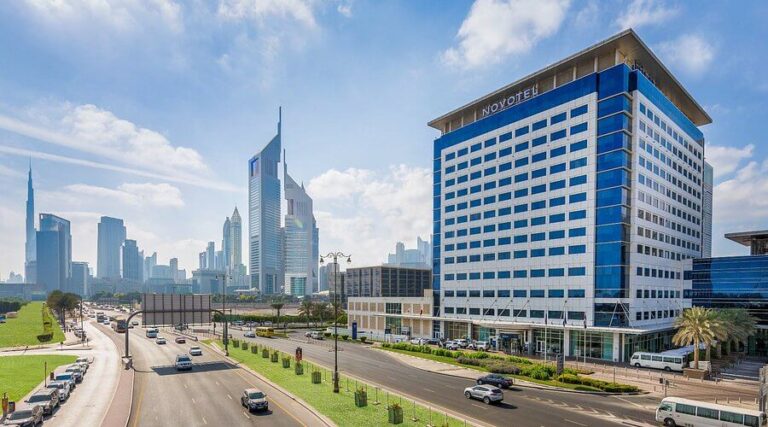
From Downtown Dubai, the drive to DXB typically takes 15–20 minutes outside peak hours; from Dubai Marina or Jumeirah, budget closer to 35–50 minutes by road during rush hour, or a comparable Metro journey without the traffic uncertainty.
Shopping, Dining, and Lounges at DXB
Dubai Duty Free operates across all three terminals and remains one of the largest airport retail operations in the world, spanning perfumes, electronics, gold and jewellery, chocolates, and duty-free liquor and tobacco — it’s also the primary retail anchor inside Terminal 2. Terminal 3 in particular offers an extensive range of dining options and Emirates’ own network of Business and First Class lounges across Concourses A, B, and C, several of which are open around the clock and include rest areas and shower facilities. For travellers without lounge access through their airline, the Marhaba Lounges (available in multiple terminals, priced per visit) and the Ahlan Lounges in Terminal 3 accept walk-ins and Priority Pass memberships.
Security, Immigration, and the Move Toward Biometrics
DXB has been steadily rolling out biometric processing to reduce queue times, particularly at Terminals 3 and 1, where self-service kiosks allow passengers to check in and print bag tags on their phones before reaching biometric-enabled Smart Gates for security and immigration. The direction of travel is clear: Dubai’s broader aviation strategy is oriented around reducing manual document checks in favour of facial and iris recognition for pre-registered travellers. As with any fast-evolving airport technology rollout, travellers should verify current requirements directly with Dubai Airports or the General Directorate of Residency and Foreigners Affairs (GDRFA) before their trip, since eligibility and availability can vary by terminal and nationality.
The Future of DXB: Why Dubai Is Building a Second Mega-Airport
The single biggest story shaping Dubai International Airport right now isn’t happening at DXB itself — it’s happening 40 km southwest, at Al Maktoum International Airport (DWC) in the Jebel Ali area. Dubai Airports CEO Paul Griffiths has confirmed that DXB is approaching a structural ceiling of roughly 114 million passengers a year, expected to be reached around 2031–2032, at which point Dubai plans to begin a full transition of operations to DWC rather than continue expanding a facility hemmed in by highways and residential neighbourhoods on all sides.
DWC itself is being built as a genuine successor rather than a secondary airport: five parallel runways, up to 400 aircraft gates, and an eventual capacity of 260 million passengers a year, developed under a budget estimated between roughly $35 and $38 billion (around AED 128 billion). Emirates chairman Sheikh Ahmed bin Saeed Al Maktoum has said the airline intends to move its entire operation to DWC “in one go” rather than in phases, once the new terminal is tested and ready.
Timelines vary depending on the source and have shifted over time — some reporting points to a transition beginning around 2032, with various projections placing a full DXB closure and site redevelopment (likely into real estate) anywhere between the early and mid-2030s. For now, DXB remains fully operational and will continue to be Dubai’s primary international gateway for years to come; travellers booking flights to Dubai in the near term should still expect to fly through DXB rather than DWC, unless their airline specifically operates from Al Maktoum.
DXB vs DWC: Quick Comparison
| Feature | Dubai International (DXB) | Al Maktoum International (DWC) |
|---|---|---|
| Status in 2026 | Fully operational, primary hub | Operational for flydubai and select carriers; under major expansion |
| Distance from Downtown Dubai | ~15 km | ~40 km |
| 2025 passenger traffic | 95.2 million | Smaller, growing share |
| Long-term role | Planned phased wind-down | Future primary hub for Dubai |
| Primary airline | Emirates, 100+ international carriers | flydubai (expanding), future Emirates base |
FAQs
1. What terminal does Emirates use at Dubai International Airport?
Emirates operates almost exclusively out of Terminal 3, including all Concourse A A380 flights.
2. How many terminals does Dubai International Airport have?
DXB has three terminals: Terminal 1, Terminal 2, and Terminal 3.
3. How do I get from Terminal 2 to Terminal 1 or Terminal 3?
Terminal 2 is not linked airside to the other terminals, so transferring passengers must use an RTA shuttle bus or taxi, as it sits on the opposite side of the airfield.
4. Is Dubai Metro a good way to reach the airport?
Yes – the Red Line connects directly into Terminal 1 and Terminal 3, and during peak road traffic it can be faster than a taxi.
5. How many passengers does Dubai International Airport handle each year?
DXB handled a record 95.2 million passengers in 2025 and is projected to reach roughly 99.5 million in 2026.
6. Which airport will replace Dubai International Airport?
Al Maktoum International Airport (DWC), located in the Jebel Ali area, is planned as DXB’s eventual successor as part of a long-term transition strategy.
7. When will Dubai International Airport close?
No fixed closure date has been officially confirmed. Dubai Airports has indicated the transition to DWC is likely to begin once DXB approaches its capacity ceiling of around 114 million passengers, expected around 2031–2032, with full closure projections varying across sources into the mid-2030s.
8. Which airline operates from Terminal 2?
Terminal 2 is used primarily by flydubai and a number of regional carriers.
9. Does Dubai International Airport have duty-free shopping?
Yes, Dubai Duty Free operates across all three terminals, including perfumes, electronics, gold, and jewellery.
10. How far is DXB from Downtown Dubai?
Approximately 15 km, roughly a 15–20 minute drive outside of peak traffic hours.
11. What is oneDXB?
oneDXB is the data-sharing platform Dubai Airports uses to coordinate airlines, ground handlers, immigration, customs, and police in real time, helping DXB manage record passenger volumes.
12. Can I use Priority Pass at Dubai International Airport?
Yes, several lounges — including the Ahlan Lounges in Terminal 3 and various contract lounges – accept Priority Pass memberships.
Conclusion
Dubai International Airport isn’t just a stopover point — it’s a working demonstration of how much traffic a single, tightly-located hub can absorb while still functioning smoothly, having broken its own passenger records in 2025 for the fourth year running. Knowing which terminal you’ll land in, how the Metro and taxi networks connect to it, and where DXB sits in Dubai’s longer-term shift toward Al Maktoum International will make navigating it far easier, whether you’re passing through for a few hours or beginning a stay in Downtown Dubai.

Sara is a UAE-based banking and accounting expert with over 4 years of professional experience in the financial sector. Her expertise spans retail banking, financial reporting, compliance, and practical money management topics relevant to individuals and businesses in the UAE.
She contributes clear, accurate, and well-researched financial content, simplifying complex banking and accounting concepts for everyday readers. Sara’s writing reflects strong industry knowledge, regulatory awareness, and a commitment to financial accuracy and transparency.