Dubai World Central Guide 2026: Inside the World’s Future Largest Airport City
Dubai World Central (DWC) is the master-planned “airport city” built around Al Maktoum International Airport in southwest Dubai – a AED 128 billion ($34.8 billion) development that Dubai Airports and the UAE government intend to grow into the world’s largest airport by passenger capacity. Today the area operates under the broader brand name Dubai South, but the name Dubai World Central persists in daily use, in official airport branding (DWC is still the airport’s IATA-linked identity), and in the free zone name that governs business licensing there.
Whether you’re researching a future move to Dubai South, planning around the airport’s phased handover from Dubai International, or evaluating a free zone company setup, this guide maps every layer of Dubai World Central – its history, its districts, its airport expansion timeline, and what living or investing there looks like heading into 2026 and beyond.
What Is Dubai World Central?
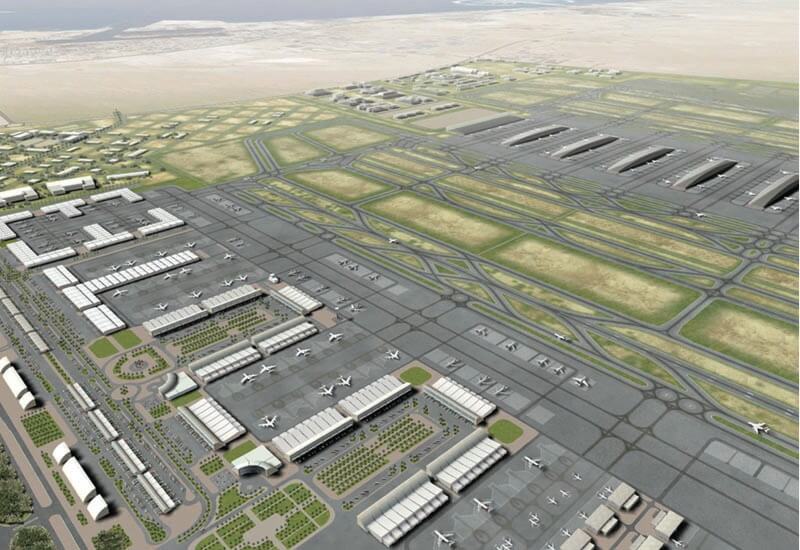
Dubai World Central (DWC) is a 145-square-kilometre master-planned development in southwest Dubai, launched in 2006 and rebranded as Dubai South in 2015. It is built around Al Maktoum International Airport and organized into distinct districts covering aviation, logistics, residential, commercial, and exhibition uses. Once fully complete, DWC’s airport is planned to handle up to 260 million passengers a year, eventually absorbing all operations currently run through Dubai International Airport (DXB).
From Dubai World Central to Dubai South: Understanding the Name Change
One of the most common points of confusion for newcomers researching this area is the relationship between “Dubai World Central” and “Dubai South.” They refer to the same physical development and the same governing free zone authority, but the branding shifted over time as the project’s scope grew.
Dubai South, formerly known as Dubai World Central, is a master-planned city in Dubai launched in 2006 as a 145-square-kilometre development built around Al Maktoum International Airport, which is under phased expansion to become the world’s largest airport by passenger and cargo capacity. The original name emphasized the airport-centric vision. As the master plan expanded to include full residential communities, a business park, an exhibition district, and a dedicated logistics city, Dubai’s planners rebranded the wider development as Dubai South in 2015 to reflect that broader identity, while the airport itself retained the DWC designation that appears on flight bookings and cargo manifests to this day.
For practical purposes, when people search for “Dubai World Central” in 2026, they are usually looking for one of three things: the airport (Al Maktoum International), the free zone and business setup opportunities, or the residential and investment community now marketed as Dubai South. This guide covers all three, since they are structurally and administratively the same project.
Where Is Dubai World Central Located?
DWC sits in the southwestern corner of Dubai, adjacent to Jebel Ali and roughly 35 kilometres from Dubai Marina, positioning it between Dubai’s established urban core and the emirate of Abu Dhabi.DWC is situated in Dubai South, approximately 35km from Dubai Marina. This location was deliberate: it places the development within reach of Jebel Ali Port, one of the busiest man-made harbours in the world, creating a rare combination of air, sea, and land logistics infrastructure within a single economic zone.
The site’s distance from central Dubai has historically been viewed as a drawback for residents, but it is also the reason DWC has room to expand on a scale that is no longer possible in the built-up corridor around Sheikh Zayed Road. As new metro links, road upgrades, and eventually high-speed rail connections come online, that distance is expected to matter less for daily commuters and more as a selling point for space, affordability, and long-term growth potential.
The Eight Districts of Dubai World Central
Dubai South’s master plan divides the development into a set of purpose-built districts, each targeting a specific economic or residential function. Sources describe the plan as comprising six to eight integrated districts depending on how sub-zones are counted, but the core components are consistent across official material:
| District | Primary Function | Key Features |
|---|---|---|
| Al Maktoum International Airport | Aviation hub | Passenger terminals, cargo operations, five planned runways |
| Aviation District | Aerospace and MRO | Mohammed bin Rashid Aerospace Hub, the region’s first dedicated aviation and aerospace free zone |
| Logistics District | Supply chain and cargo | An 18 square-kilometre area providing solutions for the global supply chain system |
| Residential District | Housing | South Bay, The Pulse, Pulse Beachfront, Hayat, South Living |
| Commercial / Business District | Offices and enterprise | Dubai South Business Hub Free Zone, multi-storey office buildings |
| Exhibition District | Events and legacy site | Expo City Dubai, District 2020, GITEX Global’s new venue |
| Golf District | Leisure and residential | Golf course-fronted villa and townhouse communities |
| Humanitarian District | Aid and NGO logistics | International Humanitarian City operations |
The Exhibition and Humanitarian District hosts Expo City Dubai, the post-Expo legacy development now repurposed into a smart city focused on innovation, business, and sustainability. Meanwhile, the Residential District has been thoughtfully developed with a strong emphasis on eco-friendly practices and long-term livability, positioning Dubai South as a self-contained city rather than a satellite suburb.
The Logistics District: A Supply Chain Powerhouse
The Logistics District is arguably the most commercially significant part of DWC for businesses rather than residents. Dubai South Logistics City sits adjacent to Al Maktoum International Airport and enables fast-cycle logistics businesses to better control their inventory and create greater efficiencies across their supply chain, positioning it as an effective distribution hub for the Middle East, Southeast Europe, the CIS region, and the Indian subcontinent. Companies operating here benefit from direct airside access, meaning cargo can move from aircraft to warehouse to onward distribution without leaving the free zone. Cold chain logistics infrastructure is available in the Logistics District for food, pharmaceutical, and temperature-sensitive product businesses.
The Business and Commercial District
Dubai South Commercial City is planned to cover 795 hectares with buildings up to 45 storeys high, is expected to employ around 150,000 people, and is divided into eight zones including the Urban Village, Lake District, Central Park, and Business District, with a total estimated population of 450,000. This district is where most new-economy businesses – tech, consultancy, trading, and services firms without a direct aviation link – are choosing to license, drawn by lower setup costs than free zones closer to Downtown Dubai.
Al Maktoum International Airport: The Engine of DWC
The airport is the reason Dubai World Central exists, and its expansion is the single biggest driver of everything else happening in the area. Al Maktoum International Airport, located in Jebel Ali, Dubai, is undergoing an expansion approved in 2014 and being carried out by the Dubai Aviation Engineering Projects (DAEP) that will make it approximately five times the size of Dubai International Airport, currently the largest airport in Dubai.
Expansion Timeline and Scale
Phase Two of the DWC expansion was announced by the Dubai government in April 2024, with plans for the airport to eventually become the world’s largest hub by capacity, featuring five runways and capacity for 150 million passengers annually within a decade, ultimately rising to 260 million passengers and 12 million tonnes of cargo per year.
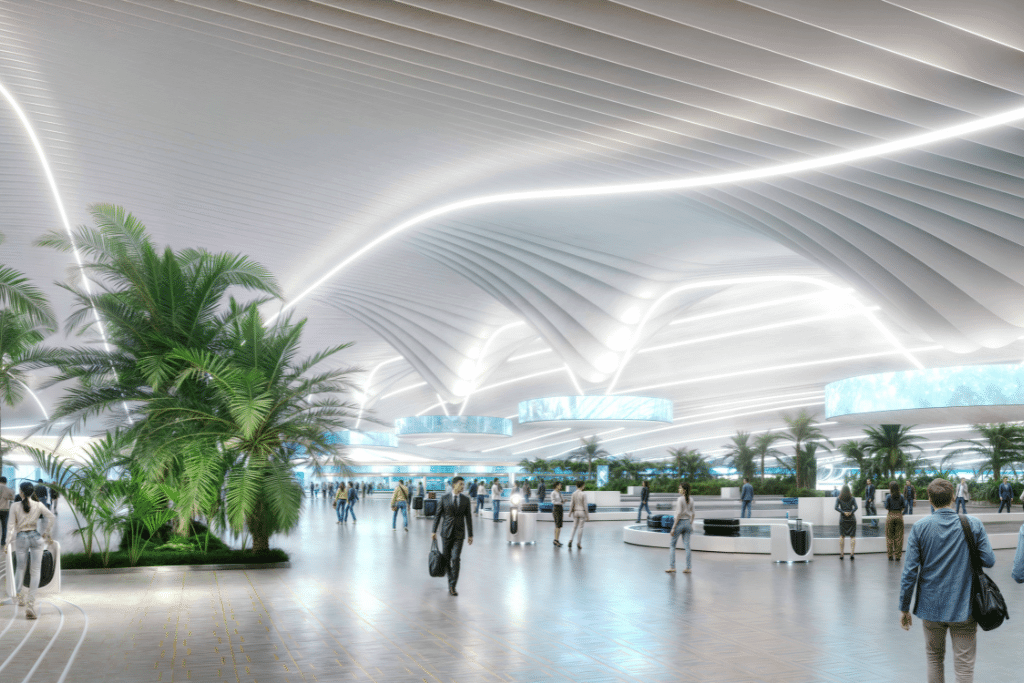
DWC will have five parallel runways and can accommodate 400 aircraft gates, with the first phase of expansion targeted for completion around 2032, including a central passenger terminal and four concourses designed to handle 150 million passengers annually. Eventually, all operations at Dubai International Airport (DXB) will be transferred to DWC, making the Dh128 billion megaproject the world’s largest airport, capable of accommodating 260 million passengers annually.
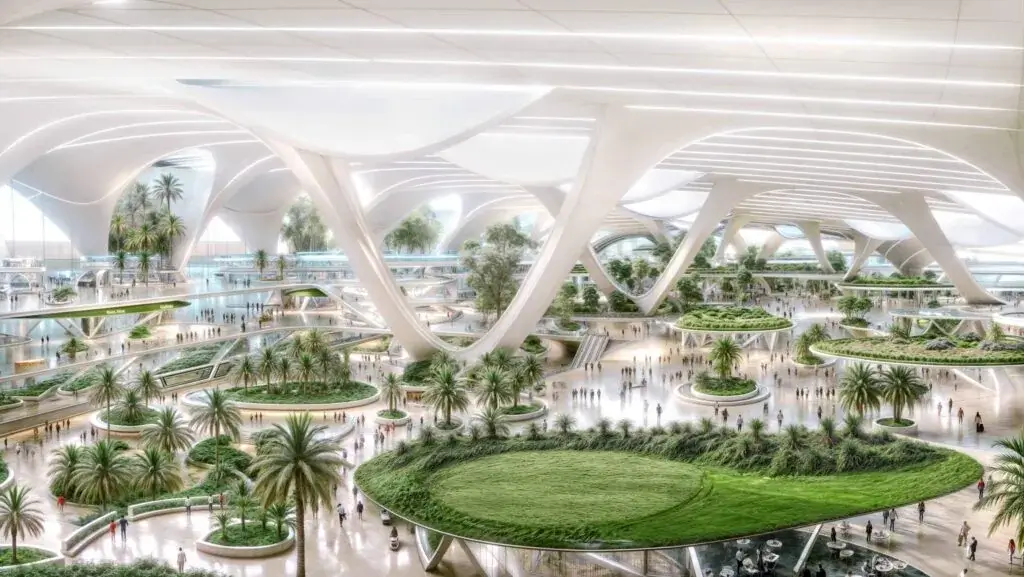
What the New Terminals Will Look Like
The scale of the physical build reflects the ambition of the project. The West Terminal will be a seven-level, 800,000-square-metre facility with a capacity of 45 million passengers annually, while the East Terminal will be the third terminal at DWC, completed during the ultimate phase. The concourses — Concourse 1 through 4 — will be built in sequence, with Concourse 3 being the first built on the eastern side of the platform and Concourse 4 the fourth and final concourse.
Behind-the-scenes infrastructure is being built on an equally large scale. The Baggage Handling System at DWC is designed to process 30,000 bags an hour, and a 14-station, multi-track train will link passengers across the airport. Three train stations are planned at each concourse, with an additional station at the West Terminal, plus a metro station connecting passengers from around the city to DWC.
Connectivity Beyond the Runway
DWC’s ambitions extend past aviation into multimodal transport. The site is planned to be well connected to the rest of Dubai and the UAE by land and air, via a high-speed rail link (Etihad Rail), a new Dubai Metro line, air taxi services, and autonomous vehicles. This is a meaningful shift for an area historically seen as remote — if these links deliver on schedule, DWC will have some of the most diverse transport connectivity of any district in Dubai.
A Word on Timelines
It’s worth noting that DWC’s expansion has been repeatedly rescoped and re-timed since construction first began. Early projections in the mid-2010s targeted completion “by 2022,” a date that was not met as the project’s scale and budget grew substantially. Readers researching DWC for investment or relocation decisions should treat published completion dates — including the ~2032 first-phase target — as subject to revision, and should verify the latest timeline directly with Dubai Airports or DAEP before making binding commitments.
GITEX Global and DWC’s Growing Events Profile
Dubai World Central’s Exhibition District has taken on new significance as one of the region’s premier events destinations. A notable shift for 2026: GITEX Global, previously hosted at Dubai World Trade Centre, has relocated to the Dubai Exhibition Centre at Expo City Dubai — placing the region’s flagship technology exhibition squarely within the DWC/Dubai South master plan rather than along the Sheikh Zayed Road corridor. This move reinforces Expo City’s transition from a temporary World Expo site into a permanent fixture of Dubai’s exhibition and innovation calendar, and it gives DWC a recurring, globally recognized event anchor that draws business travellers directly through Al Maktoum International Airport.
Living in Dubai South: Residential Communities
For residents, Dubai World Central’s Residential District offers a different value proposition than central Dubai: larger footprints, newer infrastructure, and comparatively accessible pricing, at the cost of distance from the traditional downtown core.
Located in Dubai South’s Residential District, the area offers a variety of housing options including beachfront properties, townhouses, and villas, serving as the district’s centrepiece community, alongside low-cost housing alternatives for workers plus recreational facilities, healthcare services, and a secure environment.South Bay is another large housing development with over a thousand dwelling units, including detached villas with three to five bedrooms, townhouses with two to three bedrooms, and detached beachfront mansions with five to seven bedrooms, with residents given access to pools, a fitness centre, a pet park, playgrounds, a mall, and a water sports club.
Beyond South Bay, Dubai South offers a growing residential community through developments including Emaar South, The Pulse by Meraas, MAG communities, Celestia by DAMAC, and Urbana, with schools, healthcare, retail, and green spaces at price points more accessible than central Dubai – making it a practical choice for professionals working in the nearby aviation and logistics sectors. According to recent market trends, villas and townhouses in Emaar South and South Bay are among the most in-demand assets for long-term capital growth.
Real Estate Momentum
Property analysts have flagged Dubai South as one of the more closely watched growth corridors in the emirate, largely on the strength of the airport-led master plan. Transactions in Dubai South were reported above AED 15 billion in the first five months of 2025, nearly matching the full-year 2024 total, with that momentum going into 2026 still treated as a signal of sustained DWC-led demand rather than a short-term spike. Rents rose by around 20% year-to-date in 2025 in the immediate DWC expansion cycle, with the 2026 trend remaining growth-oriented as market commentary continues to link rental resilience to airport-led infrastructure delivery and connectivity upgrades.
Analysts caution that this growth is not evenly distributed. The district is described as moving from a value market to a growth market, a shift tied to the timing of airport developments, utility upgrades, and transport planning — meaning projects near planned transit corridors, employment clusters, and completed social infrastructure are likely to hold demand better through market cycles, while asset selection discipline matters for investors. Prospective buyers should treat area-wide averages with caution and evaluate specific sub-communities individually, ideally with an RERA-registered agent and up-to-date Dubai Land Department transaction data.
Setting Up a Business in the Dubai World Central Free Zone
DWC’s free zone status is one of its biggest draws for entrepreneurs and logistics operators. Dubai South offers 100% foreign ownership, 0% corporate and personal income tax on qualifying income, and full profit repatriation, consistent with other UAE free zones.As a designated free zone, Dubai South also offers full repatriation of capital and profits and exemption from personal income tax.
Licensing is broader in scope than the “airport city” branding might suggest. License categories go beyond aviation to include logistics, trading, services, and industrial licenses — a technology services company with no aviation connection can license in the Business Park District of the Dubai South free zone and operate fully independently of the airport next door. For founders targeting e-commerce specifically, Dubai South offers a dedicated e-commerce licence starting from AED 9,000 per year that permits online trading, dropshipping, and digital retail operations, and businesses in the Logistics District can pair this licence with on-site warehousing and fulfilment capabilities.
Cost positioning is another differentiator versus free zones nearer central Dubai. Within the Business District, the Dubai South Business Hub Free Zone offers licensing from AED 12,500, significantly lower than comparable free zones in central Dubai, with zero personal income tax and full profit repatriation as standard. This free zone is best suited to SMEs, startups, trading companies, consultancies, tech firms, and logistics operators that want aviation ecosystem access without industrial-scale land costs.
Business Setup at a Glance
| Factor | Detail |
|---|---|
| Foreign ownership | 100% |
| Corporate/personal tax | 0% on qualifying income |
| Profit repatriation | Full |
| Entry-level licence cost | From roughly AED 12,500 (business hub) |
| E-commerce licence | From roughly AED 9,000/year |
| Governing authority | Dubai Aviation City Corporation (DACC) |
| Suited to | Logistics, aviation, trading, e-commerce, SMEs, consultancies |
Advantages and Trade-Offs of Dubai World Central
No area of Dubai is a fit for everyone, and DWC’s profile is unusually specific: it rewards long-horizon thinking and penalizes anyone expecting Downtown-style convenience today.
Advantages:
- Direct access to one of the world’s most ambitious airport developments, with long-term upside for property and business value as construction progresses
- Lower business setup and licensing costs than free zones closer to central Dubai
- Integrated air, sea (via nearby Jebel Ali Port), and future rail connectivity
- More spacious, newer-build residential product at comparatively accessible price points
- A growing calendar of major events anchored by Expo City Dubai and GITEX Global
Trade-offs:
- Significant distance from Downtown Dubai, Dubai Marina, and the established retail and dining core
- Ongoing construction across large parts of the master plan, which can mean noise, dust, and shifting timelines for years to come
- Full airport capacity and the eventual DXB-to-DWC handover remain years away, so some of the area’s appeal is forward-looking rather than immediate
- Public transport links, while planned extensively, are still catching up to the pace of residential and commercial delivery
Practical Tips for Researching Dubai World Central
- Clarify which “DWC” you mean. Searches for flights and cargo will point you to Al Maktoum International Airport; searches for property or business setup will more often surface the “Dubai South” brand name.
- Cross-check completion dates. Airport and infrastructure timelines in DWC have shifted before; always verify current milestones with Dubai Airports, DAEP, or Dubai South’s official channels before making decisions tied to a specific date.
- Compare sub-communities, not just the district. Rental and price growth in Dubai South is uneven across South Bay, Emaar South, The Pulse, and other communities — treat headline growth figures as a starting point, not a guarantee for any single project.
- Factor in commute reality. If you work outside Dubai South, model your commute against current road infrastructure rather than planned future metro or rail links, since those are not yet operational.
- For business setup, match your licence to your activity. Not every Dubai South licence requires an aviation or logistics connection — trading, services, and e-commerce licences are available for founders with no direct ties to the airport.
Frequently Asked Questions
1. Is Dubai World Central the same as Dubai South?
Yes. Dubai South was originally called Dubai World Central and is still referred to by that name in many contexts; the rebranding occurred as the development expanded beyond the original airport-centric concept, but both names refer to the same free zone authority and location.
2. Which airport is Dubai World Central built around?
Al Maktoum International Airport, also known by its original DWC designation, located in the Jebel Ali area of Dubai.
3. How big will Al Maktoum International Airport eventually be?
Once fully built out, the airport is planned to handle up to 260 million passengers and 12 million tonnes of cargo annually across five runways and roughly 400 gates.
4. Will Dubai International Airport (DXB) close?
The long-term plan is for all operations at DXB to transfer to DWC once the expansion is complete, though this is a multi-decade process and DXB continues to operate as Dubai’s primary airport in the meantime.
5. What districts make up Dubai World Central / Dubai South?
Core districts include the Aviation District, Logistics District, Residential District, Commercial/Business District, Exhibition District, Golf District, and Humanitarian District, all built around Al Maktoum International Airport.
6. Can I set up a business in Dubai World Central without an aviation background?
Yes. The Dubai South free zone offers trading, services, e-commerce, and industrial licences alongside aviation and logistics licences, so companies with no direct aviation connection can license there.
7. Is Dubai South a good place to live?
It depends on priorities. It offers newer, more spacious housing at generally lower price points than central Dubai, but sits roughly 35 kilometres from areas like Dubai Marina, so commuting distance is a real consideration.
8. What is Expo City Dubai’s relationship to DWC?
Expo City Dubai occupies the Exhibition District within the Dubai South/DWC master plan and is the permanent legacy development that followed the Expo 2020 world fair.
9. Why has GITEX Global moved to Dubai World Central for 2026?
GITEX Global has relocated from Dubai World Trade Centre to the Dubai Exhibition Centre at Expo City Dubai, reflecting the growing role of DWC’s Exhibition District as a major events venue.
10. Is Dubai South a free zone?
Yes. It operates as a designated free zone offering 100% foreign ownership, tax exemptions on qualifying income, and full profit repatriation, governed by the Dubai Aviation City Corporation.
11. How much does it cost to license a business in Dubai South?
Entry-level licensing in the Business Hub Free Zone starts from roughly AED 12,500, with e-commerce licences available from around AED 9,000 per year, though exact costs vary by activity and package.
12. What real estate developments are available in Dubai South?
Major residential projects include South Bay, Emaar South, The Pulse, Pulse Beachfront, MAG communities, Celestia by DAMAC, and Urbana, spanning villas, townhouses, and apartments.
Conclusion
Dubai World Central represents one of the most ambitious airport-led urban developments anywhere in the world — a project that has already reshaped how Dubai talks about long-term growth beyond its traditional downtown core. Whether the entry point is the ongoing airport expansion, the free zone’s business licensing advantages, or the residential communities taking shape across Dubai South, the throughline is the same: this is a development built for the Dubai of the 2030s and beyond, not the Dubai of today. Readers evaluating DWC for relocation, investment, or business setup should treat published timelines as directional rather than fixed, verify current figures against official Dubai Airports, DAEP, and Dubai South sources, and weigh the area’s long-term upside against its present-day distance from the city’s established centre.

Shahzeen Usman is a full-time content writer based in the UAE, with over 5 years of local experience covering travel, lifestyle, and destination-focused stories. She specializes in creating engaging, research-driven content that highlights hidden gems, cultural insights, and travel trends across the Emirates and beyond.
With a deep understanding of UAE tourism, Shahzeen brings authentic perspectives to her writing, helping readers discover meaningful travel experiences. Her work combines storytelling with SEO best practices, making her content both informative and search-engine friendly.